Most hospitality businesses ask for Google reviews. Fewer think carefully about why their customers actually want to leave one.
The gap between a business collecting 10 reviews a month and one collecting 100 usually isn't the collection tool or the follow-up SMS sequence. It's the experience that precedes the ask. Get the experience right, and customers will want to share it — with or without prompting.
The Peak-End Rule: Your Hidden Lever for More Reviews
In the 1990s, behavioral economist Daniel Kahneman and his colleagues discovered something counterintuitive about how people evaluate experiences: we don't average every moment. Instead, we remember two things — the most emotionally intense moment (the peak) and how the experience ended.
This is the Peak-End Rule, and it has direct, practical implications for any local business that wants more Google reviews.
A customer who waited 15 minutes for their order but received an unexpected complimentary dessert at the end and a genuinely warm farewell will remember — and rate — the experience more positively than a customer who had a perfectly smooth but forgettable visit. Emotion beats efficiency in the memory of experience.
Your strategic goal: engineer both the peak and the ending with deliberate intention. Everything else is maintenance.
Four Touchpoints That Determine Whether You Get a Review
The Welcome: Setting the First Emotional Peak
First impressions carry disproportionate psychological weight. A genuine, personal welcome — using a returning customer's name, acknowledging a special occasion, commenting on something specific to that moment — creates an early emotional peak that colors the entire visit.
Train your front-of-house team not merely to greet customers, but to recognize them. The language sounds similar; the psychological impact is fundamentally different. Greeting is a protocol. Recognition is a relationship signal.
The Core Service: Meet Expectations, Then Exceed Them Once
Your core product or service needs to be consistently good — that's the baseline. But consistent quality alone doesn't generate reviews. It prevents negative ones. What generates reviews is the unexpected: the detail that went beyond what the customer thought to expect.
Examine what your category delivers as standard. Find one element — a presentation touch, a knowledge moment, a timing improvement — that you can reliably deliver better. It doesn't need to cost more. It needs to be noticed, and it needs to be consistent enough that your team delivers it every service, not just when they remember.
The Surprise Moment: The Emotional Trigger for Reviews
Research on consumer behavior consistently shows that reviews are driven by emotion, not satisfaction. Satisfaction is neutral: "fine, no complaints." Emotion is what gets someone to open their phone and type.
The surprise moment is your best opportunity to create that emotion. It can take many forms: a small gift with purchase, an unexpected upgrade, a piece of insider knowledge about a product's origin, a proactive remedy to a problem before the customer mentions it. What matters isn't the monetary value — it's the emotional charge of the unexpected.
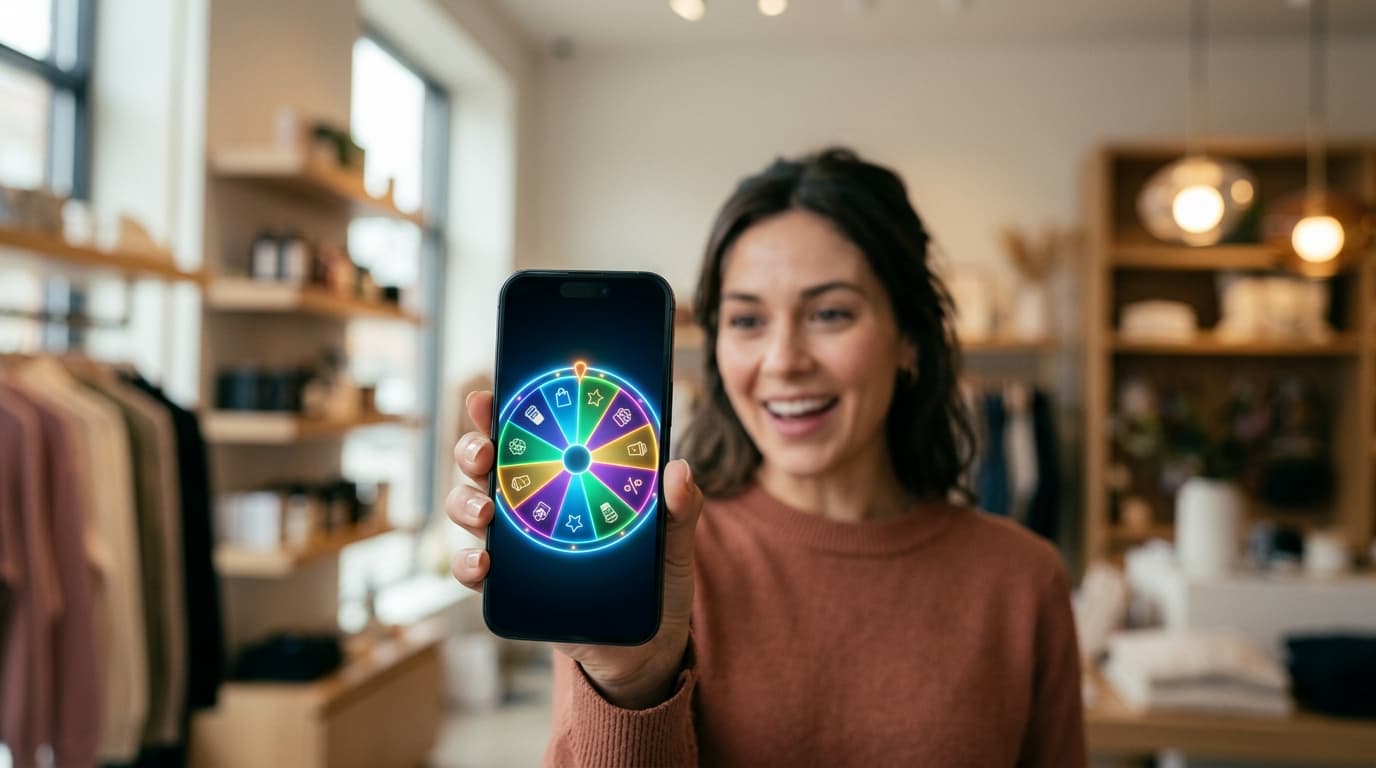
This is exactly where gamification becomes a powerful business tool. Inviting a customer to spin a digital fortune wheel for a chance to win a reward — a discount, a complimentary drink, an exclusive experience — creates a moment of playful engagement that feels genuinely fun, not transactional. The QR code that leads to the wheel naturally guides customers to your Google review page at precisely the moment they're in the right emotional state to write something.
The fortune wheel isn't just a gimmick. It's a psychological bridge between a great experience and a completed review.
The Exit: Sculpting the Final Memory
The Peak-End Rule is equally clear on endings: how an experience concludes matters as much as its best moment. A warm farewell, a genuine invitation to return, a reference to something specific from the visit — these elements shape the final memory, which shapes the retrospective evaluation of the entire experience.
The moment of departure is also the optimal moment for your review invitation. After a surprise (the wheel, the unexpected gesture), during a well-managed goodbye, customers are in the emotional state most likely to produce a written review. The barrier to action is at its lowest.
Physical Environment: Remove Every Friction Point
Even a delighted customer won't leave a review if the path to doing so is unclear or requires effort. Your physical environment should make the action of leaving a review as close to effortless as possible.
Practical guidelines:
- Position your QR code at eye level, along the natural sightline — checkout counter, table surface, printed receipt, or the back of a purchase bag.
- Use a short, clear value proposition: "Spin the wheel. Win a reward." Not a paragraph — one sentence.
- Avoid placing QR codes at the bottom of menus, on cluttered notice boards, or anywhere competing with visual noise.
- Brief your team to mention the QR code naturally, in a single sentence, without urgency or repetition: "Before you head off, feel free to spin the wheel by the door."
Zero friction is the standard to reach for. If a customer needs more than two taps to reach your review page, you lose the majority of them before they start typing.
Build a Review-Oriented Team Culture
The experience doesn't only live in your procedures — it lives in your team's understanding of why reviews matter. Businesses that generate the most Google reviews consistently are those where staff understand the why, not just the how.
Share reviews with your team regularly — positive and critical alike. A five-star review that names a team member by name has more motivational impact than any bonus structure. A three-star review discussed openly in a team meeting is the most efficient training tool available.
When your team sees that their specific actions generate specific reviews, the behavior becomes intrinsically motivated. The review collection system works because the team believes in it.
Measure, Test, and Continuously Improve
No customer experience protocol is ever finished. The businesses that generate the most Google reviews are not those who got it right on the first attempt — they're the ones who measure consistently and adapt quickly.
Key metrics to track:
- QR code scan rate: scans divided by customer visits, tracked weekly
- Review completion rate: completed reviews divided by QR scans
- Average star rating from QR-driven reviews compared to organic reviews
- Review volume trend week over week — are you growing, plateauing, or declining?
Test different QR code positions. Test different prize options on the fortune wheel. Observe which surprise moments generate the most reviews in the 24 hours that follow. When you find something that works — standardize it. When you find something that doesn't — change it, quickly.
This is systematic optimization, not guesswork. And the businesses that treat it as a system consistently outperform those that treat it as an afterthought.
Ludofy: The Infrastructure That Converts Experience Into Reviews
Designing a review-driving customer experience requires thoughtful planning and a team aligned behind it. Deploying that system at scale — reliably, week after week, without requiring constant management attention — requires the right infrastructure.
Ludofy pairs a customized QR code with a gamified fortune wheel and a Google review collection funnel, all inside an interface you can set up in under five minutes. No developer, no agency, no technical complexity. A printed QR code, a brief team briefing, and a system that runs while you focus on service.
The experience you design earns the reviews. Ludofy makes sure they're captured — every customer, every week, without extra effort on your part.