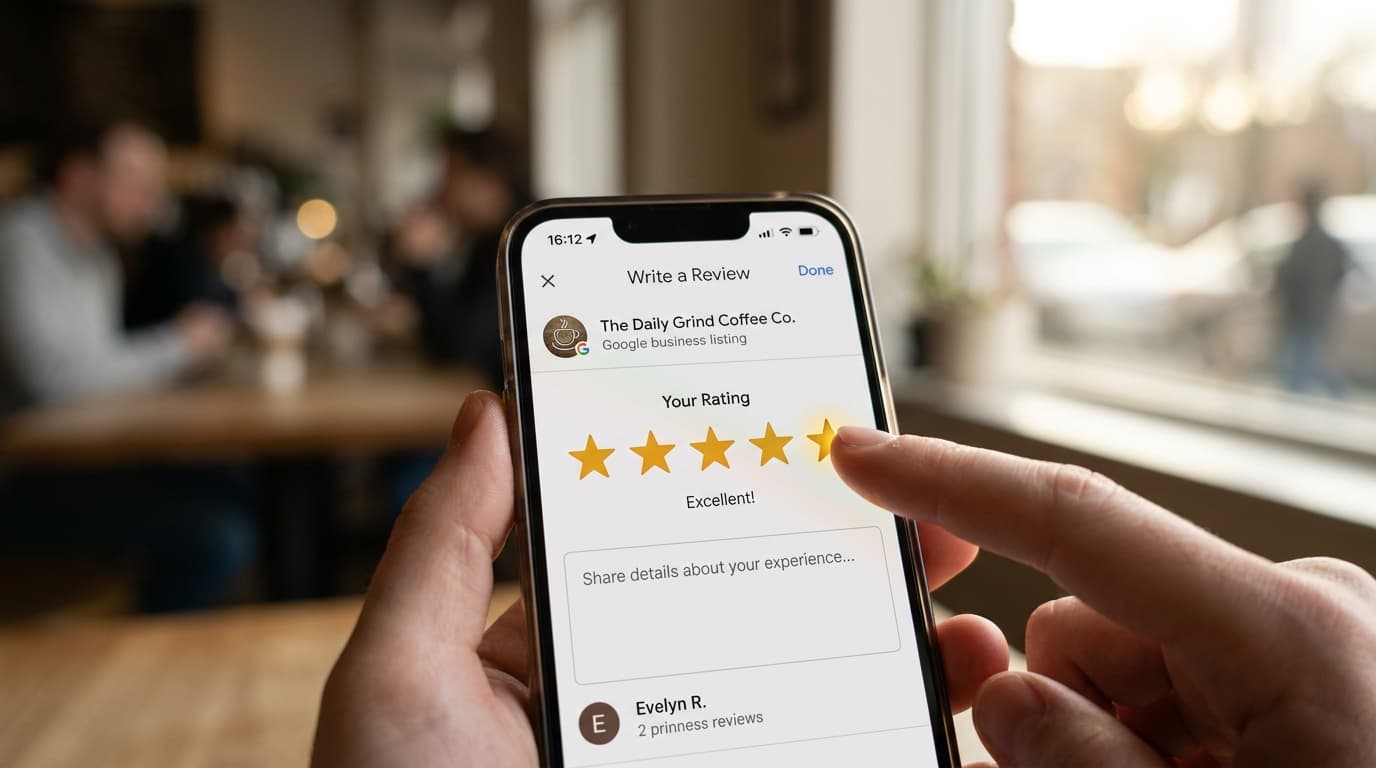
It can happen faster than you'd expect. You open your Google Business Profile on a Tuesday morning to find three new one-star reviews — all posted within the last 12 hours, all from accounts with no profile photo and no other review history. Your rating drops from 4.6 to 4.1. Potential customers searching for your category now see that number before they see anything else about you.
Fake Google reviews — whether they come from a competitor, a disgruntled former employee, or someone running a blackmail scheme — are one of the most frustrating problems in online reputation management for local businesses. This guide walks you through how to identify them, how to report them, and most importantly, how to build a review profile resilient enough that any attack loses its power.
How to Recognize a Fake Google Review
Not every negative review is fake. Starting from that assumption is a mistake that can hurt your responses and damage your credibility. The goal is to distinguish a legitimate complaint — even an unfair one — from a deliberate attack. Here are the concrete signals:
The account was just created. Click on the reviewer's name. If the account was created days or weeks ago, has no profile photo, and has no other reviews posted anywhere, that's a red flag. Accounts established specifically to post targeted reviews follow this pattern consistently.
The review is vague and non-specific. Real customers describe real details: a specific dish that disappointed them, a long wait on a particular night, an interaction with a staff member. Fake reviews often consist of generic accusations — "terrible place," "total scam," "avoid at all costs" — with no specifics that could tie them to an actual visit.
Multiple similar reviews arrive in a short window. A coordinated attack often looks like three to eight one-star reviews posted over a few hours or days, sometimes with similar phrasing or punctuation patterns. Natural review patterns don't cluster this way.
No record of the reviewer exists. If you keep reservation records, a bookings system, or can cross-reference transaction records, check whether the reviewer's name appears anywhere in your customer history.
How to Report Fake Reviews to Google
Once you've identified a review that appears to violate Google's policies, here's the step-by-step process:
Step 1: Flag the review directly in your profile. In Google Maps or your Google Business Profile dashboard, click the three-dot menu next to the review and select "Report review." Choose the most accurate category: spam, off-topic, conflict of interest, or fake engagement.
Step 2: Use Google's dedicated reporting form. Google offers a separate form specifically for business owners to escalate review policy violations. Search for "report a Google review" in the Business Profile Help Center to find it. Use this form for cases where the in-app flag doesn't produce results quickly.
Step 3: Document your evidence. A stronger report is more likely to get results. Gather screenshots of the reviewer's profile page, note the date the account was created, document any patterns across multiple suspect reviews (similar wording, timing, account age), and note whether you have any record of the person visiting your business. The more specific the evidence, the better.
Step 4: Follow up if the first report is rejected. Google doesn't remove reviews simply because you dislike them. But if you have solid evidence and the first report doesn't lead to removal, you can submit a follow-up with additional documentation. Persistence is often necessary.
What Google Will (and Won't) Remove
Understanding Google's actual policies sets realistic expectations. Google will remove reviews that:
- Contain spam or are posted from inauthentic accounts
- Are off-topic or have no apparent connection to your business
- Come from someone with an obvious conflict of interest (a competitor, for example)
- Include illegal content, hate speech, or explicit personal threats
- Were posted as part of a paid or coordinated manipulation scheme
What Google will not remove: any negative review that reflects a genuine customer experience, even if it's harsh, unfair, or exaggerated. A dissatisfied customer's honest opinion — even if you believe it's disproportionate — is considered legitimate expression under Google's guidelines.
When Google Doesn't Remove the Review
Sometimes the report doesn't work, even for reviews that seem clearly fraudulent. When that happens, you still have options.
Respond publicly and professionally. A calm, factual public response is visible to every future customer who sees that review. It signals that you take your reputation seriously and have nothing to hide. Never respond with hostility or legal threats in the comment itself — that typically amplifies the visibility of the review.
A model response for a suspected fake review: "We weren't able to find a record of your visit in our system. We'd welcome the chance to hear more details directly so we can understand what happened — please reach out to us at [contact]."
This response serves two purposes: it shows prospective customers you investigated the claim, and it gently signals to other readers that the reviewer's identity couldn't be confirmed.
Consider legal options for coordinated attacks. If you have evidence that a competitor is running a deliberate fake review campaign against your business, this may constitute unfair business practice or defamation, depending on your jurisdiction. Document everything from the start. An attorney experienced in online defamation can advise whether legal action is warranted.
Report to relevant consumer protection agencies. In many countries, consumer protection bodies accept reports about fake review manipulation. These cases rarely resolve quickly, but filing a report contributes to the regulatory record and may support future legal action.
The Strongest Defense: Volume You Can't Fake
Here's the mathematical reality every local business owner should internalize: a fake one-star review has far less impact when it lands in a pool of 300 authentic reviews than when it lands in a pool of 25.
On a profile with 25 reviews, a single one-star review moves your average by roughly 0.2 points. On a profile with 300 reviews, the same review barely shifts the decimal. The dilution effect is your most durable protection.
This leads to the most effective long-term strategy against fake review attacks: build your authentic review volume high enough that no realistic coordinated attack can meaningfully change your rating.
For most local businesses, reaching that resilient position means consistently collecting 20 to 40 new reviews per month. A business starting at 50 reviews and adding 30 per month reaches 350 reviews in 10 months — a position where even a burst of five fake one-star reviews moves the needle by less than 0.1 points.
Building Review Volume Fast Without Policy Violations
Getting to a high-volume, high-rating position quickly requires removing friction from the collection process. The businesses that do this best have moved beyond verbal asks and passive QR codes to something more engaging.
Fortune wheel gamification — a format where customers scan a QR code, spin for a chance to win a reward, and leave a Google review as part of the experience — produces review conversion rates of 15–25% versus the 2–5% typical of verbal requests or simple QR codes. That's not a marginal improvement; it means collecting the same number of reviews in a fraction of the time.
Platforms like Ludofy are built specifically for this use case. The setup process takes under an hour: a QR code display goes at your checkout or front desk, connected to a spin-to-win mechanic that routes customers to your Google Review page after they play. Once it's running, the system collects reviews every shift, every day — without depending on any individual employee's initiative or memory.
The compound effect: a business that collects 25 authentic reviews per week builds a 300-review profile in three months. At that point, fake review attacks become logistically pointless — the effort-to-impact ratio makes you an unattractive target.
Reputation Isn't Defended by Arguing — It's Defended by Volume
When fake reviews hit, the instinct is to fight back loudly. But the more effective investment is building a review base that makes the fight unnecessary. A profile with 400 authentic five-star reviews isn't vulnerable to one-star bombing — the math simply doesn't work for the attacker.
Report the fakes, respond professionally, and then focus your energy on the thing you can control: collecting more real reviews from the customers who already like what you do. That's where the durable protection is built, one satisfied customer at a time.