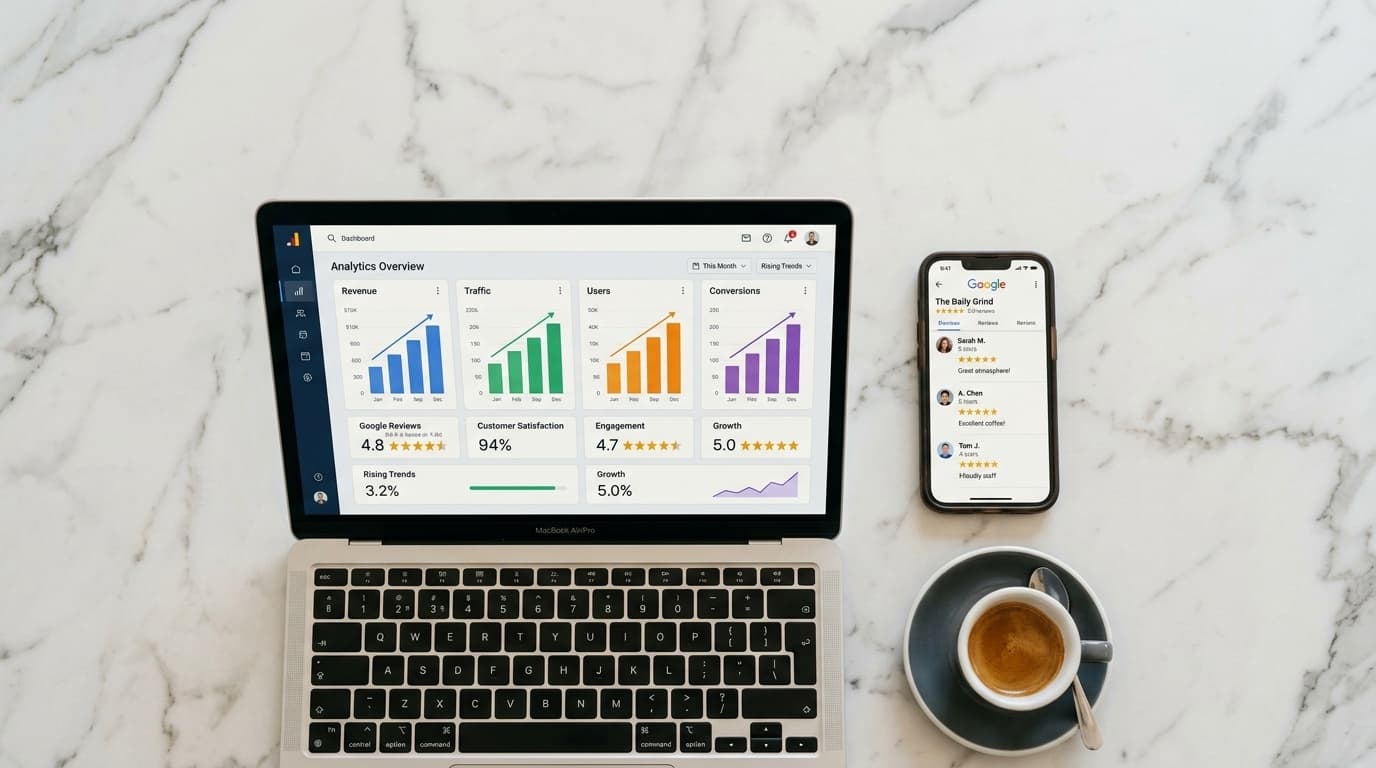
Picture two restaurants. The first has 800 Google reviews collected over five years of operation. The second has just 80 — but every single one came in over the past six months. In local search results, the second restaurant often ranks higher.
Why? Because Google's algorithm treats a consistent flow of recent reviews as a powerful signal that a business is active, trusted, and worth recommending right now.
Most business owners still think in terms of total count. "I need to hit 500 reviews." This is a strategic mistake that quietly costs them rankings, foot traffic, and revenue — without ever triggering an obvious warning sign.
How Google's Algorithm Actually Values Reviews
Google Maps and local search rankings factor in three primary signals: relevance, proximity, and prominence. Review recency is one of the strongest inputs to that last signal. Here's what consistent local SEO research shows:
- A business receiving 10 reviews per month frequently outranks competitors with 300 older reviews
- Reviews published within the last 90 days carry significantly more ranking weight than older ones
- A steady review stream signals to Google that your business is active, popular, and worthy of recommendation
Put simply: Google cares whether your business was buzzing this month — not whether it was well-reviewed in 2021.
Review Decay: The Silent Rankings Killer
Your old reviews don't disappear, but their ranking power fades. This is what local SEO practitioners call review decay. Old reviews still count toward your star average, but they contribute very little to the dynamic local ranking algorithm.
Think of it like a fitness tracker: your current health score reflects this week's activity, not the marathon you ran three years ago. For Google, a dormant review profile — no new reviews for several weeks or months — can signal a business in decline, or one that's quietly winding down.
The practical consequence: restaurants and shops with excellent overall ratings can slip down local search results simply because they stopped generating new reviews. This slide is invisible — no alert, no warning. But it costs customers every single day.
Review Velocity: The Metric That Actually Predicts Rankings
Instead of fixating on your total review count or star rating, the most effective local businesses track a different metric: review velocity — the average number of new reviews received per week or per month.
Here are realistic velocity targets by business type:
| Business type | Weekly target | Monthly target |
|---|---|---|
| Restaurant / Bar | 5–10 reviews | 20–40 reviews |
| Café / Bakery | 3–6 reviews | 12–25 reviews |
| Hotel | 8–15 reviews | 30–60 reviews |
| Retail store | 2–4 reviews | 8–16 reviews |
These numbers may feel ambitious — especially if you're relying purely on staff verbally asking customers. But with the right system in place, they become very achievable.
Why Verbal Requests Don't Scale
The operational reality of running a restaurant or retail shop is unforgiving. During a busy lunch service, your staff are managing multiple tables, processing payments, and handling any number of issues that come up. Consistently asking every satisfied customer for a Google review — then hoping they'll actually follow through at home — is unrealistic and ineffective.
When businesses rely solely on verbal requests, review conversion rates typically land between 2 and 5 percent. That means 19 out of 20 customers who genuinely enjoyed their experience never leave a review. Not because they didn't want to — because life got in the way.
This isn't a motivation problem. It's a systems problem.
Building a Consistent Review Flow Without Manual Effort
The businesses with the strongest local rankings have solved this with one core principle: make leaving a review immediate, natural, and rewarding — at the exact moment the customer's experience is at its peak, not the next morning or the following week.
QR Codes at the Right Moment
A well-placed QR code — on the receipt, at the register, on a table tent card — removes the friction between "I had a great experience" and "I left a review." The customer scans, lands directly on your Google Business Profile, and posts their review in under a minute.
Timing is everything. The code needs to reach the customer while they're still in your space, still feeling the positive emotion from a great meal or service — not after they've walked out and been distracted by everything else.
Gamification: Turning a Request into a Game
The psychology of reward works where direct requests don't. Instead of asking for a review — which can feel like a commercial transaction — invite the customer to spin a fortune wheel for a chance to win something: a discount on their next visit, a free coffee, or a small gift.
To unlock the spin, they leave a Google review first. What felt like an obligation becomes a fun, voluntary moment. Review conversion rates using this mechanic typically jump from the usual 3–5% all the way to 25–40%. The customer wins (or hopes to win), and so does your business.
Operational Consistency: The Real Secret
A spike of 50 reviews this month followed by silence next month is worse than a steady 15 reviews every month. Review velocity isn't about bursts — it's about building a consistent baseline that compounds over time.
Automated systems that don't depend on staff memory or daily motivation are what make this sustainable. The QR code is always there. The fortune wheel always works. Reviews keep coming in — every service, every day — without adding a single task to your team's workload.
The Compounding Effect of Sustained Review Velocity
Businesses that maintain a consistent review velocity for three to six months report the same outcomes, again and again.
In local search: Progressive improvement in the local pack — the three results displayed prominently at the top of Google Maps. Consistent review flow is one of the most reliable levers for moving from position 4–10 into the coveted top three.
In customer conversion: New customers who land on your profile see recent reviews — not just a high average from years past. Seeing "reviewed 2 days ago" and "reviewed last week" builds social proof in a way that old reviews simply can't. It signals: this place is busy, this place is worth visiting right now.
In team morale: A continuous stream of positive reviews creates a feedback loop for your staff. When your team can see 20 new five-star reviews from this month, they feel the direct impact of their work. That tangibly improves service quality — which in turn generates even more positive reviews.
Stop Counting Reviews. Start Measuring Flow.
The "reach X total reviews" mindset is a fixed target in a constantly moving game. Your competitors are collecting reviews too. If your flow stops while theirs continues, they will eventually outrank you — even if they started with fewer reviews overall — simply because their reviews are more recent.
The better question is not "how many reviews do we have?" but "how many new reviews are we generating each week?"
Ludofy was built to answer that question at scale. By combining a QR code touchpoint with a gamified fortune wheel, Ludofy creates an automated, consistent review flow for local businesses — without adding a single task to your team's day. Your review velocity works for you seven days a week, turning every satisfied customer into a fresh signal that keeps your business at the top of local search.