You spent six months planning the renovation. New flooring, a redesigned layout, fresh branding. The doors are open again — and your Google reviews tell a different story. Half the comments mention things that no longer exist. Your review count looks thin compared to the competitor down the street who opened eight months ago. And asking customers for reviews feels awkward when they're still getting used to the changes themselves.
This is the review reset: one of the most underestimated problems in local business reputation management. And it hits more businesses than you'd expect.
Why major changes stall your review momentum
A renovation, rebrand, or extended closure doesn't erase your reviews — but it makes them less useful. A customer reading your profile sees "2022: cozy little place with the low lighting" and can't tell if that still applies. Worse, your most loyal customers have already left reviews and won't naturally think to leave another one.
Meanwhile, new customers visiting for the first time are experiencing the business with fresh eyes — but no established understanding that they should share it. The friction around asking for reviews is amplified: your team is focused on the new space, the new menu, the new flow. Nobody is thinking about review collection.
The result is a period where your review velocity drops exactly when it matters most — when new customers are forming first impressions of a business they've never seen before.
The three scenarios that create a review reset
Not all disruptions are equal. Understanding which situation applies to you determines which recovery tactics will work fastest.
Full rebrand or name change
If your business has changed its name, Google may create a new Business Profile or merge profiles inconsistently. Reviews from the old listing may not carry over cleanly, and customers searching for your new name won't find the history you built up under the old one. The first priority is ensuring your Google Business Profile reflects the new name, category, and address — and that any duplicate listings are merged or removed through the Google Business support channel before you do anything else.
Renovation or extended closure
Your profile and reviews remain intact, but the review content becomes outdated. A reviewer who praised your "intimate six-table setup" or "the corner booth by the window" is describing a space that no longer exists. This isn't a catastrophe — but it creates a credibility gap that only fresh reviews can close.
Change of ownership
You inherit the previous owner's reviews — including any negative ones that have nothing to do with how you operate. Your goal is to generate enough recent, positive reviews that the overall profile reflects the current experience, not the history. This is the scenario where urgency matters most: the gap between old reviews and new ones is a visible signal to every customer who reads your listing.
Start with the customers who already know you
The fastest path to rebuilding review volume is not casting a wide net — it's going deep with the people who already have a reason to support you.
Regular customers who followed the renovation on Instagram, stayed on your email list, or simply came back within the first two weeks are primed. They've seen the change. They have an opinion. They just haven't been asked.
A direct, personal appeal works far better than a generic request. A message that says "We just reopened after a full renovation and would love to know what you think — a quick Google review would mean a lot to us right now" outperforms a standard review request by a significant margin. The specificity — "after a full renovation" — signals that their review is timely, useful, and genuinely wanted.
Segment these customers from your email list or WhatsApp contact list if you have one. Reach out within the first 30 days of reopening. Every week you wait, the sense of novelty fades — and with it, the implicit reason to write something new.
Communicate the change before they show up
One underused tactic in relaunch reputation management is getting the review ask in front of customers before they even walk through the door.
An email or message to your contact list two days before reopening — "The new look is ready, and we'd love for you to be among the first to see it" — builds anticipation and creates a natural frame for feedback once they visit. Include your Google review link in the message itself. Not as the main call to action, but as a light mention: "We'd love to hear what you think, and a Google review helps others find us."
This pre-loads the review ask. When customers arrive and see the new space, they've already been reminded that sharing their experience is welcome.
Turn your reopening into a review collection event
A physical reopening creates a moment of heightened emotional engagement. Customers are curious, staff are energized, and the experience feels new even to regulars. This is exactly when reviews are most likely to be written organically — and when a structured system will dramatically amplify what would otherwise happen by chance.
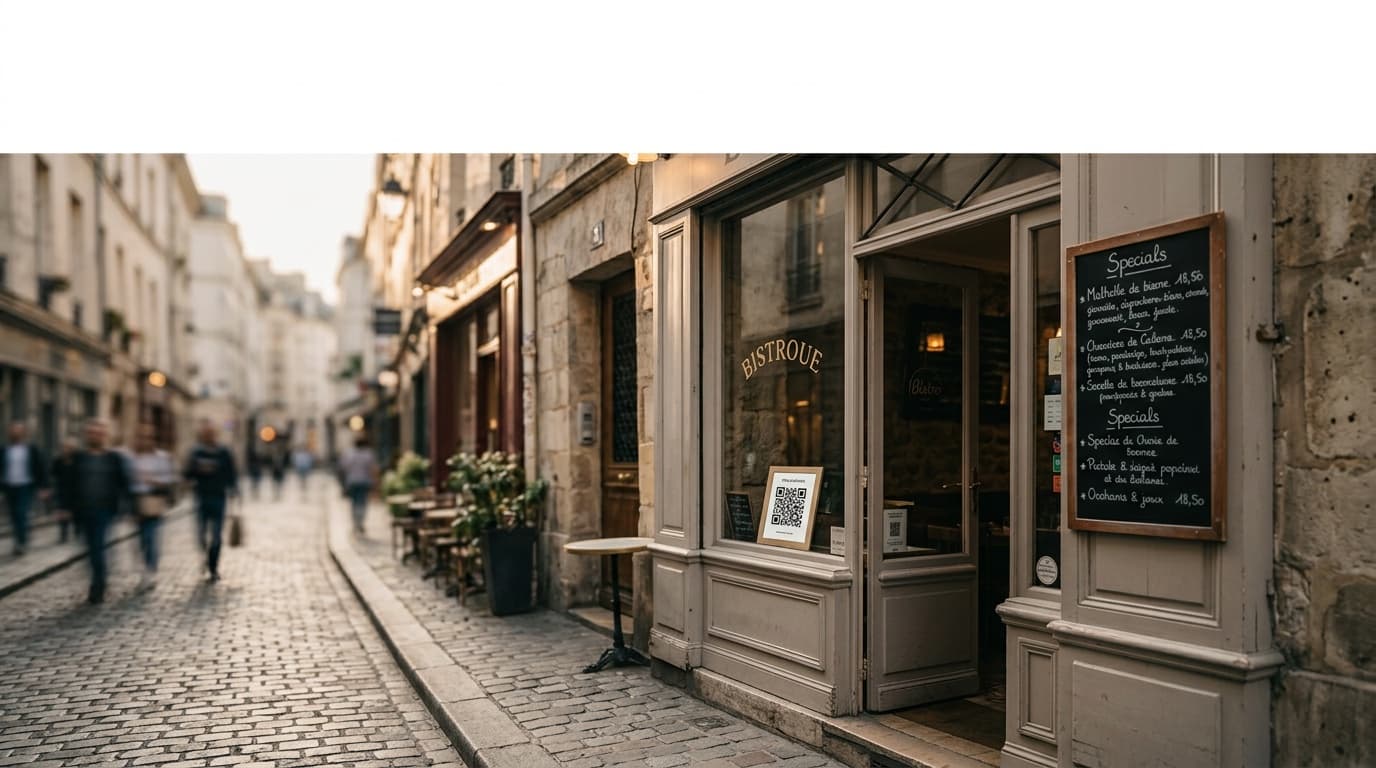
At the event itself, review collection should be built into the flow, not bolted on after the fact. A QR code displayed at checkout, on a counter stand, and on each table gives every customer a clear path to your Google listing without requiring any verbal request from your team.
A simple visual announcement normalizes the ask. A sign near the entrance that reads "We're launching our new space on Google too — your review helps more people find us" turns passive guests into active advocates. One sentence. No pressure. Significant results.
How gamification removes the awkwardness of asking
One of the biggest barriers to asking for Google reviews during a relaunch is the awkwardness. Your team is managing new processes, new layouts, and in many cases a new menu. Adding "and ask everyone for a review" to their job creates resistance — and rushed, halfhearted asks rarely produce reviews anyway.
Gamification moves this responsibility out of your team's hands and into a system that runs on its own.
A QR code connected to a fortune wheel — where customers spin for a prize after completing a Google review — transforms the request into an invitation. The customer who scans the code is choosing to participate. The prize creates a moment of fun that makes the review part of a memorable visit. And because the mechanic runs itself, your staff doesn't have to pitch anyone.
For a reopening specifically, the fortune wheel fits the occasion perfectly: "Spin our reopening wheel — win a prize and help us launch our new chapter." The frame aligns with the celebration, the energy of the new space, and the sense of shared investment that a major renovation or rebrand tends to create among loyal customers.
Setting a realistic 30-day recovery target
Most businesses that approach a post-renovation review rebuild with a clear system can expect 20–40 new reviews in the first 30 days — enough to shift the recency signal in Google's algorithm and push outdated reviews further down the visible stack.
The goal isn't just volume: it's recency. Google's algorithm weights fresh reviews heavily. Five reviews left this week carry more ranking impact than fifty reviews spread over the past four years. Focus on consistent collection over the 30 days following reopening, not a single high-volume push that tapers off.
Track your review velocity week by week. If you're averaging fewer than one new review per day, investigate whether your QR code placement, your in-team communication, or your follow-up email sequence needs adjustment. Low velocity is always diagnostic of something specific — it rarely corrects on its own.
A renovation is a second opening
A rebrand or renovation is, in the most practical sense, a second opening. It's an opportunity to generate local press coverage, reactivate customers who drifted away, and collect a fresh wave of reviews that reflect the experience as it actually exists today. The businesses that treat it that way — with deliberate intent, not as an afterthought — rebuild their review profile faster and emerge ahead of competitors who are still showing pre-renovation content to every potential customer searching on Google Maps.
Ludofy is built for exactly this moment. The platform's QR-code fortune wheel mechanic deploys in minutes and is designed for high-traffic moments — grand reopenings included. Configure your prizes, set your review gate, download your QR code, and launch before the first guests walk in. The platform tracks review velocity and prize redemptions in real time, so you know from day one whether your reopening campaign is on track.