Escape rooms have something most businesses would kill for: customers who leave genuinely excited. After 60 minutes of puzzles, teamwork, and adrenaline, your players emerge in exactly the emotional state that produces memorable, enthusiastic Google reviews. And yet, most escape room operators collect fewer than ten reviews per month.
The gap between excited customers and written reviews isn't a satisfaction problem. It's a timing and system problem — one that's entirely fixable. This guide walks you through exactly how to close that gap.
Why Escape Room Players Are Uniquely Primed to Leave Reviews
The psychology of review-leaving is straightforward: people write reviews when their emotions are elevated and the action is frictionless. Escape room players tick both boxes more completely than almost any other customer type.
Emotional intensity is high by design. Whether your group solved the final puzzle with thirty seconds to spare or failed spectacularly at the last obstacle, the experience generates a shared emotional peak. Neuroscience is clear on this: memories formed during high emotional arousal are more vivid, more personally meaningful, and more likely to be recounted to others. That's exactly the state that drives spontaneous review behavior.
The social dimension amplifies the urge to share. Your players experience everything as a team. They already want to tell people about it — that's half of why they came. A Google review is another form of that storytelling, and if you make the path easy and immediate, they'll take it.
Your audience is digitally comfortable. Escape room customers skew toward younger adults who book online, navigate apps, and scan QR codes without hesitation. The activation energy required to open Google and write a review is lower for your customer base than it is for many other local businesses.
The challenge isn't motivation. It's capturing the moment before the excitement fades — and it fades faster than most operators realize.
The Review Window: Where Escape Rooms Win or Lose
Google reviews follow a predictable pattern: they're most likely to be written within 20 to 30 minutes of an experience. After that, the emotional peak fades, the group disperses, and the moment passes unretrieved.
For escape rooms, that window falls precisely during the post-game debrief, group photos, and lobby lingering. This is both the problem and the opportunity.
Immediately after the final puzzle (first five minutes): This is your highest-conversion window. Your game master is present. Emotions are at peak. The group is together and unhurried. A warm, confident ask works better here than at any other point in the customer journey: "If you had fun tonight, a quick Google review helps us a lot — and we have something fun for you if you leave one right now." Pair it with a visible QR code on the counter or a dedicated sign.
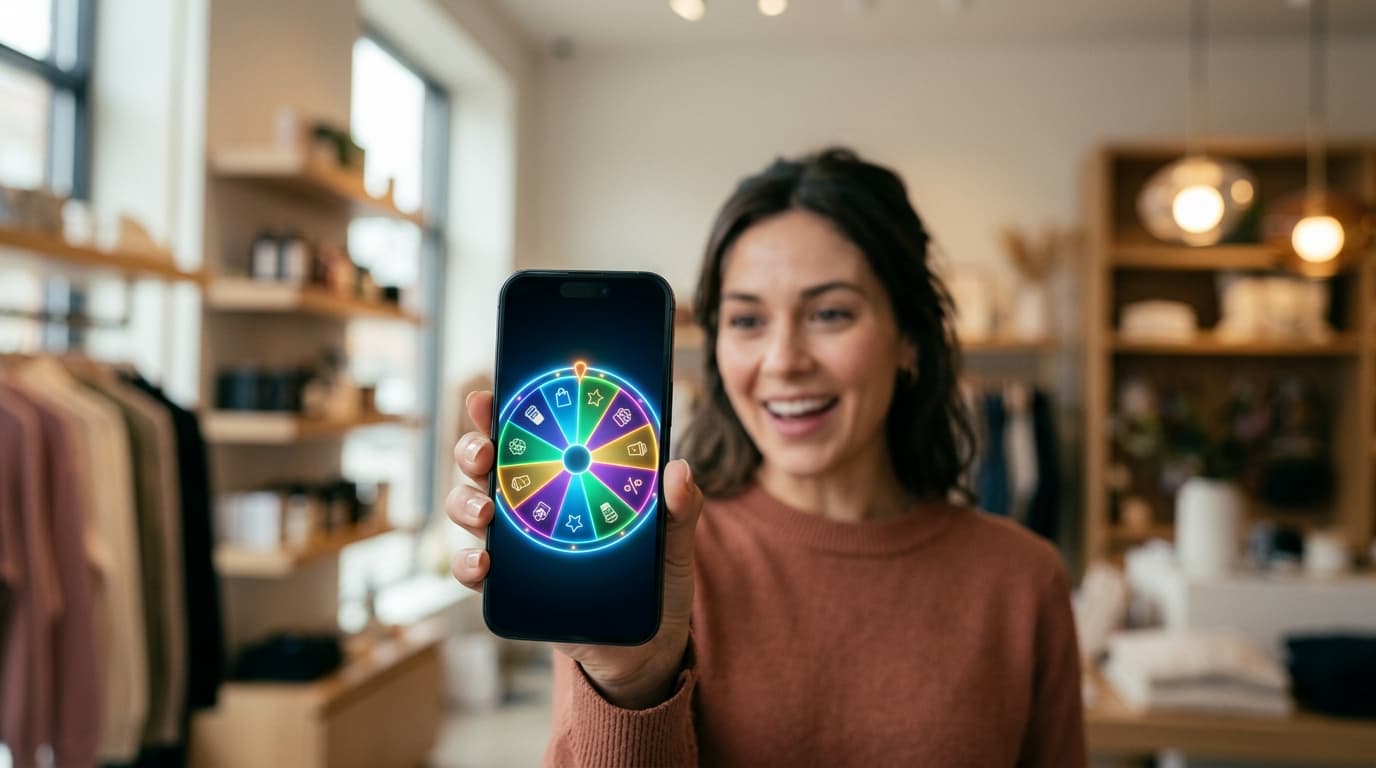
During the debrief or photo session (five to fifteen minutes post-game): If you run a video debrief or take team photos, this is an ideal moment to introduce a spin-to-win mechanic. The group is still together, engaged, and in a playful mood — exactly the state where a digital fortune wheel feels like a natural extension of the experience rather than a marketing tactic.
Follow-up SMS or email (within two hours): Not everyone acts on the spot. A timely follow-up with a direct link to your Google review form — not your website, the review form itself — captures a significant second wave. Keep it brief: one sentence, one link, one reason to click.
Gamifying the Review Ask: The Fortune Wheel Approach
If any business has an inherent right to use a game mechanic in its marketing, it's an escape room. Your customers came to play. Let them play one more round on the way out.
A digital spin-to-win wheel works simply: the player shows your staff that they've just left a Google review, then spins a branded wheel on a provided tablet for a chance to win a prize. Prizes might include a discount on their next booking, a free drink, priority access to your newest room, or a voucher for a friend.
The mechanic works for several reinforcing reasons.
It's on-brand. Your customers are already in game mode. A wheel spin feels like a natural extension of the escape room experience — not a transactional ask. The request doesn't break the emotional spell; it extends it.
The variable reward structure is more motivating than a guaranteed fixed offer. Not knowing what they'll win creates anticipation that's more compelling than "show us your review for 10% off." This is the same psychological mechanism that makes games of chance engaging: the possibility of a surprise outcome beats the certainty of a small gain.
The group dynamic amplifies the moment. Spinning the wheel in front of friends becomes a shared event — teammates cheer, comment, and compete. The review ask transforms from an administrative task into a story your players will tell later.
Escape room operators who implement this type of system typically see review volume increase five to tenfold within the first month. For a venue running 150 groups per month, moving from 8 reviews to 80 dramatically changes your Google Maps ranking and your conversion rate for new visitors evaluating your listing.
Optimizing Your Google Business Profile for Escape Rooms
More reviews matter. But how you manage those reviews matters equally for local search visibility.
Use the right primary category. Google Maps offers "Escape room game" as a specific business category. Using it — rather than "Amusement center" or "Entertainment" — signals precise relevance to the ranking algorithm and surfaces your listing for searches that are actually your target customers.
Respond to every review, positive and negative. Each response is indexed by Google and contributes to your profile's freshness signals. For positive reviews, personalize your response: mention the room they played, reference something specific they described. "So glad your team cracked the final cipher in the Alchemist's Tower! That puzzle takes down a lot of groups." This signals to both the algorithm and prospective visitors that real, attentive people run your business.
Use Google Posts actively. Escape rooms with rotating room offerings have more content to post than most businesses. New room launch, seasonal event, group booking promotion — publish these updates directly to your Business Profile. Each post extends your search impression lifetime and gives return customers a reason to check your profile.
Populate the Q&A section proactively. Write answers to your 8-10 most common questions before customers ask them: minimum age requirements, booking policies, group size limits, accessibility provisions, cancellation terms. This reduces friction for new visitors and demonstrates operational transparency that builds trust before the first booking.
Common Mistakes That Kill Escape Room Review Strategies
Asking only at checkout. The payment moment is psychologically misaligned — customers are already transitioning out of the experience, mentally calculating their next move. The ask needs to happen while they're still inside the emotional glow of the game.
Linking a QR code to your website. Every extra step between the customer and the review form reduces conversion. Your QR code should land directly on the Google review submission page for your specific location. You can generate this URL from your Google Business Profile dashboard.
Not briefing game masters. Your game masters are your highest-leverage asset for review collection. One natural, well-delivered ask from a trusted guide delivers more than five passive signs around your lobby. Write two or three variations of the ask, practice them in team meetings, and make review requests a standard part of your end-of-session protocol.
Leaving negative reviews unanswered. A thoughtful, non-defensive response to a critical review demonstrates to the thousands of future visitors who read it that you take service seriously and handle problems professionally. Businesses that respond well to negative reviews consistently outperform those that ignore them — both in trust scores and in local search ranking.
Building a Self-Sustaining Review Engine
The goal isn't a one-month review push. It's a system that generates reviews automatically, every week, without requiring your ongoing attention.
The flywheel is straightforward: more reviews lead to better Google Maps ranking, which drives more new visitors to your listing, which converts into more bookings, which generates more reviews. But there's a second flywheel that's equally valuable: customers who return for a second booking because they won a voucher spinning the wheel the first time, generating another review — and bringing friends who then become new customers.
With Ludofy, escape rooms can deploy this entire system in under 30 minutes: a custom-branded QR code, a personalized fortune wheel featuring your prizes and brand colors, and a dashboard that tracks review volume week over week. No development work. No agency retainer. No ongoing management overhead.
Your game masters keep doing what they do best — creating extraordinary experiences. Ludofy quietly converts those experiences into the online reputation that fills your booking calendar months from now.