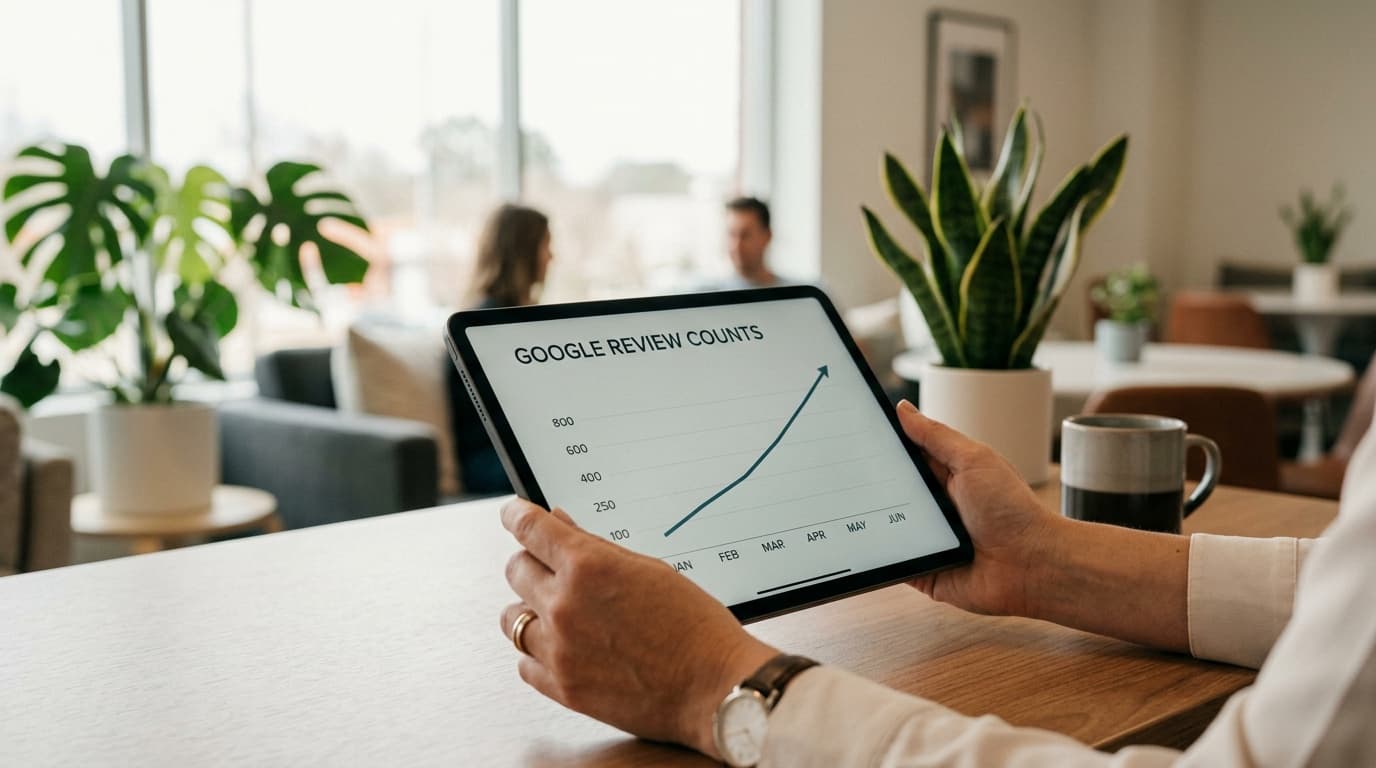
A tunnel car wash running 80 cars per day has more customer touchpoints than most restaurants. An auto detailing shop builds intimate, hour-long relationships with clients who've just paid $150–$400 to protect their vehicle. Both serve customers who walk away satisfied — and both typically have fewer than 40 Google reviews.
This disconnect isn't a customer satisfaction problem. It's an operational one. Once you understand why car washes collect so few reviews, the fix becomes straightforward.
Why Google reviews are a bigger deal for car washes than most operators realize
When someone moves to a new area or needs a detailing service for the first time, they do exactly one thing: open Google Maps and search "car wash near me." The results that dominate the local pack share two characteristics — proximity and review volume.
A car wash with 8 reviews and a 4.2-star average is effectively invisible next to one with 180 reviews and a 4.7-star average, even if they're the same quality and the same distance from the searcher. Review volume is the signal Google's algorithm uses to estimate relevance and trust. More reviews equal more visibility. More visibility equals more first-time customers.
The secondary effect is equally important: auto detailing is a high-trust, high-consideration purchase. Someone spending $300 on a paint correction or ceramic coating is not choosing their shop based on price alone. They're choosing based on evidence of quality — and Google reviews are the most credible evidence available. A sparse review profile actively costs you bookings in this segment.
The waiting room is your best untapped asset
Here's what makes car washes structurally different from most businesses: customers hand over their keys and then have nothing to do.
A full interior and exterior wash takes 20–40 minutes. An interior detail takes 1–3 hours. During that window, your customer is sitting in a waiting area with their phone in hand, no urgent tasks, and mild positive anticipation about picking up a clean vehicle.
That's not incidental — that's a built-in review window that virtually no car wash operator deliberately exploits.
The moment is perfect for a review request that doesn't feel like a request. If you give the waiting customer something to engage with — not a pop-up nagging them to rate you, but an interactive experience where the review is simply one step — the participation rate will be dramatically higher than any verbal ask before or after.
Where to place your QR code
In a car wash environment, placement determines conversion. The touchpoints that work best:
The waiting area
This is where customers spend the most time with their eyes available. A table placard, a wall-mounted display, or a framed card on the counter converts well. The key is framing: the copy shouldn't read as a review request. Something like "Waiting on your car? Spin for a reward — takes about 45 seconds" outperforms "Please leave us a Google review" because it leads with the customer's benefit, not yours.
The payment terminal
The highest-intent moment in any transaction is payment. A QR code sticker on the terminal, paired with a single verbal cue from the cashier, captures customers right at their emotional peak. Keep the staff script simple: "We have a quick game if you want to try for something free."
The receipt or invoice
For detailing services where a paper or digital invoice changes hands, printing the QR code at the bottom of the receipt is a simple but underused tactic. The customer sees it again at home, in a calm moment, and often follows through then.
The exit lane or exit sign
A banner or sign positioned as customers pull out — when they can see the clean result of your work — captures the moment of maximum satisfaction. The car is visibly clean, the experience just happened, and no time has elapsed for the memory to fade.
Why gamified review flows outperform direct requests
Research on review collection is unambiguous: gamified participation rates are consistently 5–10 times higher than direct verbal requests. The reason is behavioral, not cosmetic.
A verbal "please leave us a review" stacks cognitive friction and social awkwardness on top of each other. Leaving a review requires opening Google, finding the business, rating it, writing text, and submitting — that's five steps the customer doesn't particularly want to take when they could just go home. A direct request also creates an implicit social obligation that many people resolve by saying yes and then doing nothing.
A QR code linking to a digital fortune wheel restructures the same request into an experience. The customer scans, completes their Google review freely and without any direction from you, then spins the wheel for a chance to win a free car vacuum, a discount on their next visit, a free exterior wash, or whatever prizes you choose.
Three behavioral mechanisms drive the effect:
Reward anticipation. The brain releases dopamine in anticipation of a reward, not just upon receiving it. Before the wheel stops, the customer is already in a state of elevated engagement. In that state, the cost of leaving a review — the "entry ticket" to spin — registers as trivially small.
Reciprocity. When you give something first (a chance to win), the customer feels an unconscious impulse to give something back. The review stops feeling like a compliance task and starts feeling like a natural exchange.
Variable rewards. Unpredictable outcomes are more motivating than fixed ones. A prize wheel that might produce a 10% discount or a full free wash creates genuine curiosity that a guaranteed small discount never would.
Tunnel wash vs. detailing shop: two different playbooks
The collection strategy should fit the operational model.
For high-volume tunnel or automatic washes, automation is the priority. Customers move through quickly. A well-placed display in the waiting area, a sticker at the payment terminal, and a single verbal prompt from the cashier is the complete setup. The goal is passive visibility — the customer takes the action because the prompt was in the right place at the right time, not because staff managed the interaction manually.
For detailing shops, relationship is the asset. Clients who leave their vehicle for 3–6 hours often have a named point of contact with a service advisor. A follow-up text message or WhatsApp notification when the vehicle is ready — "Your car's done. While you're on your way over, here's a quick chance to win something on us" — converts exceptionally well in this segment. The timing is precise, the context is personal, and the customer is already in motion toward a positive experience.
How quickly can you see results?
A car wash running 70+ customers per day that activates a gamified QR review flow typically sees:
- 8–15 new Google reviews per week in the first month
- A measurable improvement in Google Maps local pack ranking within 60–90 days
- A rating trajectory that rises as fresh, high-rated reviews dilute older lower-rated ones
The compounding effect matters. Google's local ranking algorithm weights recency heavily — 20 reviews from this month carry more ranking signal than 20 reviews from two years ago. Building consistent weekly review volume creates a structural advantage that competitors relying on occasional verbal requests can't easily close.
A car wash with 200 current reviews ranking consistently in the top three results for "car wash near me" in a mid-size city will typically outperform one with 40 reviews even if the 40-review business has a marginally higher rating. Volume and freshness together are what move the algorithm.
The gap between your quality and your visibility
Most car wash operators know, at some level, that their business deserves more online visibility than it currently has. The mismatch between the actual quality of their service and a modest review count isn't a quality problem. It's a systems problem. The right system captures the customers who already had a good experience — the ones who meant to leave a review and never got around to it.
Ludofy is built for exactly this use case: a digital fortune wheel activated by QR code, with the Google review as a required step before the spin, and a simple dashboard tracking weekly participation and review volume. Setup takes under fifteen minutes. The first reviews typically arrive within hours. If your car wash or detailing shop serves more customers per day than you have total Google reviews, the gap is mechanical — and mechanical problems have mechanical solutions.