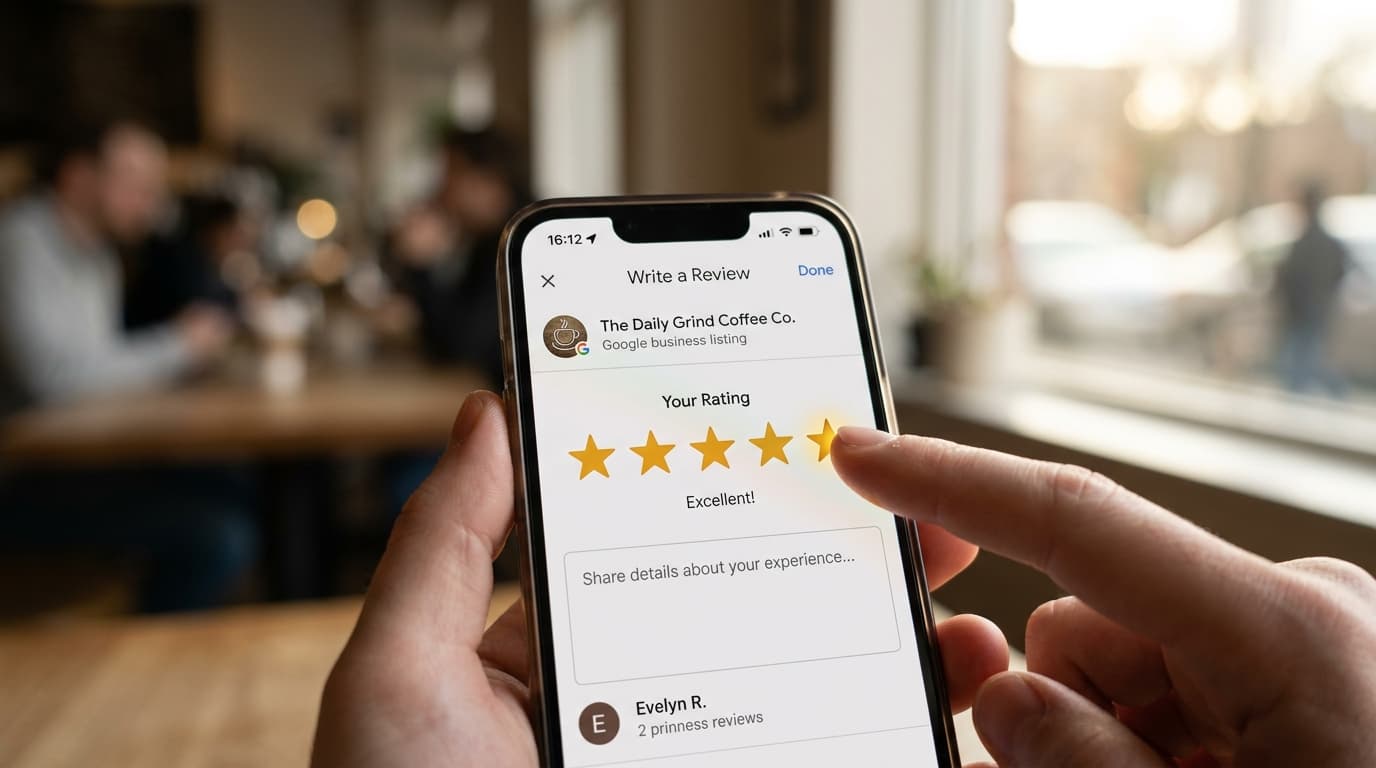
CrossFit members are famous for their intensity — inside the box and outside it. They wear their home gym's t-shirt to the grocery store, drag friends to a free Saturday class, and defend the methodology in arguments with marathon runners. Yet most CrossFit boxes sit at 4.2 stars on Google with 28 reviews, while the yoga studio two blocks away has 340+.
The loyalty is there. The online reputation isn't.
The gap is mechanical, not motivational. Your members love you. They just haven't left a review — and the reason almost certainly has nothing to do with their satisfaction.
Why Google reviews matter more for CrossFit than for mainstream gym chains
Large gym chains don't depend on Google reviews the way independent boxes do. A Planet Fitness or Basic-Fit has national advertising, thousands of locations for brand recall, and a price point so low that most people sign up without research. Your box operates differently.
When someone in your city searches "CrossFit near me" or "functional fitness gym [city]," they're an educated prospect. They know what CrossFit is, they want to commit seriously, and they're comparing two or three local options side by side. In that moment, your Google rating and review count are doing significant sales work on your behalf — or failing to.
A box with 15 reviews at 4.6 stars loses consistently to one with 90 reviews at 4.8 stars, even when the coaching quality is identical. More reviews signal an established, trusted community. Fewer reviews trigger doubt. This is especially acute for CrossFit because the decision to join a box is not a casual one — it's an identity commitment, and people research accordingly.
Beyond discovery, reviews directly influence your ranking in the local Google Maps pack. Freshness matters as much as volume: a box that consistently collects new reviews each month ranks better than one that collected 50 reviews two years ago and nothing since.
The CrossFit loyalty paradox: why your most devoted members haven't reviewed you
Here's the counterintuitive truth: your most committed members are often your least likely reviewers — not because they're less satisfied, but because they're so embedded in the community that leaving a public review feels unnecessary. They tell people in person. They show up at 6 AM in winter. They refer three friends a year through direct conversation.
Public reviews are for strangers. Your regulars don't think in those terms.
New members — those in their first 60 days — are actually your highest-converting review candidates. The novelty is fresh, the improvement curve is steep, and they're still in the phase of evangelizing their new fitness lifestyle to anyone who will listen. They're also already on their phones more, sharing progress photos and workout clips.
The practical implication: don't wait until members are deep regulars to ask for a review. Build the ask into your onboarding sequence, and specifically target people in their first few weeks.
The optimal moment: right after a WOD
Timing a review request correctly is the single highest-leverage variable. Ask too early (at sign-up), and there's nothing to review. Ask in a general email blast, and you get ignored. Ask in the right moment, and conversion is orders of magnitude higher.
For CrossFit, that moment is the 10-15 minutes immediately after a completed WOD — the window when endorphins are elevated, the sense of accomplishment is acute, and members are physically present and emotionally open.
Coaches play a key role here. A brief, casual mention at the end of class carries more weight than a digital nudge sent hours later: "If you've been enjoying your time here, we'd genuinely appreciate a quick Google review — it helps us a lot." Then point to the QR code.
The QR code does the rest.
QR code placement strategy for a CrossFit box
Unlike a restaurant or café, a CrossFit box has predictable high-traffic touchpoints that repeat daily. Strategic QR code placement means being present at each one.
The whiteboard: Your daily WOD board is the most-photographed surface in the box. Members photograph it every morning and evening. A small, well-designed QR code in the corner — "Loved today's workout? Leave us a review" — is photographed hundreds of times a month.
The water station and cooler area: Members congregate here immediately post-WOD, phones already in hand. A table tent or card at eye level converts naturally.
The check-in desk: Post it at check-in as a subtle prompt, but also at check-out — some boxes have members sign out on a tablet. A secondary QR code here catches the exit moment.
The changing room mirror or bathroom: High dwell time, phone already out. A small card above the sink or on the mirror converts better than most people expect.
The goal is ambient visibility without pressure. Members should encounter the QR code naturally, not feel hunted.
Gamification: how a fortune wheel changes the conversion math
A QR code that leads directly to your Google review page will convert some members. A QR code that leads to a spin-to-win fortune wheel will convert significantly more — typically 5 to 10 times more, based on data from businesses using gamified review flows.
The mechanism is simple: the member scans the QR code, is invited to spin the wheel for a chance to win a prize (a free protein bar, a branded water bottle, a Ludofy-powered reward), and completes a Google review as the entry step. The dopamine hit of the spin makes the review feel like participation in something fun rather than a favor being extracted.
For CrossFit boxes, prizes that resonate include:
- A free open gym session
- A month's worth of chalk or grip aids
- A branded knee sleeve or wrist wrap
- A discounted personal training session
- A coffee from the nearest coffee shop (partner deal)
The prize value matters less than its relevance to the community. A CrossFit-adjacent reward signals that the box understands its members.
Platforms like Ludofy handle the full flow — the QR code, the digital wheel, the prize reveal, and the review redirect — with no technical setup required on your end.
Responding to mixed reviews: protecting your culture online
Not every review will be 5 stars. A member who came twice and decided CrossFit wasn't for them may leave 3 stars with a comment about intensity. A visitor from another box may compare unfavorably to their home gym.
How you respond publicly defines your brand as much as the reviews themselves.
For critical reviews, acknowledge the experience without being defensive: thank the person for the feedback, note what you've done or will do, and invite further conversation offline. Prospective members who read negative reviews are watching how you handle them just as carefully as the reviews themselves.
For mediocre reviews (3-4 stars from loyal members), it's worth a quick private conversation to understand what could have been better. Often it surfaces a genuine operational issue worth fixing.
Never respond to a negative review in a way that could escalate publicly. A single poorly-judged response can undo dozens of positive ones.
Building a review culture into the box itself
The most sustainable approach isn't a one-time campaign — it's making review collection part of the culture. This means coaches mentioning it naturally at class ends, visible QR codes at key touchpoints, and a gamified flow that makes the action feel rewarding rather than obligatory.
When a box consistently collects fresh reviews — even three or four a week — it compounds rapidly. Six months of that cadence can take a 30-review box to 150, shifting its Google Maps ranking and perception entirely.
Ludofy is built specifically for this: a fortune wheel review system that any business can deploy in minutes, without a developer. If your box has the community loyalty — and CrossFit boxes almost always do — the system converts it into the online reputation you already deserve.
The WOD is done. Your members are still buzzing. That's your moment.