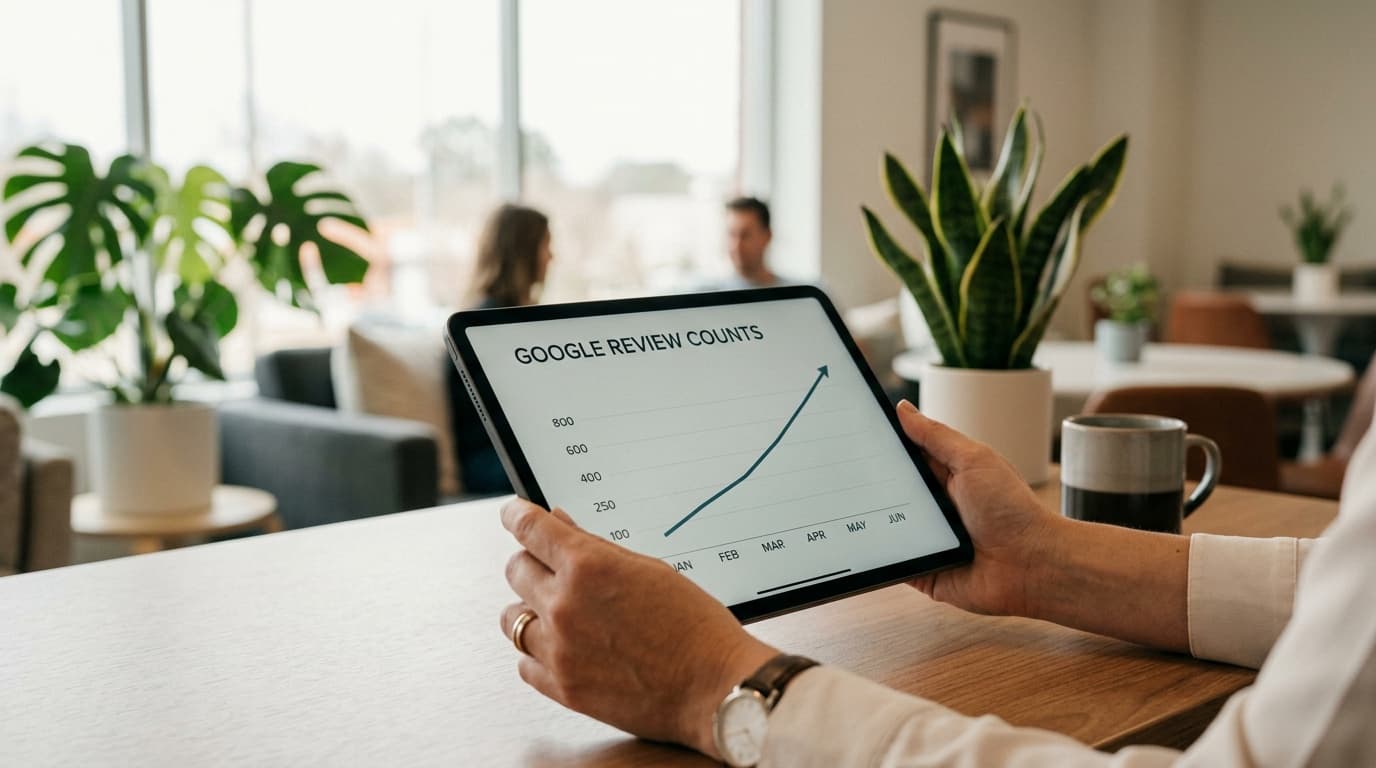
Photography is a trust business. Before a client hands you access to their wedding day, their newborn, or their professional headshots, they need to be certain they're choosing the right person. They'll look at your portfolio — but they'll also check your Google reviews.
For many prospective clients, Google reviews are where they start, not where they finish. A studio with 150 reviews and a 4.9-star rating triggers a fundamentally different emotional response than one with 12 reviews and a silent profile. The first feels safe. The second requires a leap of faith that most people aren't willing to take.
The paradox is that photography clients are uniquely primed to leave reviews — the experience is often emotionally meaningful — yet they frequently don't follow through. This guide explains why, and gives you a concrete system to close that gap.
Why Google Reviews Drive Photography Bookings
When someone searches "portrait photographer near me" or "wedding photographer [city]," Google Maps results appear first. The studios that surface at the top of those listings share three characteristics: a complete business profile, recent reviews collected consistently, and a high average rating.
The competitive implication is direct: a studio that collects 40 new reviews over three months will outrank a competitor with 200 total reviews spread sporadically across three years. Google weights recency and velocity alongside volume. Older review clusters don't decay in rating, but they do decay in ranking power.
Beyond search visibility, reviews shape the decision itself. In a service category where the outcome is high-stakes and irreversible — you can't reshoot a wedding — the trust signal carries more weight than in lower-commitment purchases. A strong Google profile doesn't just attract more clients; it attracts the right clients: people who arrive at the booking conversation already convinced of your professionalism, with fewer objections to overcome.
The Post-Session Window: Why Timing Determines Everything
Most studios that struggle with reviews share the same underlying problem: they ask at the wrong moment.
The most common approach is to send a follow-up email a few days after delivering the gallery. The logic seems sound — wait until the client has their images so they have something concrete to review. The problem is timing.
By the time the client receives their photos and processes the excitement of seeing them for the first time, the emotional peak of the session itself has already passed. They're not standing in your studio, moved by the experience. They're at home, managing everything else in their life, opening your email between dozens of others.
Emotion drives reviews. The more emotionally present a client is when you make the ask, the more likely they are to follow through. For most session types — portraits, family shoots, engagement sessions — that peak occurs at the end of the session, when you're wrapping up warmly and the experience is still vivid. For wedding clients, it often resurfaces the moment they receive their gallery for the first time.
The operational lesson: build your review request into the session close, not into a delayed follow-up.
Four Proven Tactics for Photography Studios
1. The QR code card at session close
This is the single highest-converting change you can make. At the end of every session, hand the client a small, well-designed card that reads something like: "Thank you for trusting us with this moment. If you'd like to share your experience, scan here." The QR code links directly to your Google review form.
The card works because it's a physical object the client takes with them. Even if they don't scan it at the studio, it travels home. Clients who received a QR card and didn't scan immediately are significantly more likely to leave a review within 72 hours than those who only received an email link.
Design matters here. A polished card reflects your level of craft. A plain printout communicates the opposite. Match the card to your studio aesthetic — it's still a brand touchpoint.
2. The verbal bridge
The card converts better when paired with a brief, genuine spoken moment. Before the client leaves, say one sincere sentence — not a scripted ask:
"I had a wonderful time with you today. If you're happy with how everything went, an honest Google review really helps other people find us."
Short. Genuine. No pressure. The human connection activates the reciprocity instinct: the client has just received your full attention and expertise; leaving a review feels like a natural way to give something back. The QR card then removes every friction point between intention and action.
3. The gallery delivery moment
For sessions with delayed delivery — weddings, commercial projects — the optimal ask is the moment you send the gallery link, not days later. Include a one-click path to your Google review form directly in the delivery email. That's when emotion peaks again: the client is opening their images for the first time, experiencing the work fresh.
A simple addition works well: at the bottom of your gallery delivery email, before any other call to action, add "Share your experience: [Leave a Google review]." A clean hyperlink is all it needs.
4. Add a gamified element for in-studio visits
For portrait studios, headshot studios, or any format with in-person check-in and check-out, a gamified review flow dramatically outperforms a static QR card.
The mechanic: the client scans a QR code, leaves their Google review freely on their own device, then spins a digital fortune wheel to reveal a small reward — a print discount, a complimentary photo gift, or priority booking for their next session. The reward is presented before they know what it is, which creates genuine anticipation.
Two behavioral mechanisms drive the effect. First, it reframes the review from a favor into an exchange — and an enjoyable one. Second, the variable reward (what will I win?) holds the client's attention through the review step, which is the exact friction point where most people give up.
Studios running gamified review flows consistently report participation rates of 25–35% of session clients, compared to 3–5% for static email requests.
Handling Reviews Specific to Photography
Not every review will be positive. Photography clients occasionally express legitimate frustrations — turnaround times, editing style differences, communication gaps. A few practices specific to the category:
Respond to every review, positive or negative. Prospective clients read your responses as carefully as they read the reviews themselves. A composed, professional reply to a one-star review demonstrates more about your character than a perfect rating with no engagement.
Don't get defensive about creative choices in public. If a client writes that they wanted lighter editing and received a darker treatment, acknowledge it without defensiveness: "We appreciate you sharing this — post-production direction is something we always discuss in advance, and we'll make sure to cover it more thoroughly in our pre-session consultations." You're not admitting a mistake; you're demonstrating that you listen.
View imperfect reviews as authenticity signals. A studio with 150 reviews and a 4.7 rating feels more credible than one with 30 reviews and a perfect 5.0. Occasional lower ratings, handled gracefully, are evidence that your reviews are real.
Building Consistent Review Velocity
A single burst of reviews doesn't build a strong profile. Google's local ranking algorithm rewards consistency — businesses that collect reviews every week outperform those that collect in waves and then go quiet.
The system to build: every session client receives the same closing routine. At five sessions per week, converting at 20%, you generate one new review per week. That's 50 new reviews per year — enough to shift your position meaningfully in local search within the first quarter of running the system.
The compounding effect matters too. Week one, your local ranking moves slightly. Week twelve, the gap between you and a competitor not running a review system becomes difficult to close quickly, because Google's algorithm treats consistent weekly review activity as a signal of a healthy, active business.
Ludofy is built specifically for this workflow: a fully customizable digital fortune wheel activated at the point of sale via QR code, sequenced to collect the review before delivering the reward, with a simple dashboard that tracks participation and review volume over time. Setup takes under fifteen minutes, and the first new reviews typically arrive within hours of going live.
Your work deserves to be found. Google reviews are the bridge between the clients you already have and the ones who haven't discovered you yet.