Most business owners know they should be collecting more Google reviews. Fewer understand when to ask — and almost none have solved the social awkwardness that makes the whole thing feel uncomfortable for everyone involved.
Here's the hard truth: a well-timed ask outperforms a poorly-timed one by a factor of ten. And a gamified ask outperforms a direct verbal request by even more. This post covers both: the optimal timing window, and the mechanism that makes it work at scale.
The Psychology of the Perfect Ask
Customer satisfaction isn't a flat line — it spikes, then fades. Research in behavioral psychology consistently shows that positive emotions after a good experience peak in the first 5 to 20 minutes, then decay as the customer's attention shifts to whatever comes next.
This is the peak-end rule in action: people judge an experience based on how they felt at its most intense point and at its very end. A restaurant meal, a salon appointment, a hotel checkout — each of these has a clear ending. If that ending is positive, the customer leaves with a warm, complete feeling. That's your window.
Miss that window and you're asking a customer to reconstruct an emotional memory they've already archived. The motivation to share is gone, and even a follow-up email from you will feel like extra work rather than a natural response to a genuine experience.
What Most Businesses Do Wrong
Asking before the experience is complete
Prompting for a review during ordering or check-in is premature. The customer hasn't experienced anything yet. This signals insecurity and creates a strange obligation before any value has been delivered.
The receipt footnote
"Loved your visit? Leave us a review at google.com/maps/…" printed at the bottom of a paper receipt converts at roughly 1–3%. The customer pockets the receipt and walks out. Friction is too high: they'd need to open their phone, find the link, navigate to the review form, and actually write something — all cold, with no emotional momentum.
Post-visit email or SMS
Follow-up messages have their place, but open rates hover around 15% and final conversion on review requests is typically under 2%. You're asking someone to emotionally re-engage with an experience they've mentally moved on from. Useful as a backup, not a primary strategy.
The awkward verbal ask
"Would you mind leaving us a Google review?" spoken by a slightly embarrassed staff member creates an immediate power imbalance. The customer feels put on the spot. Even customers who would have left a review spontaneously often resist when they feel socially pressured. It's a friction that most operators underestimate.
The Golden Window: End of Service, Before They Leave
The optimal moment is at checkout or departure — when the service is complete, satisfaction is at its peak, and the customer still has their phone in hand.
This moment has everything going for it:
- The experience is complete, so a review reflects something real
- The customer is relaxed — the main transaction is done
- Their phone is already out (contactless payment, parking apps, etc.)
- A 30-second micro-interaction is plausible and welcome
The challenge is turning this window into a consistent, scalable process — not a one-off moment that depends on a brave staff member working up the courage to ask.
How Gamification Solves the Awkwardness Problem
This is where a digital fortune wheel changes everything.
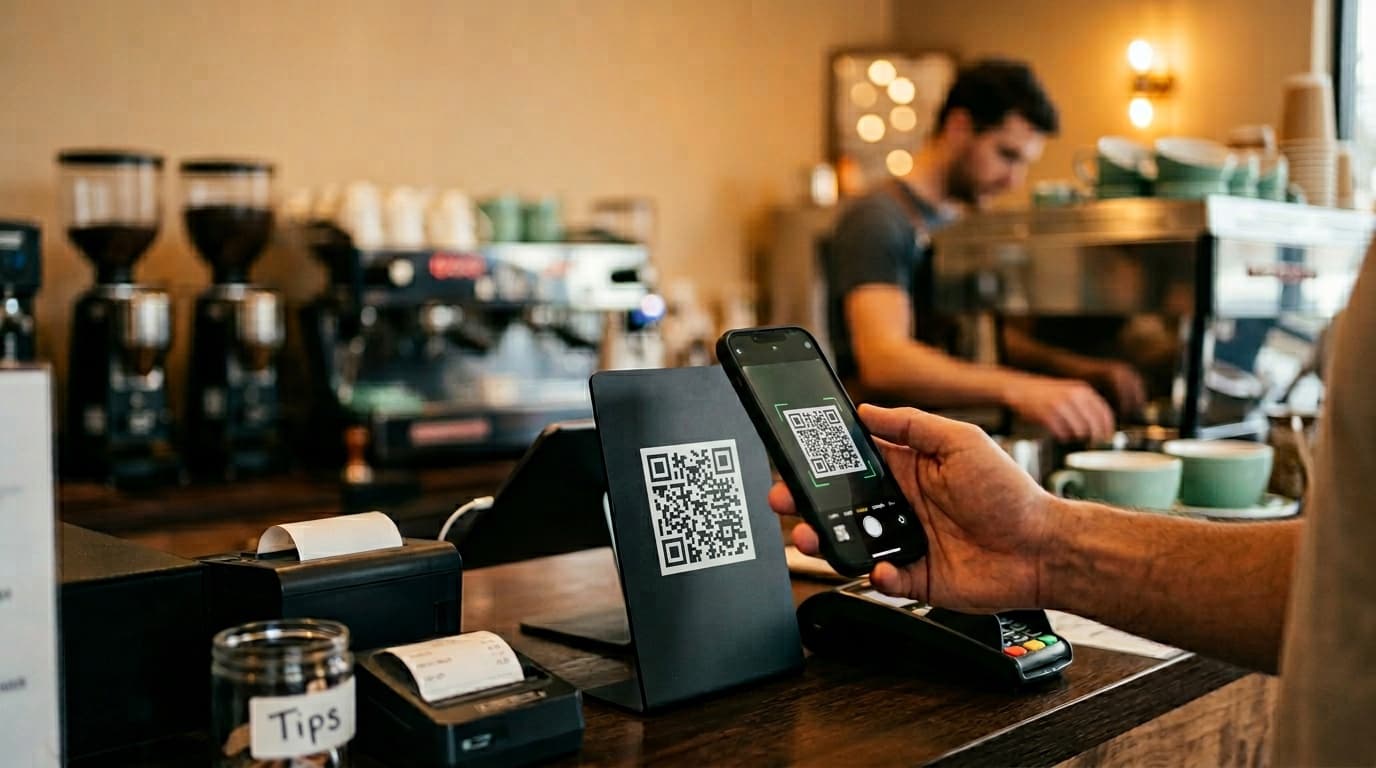
Instead of asking "could you leave us a review?" — a request that creates a social obligation — you invite the customer to spin the wheel for a chance to win something: a discount, a free item, a surprise offer. The only step to unlock their spin is scanning a QR code and leaving a Google review.
The reframing is subtle but powerful:
The interaction becomes an opportunity, not a favor. The customer isn't doing you a service — they're entering a game. Their motivation is intrinsic. No social pressure, no reluctance.
The customer initiates, not the staff. The QR code sits on the counter. The customer sees it, gets curious, and chooses to engage. That shift from pushed to pulled is the difference between 3% and 30% conversion.
The technical friction disappears. The QR code links directly to your Google review form. No searching, no navigating. Three taps and they're done.
The ending gets better. Watching the wheel spin, landing on a prize, walking out with something extra — that's a memorable finish to their visit. And a memorable finish means a better overall memory, which means a better review.
Making It Work in Practice
Place the QR code at the exit point
Not on the wall near the entrance, not on a menu they're done with — on the payment counter, at the reception desk, on the tablet stand at checkout. It needs to be in their line of sight at the exact moment they're ready to leave. If a customer can walk out without seeing it, you've already lost the window.
Give your team one sentence
You don't need a script. One line from a team member is enough: "Feel free to spin the wheel before you go — there are prizes!" That creates curiosity and a natural invitation without any pressure. It works because it's true: there genuinely is something to win.
Choose rewards that people actually want
A 5% discount on a future visit isn't exciting. A free coffee, a complimentary dessert, 20% off their next order — that's worth 30 seconds of someone's time. The more desirable the reward, the higher the participation rate. Set rewards that reflect what your customers actually value.
Match your effort to your peak hours
If you have predictable busy periods — lunch rush, Friday evenings, weekend mornings — those are your highest-yield moments. More volume means more potential reviews. Ludofy's dashboard shows you exactly which time slots generate the most reviews, so you can optimize your setup over time.
What the Numbers Show
Businesses using in-person gamification at checkout consistently report:
- 25–40% of customers who see the QR code actually scan and review
- A 8–12x increase in monthly review volume compared to passive approaches
- Stable or improving star ratings — because customers who engage with the wheel are already satisfied
Compare that to a 2% email follow-up conversion and the math is stark. The difference isn't marginal — it's structural. The mechanism matters as much as the timing.
Where Reputation Compounds
There's a compounding effect worth understanding. When you go from 40 reviews to 400 over 12 months, your Google Maps ranking improves, which puts you in front of more potential customers, who visit and — if you keep running the wheel — become reviewers too. The flywheel accelerates.
Businesses that rely on passive review collection eventually plateau. Their rating is whatever it was when satisfied customers happened to leave reviews spontaneously. Businesses running a consistent, gamified ask-at-checkout process keep climbing — because they've turned a rare, awkward moment into a reliable, enjoyable system.
Closing
The best time to ask for a Google review is the moment your customer's experience ends and their satisfaction is still fresh. The best way to ask is not to ask at all — but to invite them to play.
Ludofy combines both: the right placement (end of service) with the right mechanism (a fortune wheel that makes leaving a review feel like winning, not helping). If your review count has been flat for months, this is the lever worth pulling first.