You just hit 4.2 stars on Google. Is that good? The honest answer: it depends entirely on your industry. A 4.2 in a sector where the average sits at 4.5 puts you near the bottom of the pack. The same score in a field where most competitors hover around 3.8 makes you look like an outlier — in the best way.
Understanding industry benchmarks isn't an academic exercise. It's the difference between celebrating a mediocre score and knowing exactly how far you need to push to dominate your local market.
Why Google Ratings Vary So Much by Industry
Before diving into the numbers, it helps to understand why averages differ so dramatically across sectors. Three forces drive these gaps.
Emotional stakes. Going to a restaurant or a spa is an experience. A minor disappointment triggers a 2-star review far more readily than the same disappointment at a car wash or an accountant's office. High-emotion industries naturally see more polarized ratings and slightly lower averages.
Interaction frequency. A hair salon sees its clients every two months. A fast-food spot might see the same face twice a week. Higher frequency smooths out ratings over time — loyal regulars who keep coming back tend to balance out one-off bad experiences.
Digital maturity. Restaurants and hotels have operated in a review-heavy ecosystem since TripAdvisor. A local plumber or tutoring center, much less so. This creates real asymmetries in review volume and rating distributions.
Industry-by-Industry Benchmarks for 2026
Restaurants and Cafés
Average range: 4.1 – 4.4 Competitive threshold: 4.3+ Excellence zone: 4.5 – 4.8
Restaurants are the most-reviewed category on Google Maps. Competition is intense and customers are conditioned to share their experiences. Below 4.0, you lose visibility in "highly rated" Google Maps filters — a filter set more customers use every year, especially on mobile. At 4.3, you're in the range where undecided customers start trusting you. At 4.6 and above, you enter "go-to" territory, where your regulars recommend you without being asked.
One exception: fine dining. Expectations are higher, margins for error are lower, and ratings typically run 4.0–4.3. A strong volume of reviews and well-crafted responses matter as much as the raw score here.
Hotels and Accommodation
Average range: 4.0 – 4.3 Competitive threshold: 4.2+ Excellence zone: 4.4 – 4.7
Travelers compare Google, Booking.com, and TripAdvisor simultaneously before committing. A Google rating below 4.0 is often a dealbreaker for 3-star properties and above. For B&Bs and guesthouses, the more personal nature of the stay gives you a little more room, but 4.0 is still the floor for serious credibility.
One thing that matters especially in hospitality: trajectory. A hotel that climbed from 3.8 to 4.4 over six months signals improvement to both Google's algorithm and potential guests browsing the profile. Recent reviews count more than old ones.
Beauty, Hair, and Wellness
Average range: 4.3 – 4.6 Competitive threshold: 4.4+ Excellence zone: 4.6 – 4.9
This is consistently one of the highest-rated sectors on Google Maps. The client relationship is personal and ongoing, and satisfied customers in this category tend to be enthusiastic about leaving reviews. A hair salon sitting below 4.3 has either a service quality issue or a review collection gap — often the latter.
Important nuance: a 5.0 average based on twelve reviews is less convincing than a 4.7 average based on 200. Volume authenticates the score. Customers scan both numbers simultaneously.
Healthcare and Medical Services
Average range: 3.9 – 4.3 Competitive threshold: 4.1+ Excellence zone: 4.3 – 4.6
Dentists, physiotherapists, and veterinary clinics average slightly lower for two structural reasons: dissatisfied patients tend to leave reviews unprompted, while satisfied ones often don't think to. And most practices have no active review collection strategy in place.
A dental clinic at 4.3 is genuinely well-positioned in this context. The more important lever here is often the quality of responses to negative reviews — which reassures prospective patients that the practice takes complaints seriously and handles them professionally.
Retail and Boutiques
Average range: 4.1 – 4.4 Competitive threshold: 4.2+ Excellence zone: 4.4 – 4.7
Retail reviews are often skewed by logistics issues (out-of-stock items, wait times, payment problems) that have little to do with the actual quality of what the store sells. An independent boutique with loyal local customers that actively asks for reviews can realistically reach 4.7–4.8 — far above the sector average.
Auto Repair and Garages
Average range: 3.8 – 4.2 Competitive threshold: 4.0+ Excellence zone: 4.3 – 4.6
Structural customer distrust keeps averages lower in this sector. A garage at 4.2 reads as trustworthy; at 4.5, it reads as exceptional. This is precisely the kind of market where an active review collection strategy creates lasting competitive advantage — because most competitors aren't doing it.
The Three Rating Thresholds That Actually Move the Needle
The floor: 4.0 stars
Below 4.0, you get filtered out. Google Maps users who select "Highly rated" (4.5+) or "Well rated" (4.0+) won't see your listing. These filters are increasingly common in mobile search behavior. This is less a goal than a minimum survival threshold.
The stability point: 50 reviews
Below 50 reviews, your rating is statistically fragile. A single 1-star review can drop you by 0.1–0.3 points. Once you cross 50, your average stabilizes and Google's algorithm gives your rating more weight in local rankings.
The excellence threshold: 4.5 stars
Research into click behavior on Google Maps shows a meaningful jump in click-through rates between 4.3 and 4.5 stars. Above 4.5, the curve flattens. This means the most impactful territory to compete for is the gap between 4.2 and 4.5 — not the marginal difference between 4.6 and 4.8.
How to Benchmark Yourself Against Your Local Market
National averages are a starting point, not a target. What matters is your score relative to competitors in your specific area.
Here's the four-step process:
- Identify your 5–10 closest direct competitors — same business type, same neighborhood or city.
- Record their current rating and review count on Google Maps.
- Calculate the median for your local micro-market.
- Set your target at the top competitor's rating plus 0.1–0.2 points, with a comparable or higher review volume.
If your strongest local competitor sits at 4.4 with 140 reviews, aim for 4.5–4.6 with at least 120 reviews. That's a concrete, actionable goal — not a vague aspiration.
How to Move Your Rating Past the Benchmark
Getting there is a systems problem, not a luck problem.
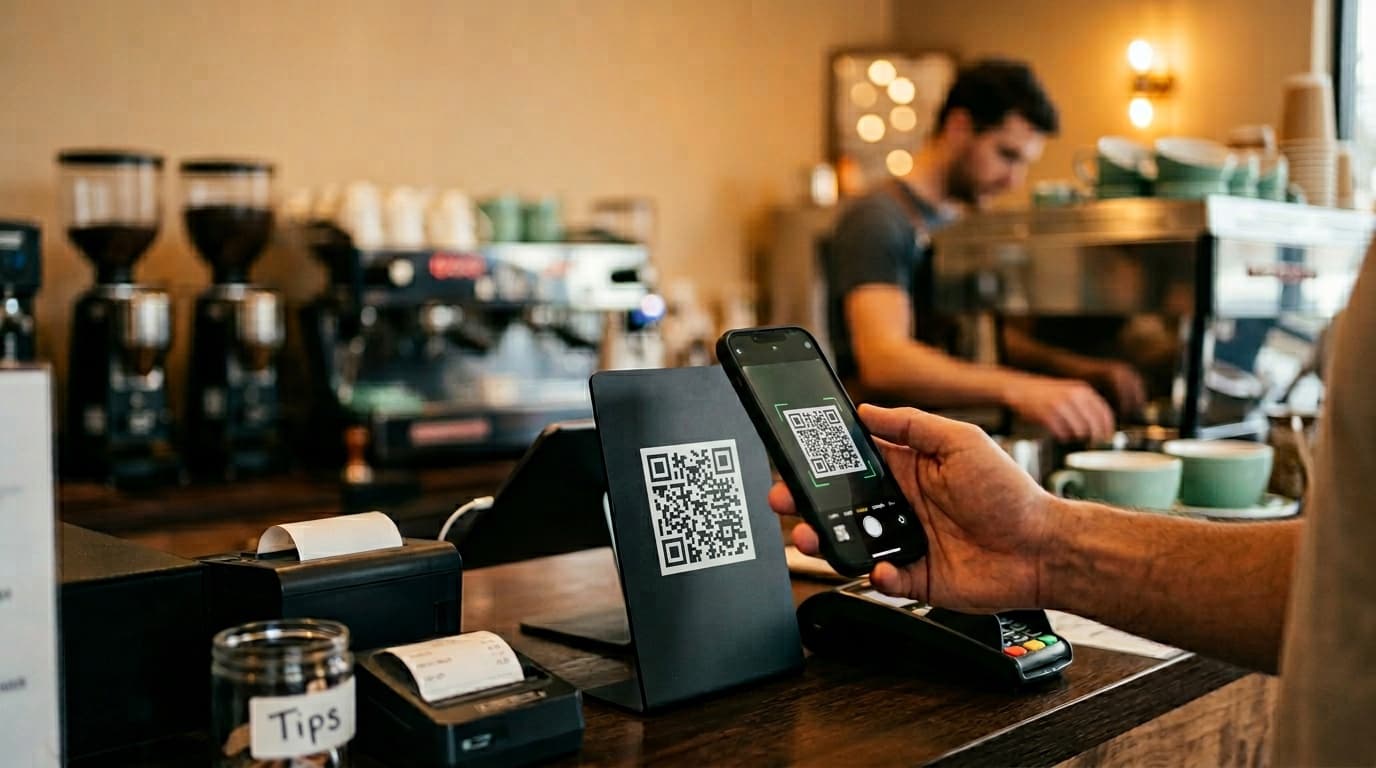
Ask actively, not passively. Waiting for spontaneous reviews generates a 1–3% participation rate. Asking face-to-face at the right moment raises that to 15–25% — but it requires consistent staff execution. Automating the ask with a strategically placed QR code at checkout removes that dependency entirely and scales the volume without adding operational overhead.
Gamify the experience. This is where real lift happens. Offering customers a spin on a digital fortune wheel — with the chance to win a discount or a small gift — in exchange for a Google review turns what feels like a chore into a moment of fun. Conversion rates jump from the 5–10% range for standard requests to 20–35% with gamified mechanics. That's the mechanism behind Ludofy's review collection tool.
Respond to every review. Google rewards active profiles. A thoughtful response to every review — positive and negative — improves your local search ranking and signals to prospective customers that your business is engaged and accountable. Even a two-sentence response matters.
Keep the pipeline fresh. A burst of 60 reviews in January followed by silence until December looks like a stale or gamed profile. Google's algorithm weighs recency. A steady stream of 2–4 new reviews per week for a restaurant tells a much more compelling story than an equivalent total drip-fed over the whole year.
The Bottom Line
Your Google rating isn't a verdict. It's a metric you can move with the right strategy. Knowing where the benchmarks sit in your sector gives you a precise target. The question is whether you have the systems to get there.
Ludofy's gamified fortune wheel turns every payment moment into a review collection opportunity — converting satisfied customers into active advocates without requiring anything extra from your team. Set up your first QR code at checkout and start closing the gap to the top of your sector, one spin at a time.