Your barbershop does great work. Your regulars are loyal, your cuts are clean, and word of mouth has kept your chairs full for years. But when someone new in the neighborhood searches "barbershop near me" on Google Maps, they're not seeing any of that — they're seeing your 31 reviews next to a competitor's 215.
The quality gap isn't real. The visibility gap is.
Why Google Reviews hit harder for barbershops than most businesses
Barbershops operate in intensely local markets. A new client isn't going to drive 20 minutes across town for a haircut — they're choosing from the three or four options within walking distance of where they live or work. In that context, Google Maps isn't just a useful marketing channel; it's the primary discovery surface for most of your potential new clients.
The numbers are stark. When a prospective client compares two barbershops at similar distances and prices, they'll choose the one with more reviews in the vast majority of cases — even if the higher-reviewed shop has a slightly lower average rating. Volume signals legitimacy. It tells a first-time visitor: other people took a chance here and it was worth it.
The men's grooming market has also grown significantly more competitive. Premium barbershops, hybrid hair-and-beard studios, and budget chains have all invested heavily in their digital presence. Standing out without a review strategy is increasingly difficult, regardless of how technically skilled your barbers are.
The structural advantage you're not using
Most businesses have to prompt customers to leave a review well after the experience — by email, receipt, or a follow-up message — at a moment of faded, general satisfaction. You have something far more valuable.
The post-cut moment is uniquely powerful. Your client just transformed. They're looking at themselves in the mirror, they're pleased — often genuinely delighted. They're still sitting in your chair, phone usually accessible, with a natural pause in the interaction while you finish the detail work or they check the back. That window — peak satisfaction, physical stillness, phone nearby — is extremely rare in retail and hospitality.
Your repeat clientele compounds the opportunity. Regulars come back every three to four weeks. That's 13 or more visits per year, per client. Every visit is a fresh chance to collect a review from someone who already trusts you. Most retail businesses have to fight hard to re-engage past customers; your customers are already scheduled to walk back through the door.
Together, these two factors mean a well-run barbershop has more natural review-collection leverage than almost any other local business type. The problem isn't the raw material — it's the lack of a system to capture it.
The mistakes costing you reviews every day
Verbal requests at checkout
"Feel free to leave us a Google review!" is the most common approach and one of the least effective. The client smiles, says they will, walks out — and the impulse evaporates within ten minutes. Verbal conversion rates for review requests typically land between 2% and 5%.
The problem isn't the client's goodwill — it's friction and timing. Leaving a review requires unlocking the phone, searching for the business, navigating to the review section, choosing a star rating, writing something, and submitting. Each step is minor in isolation. Together they're enough friction to push action to "later" — which almost always means never.
Assuming satisfied clients will self-initiate
The clients who leave reviews spontaneously are disproportionately the disappointed ones. They have a motive: processing frustration, warning others, seeking accountability. Happy clients intend to leave a review and simply forget. Without a consistent prompt system, your Google profile gradually skews negative — not because your work is bad, but because the incentive to act is asymmetric.
Treating Instagram as a substitute for Google
A strong Instagram portfolio genuinely helps with brand awareness and keeping regulars engaged. But it doesn't replace Google. First-time clients discovering you for the first time are almost exclusively coming through Maps, not Instagram. A stunning feed means little to someone who searches "barbershop + neighborhood" and sees a 3.7-star profile with 18 reviews dated eight months ago.
A review strategy built around your actual workflow
QR codes at the right touchpoints
The goal is to surface a review request at the moment of peak satisfaction, without stopping the service experience to ask. High-impact placement points for a barbershop:
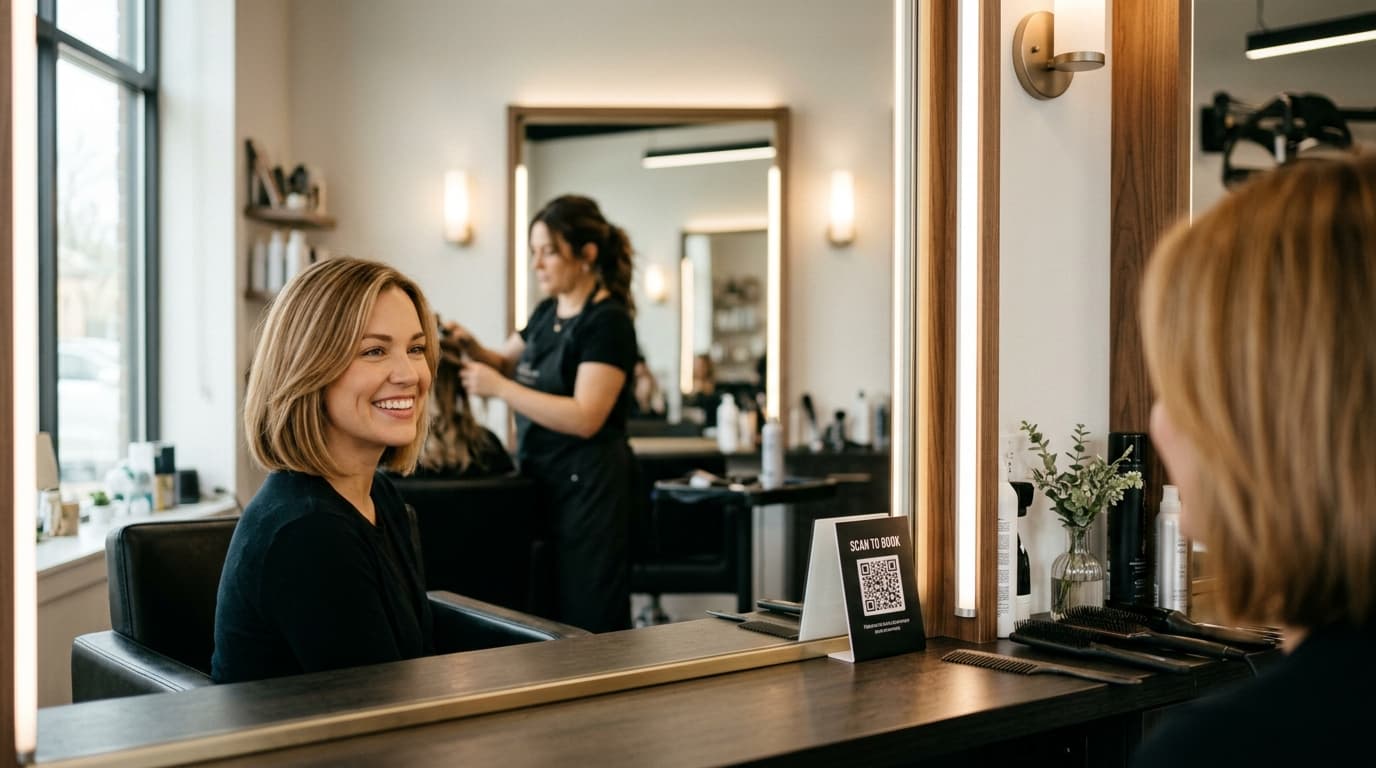
The mirror: A small QR code sticker at the base of your main mirror sits directly in the client's natural line of sight as they check their cut. The invitation to review is present without any verbal cue from you.
The receipt or change envelope: A business card-sized insert with a QR code and one line of copy — "Enjoyed your cut? Scan to spin our wheel and win something free" — turns a routine payment moment into a conversion opportunity.
The cape during the cut: A small clip-on card attached to the cape gives clients something to read while you work. They can scan at any point during the visit, at their own pace, with no social pressure.
Gamification: the conversion rate multiplier
Adding a gamified element to a standard QR code review request is the most impactful upgrade available. Instead of asking the client to do something for you, you offer them something first — a spin on a digital fortune wheel to win a prize.
The flow is straightforward: client scans the QR code, writes their Google review (freely, any rating, no editorial direction), then spins the wheel to discover their reward. The prize might be 20% off their next cut, a free beard treatment, a product sample, or — occasionally — a free haircut.
This reversal of psychology is powerful. The client experiences it as an invitation to play, not a request for a favor. The review becomes the entry ticket to something enjoyable, not an obligation. Businesses using gamified review flows consistently report participation rates of 25–35%, compared to 2–5% for verbal requests.
The reward is given regardless of what the review says — the goal is authentic feedback at higher volume, not manufactured scores. A client who had a mediocre experience and still participates is giving you useful signal. A client who had an excellent experience contributes to your rating. Both outcomes serve you.
Designing prizes that work for barbershop clients
Effective rewards for this audience balance perceived value against operational cost:
- 20% off their next visit — high perceived value, directly drives rebooking
- Free beard trim add-on — introduces a service they might not normally book, expands revenue per visit over time
- Travel-size product or sample — low cost, novel, something to take home
- Free full haircut (one-in-twenty odds) — the jackpot that makes the wheel genuinely exciting and worth mentioning to friends
Variable reward probability is what makes the mechanic work. Even when most outcomes are modest discounts, the possibility of the jackpot maintains engagement and creates word-of-mouth around the game itself. Clients who mention to friends that they "won a free cut at their barber" are doing acquisition work for you.
Training yourself or your team
If you're a solo operator, the script is simple: "Before you go — we've got a quick game for regulars. Scan this for a shot at something free." Five seconds, no awkwardness, dramatically higher conversion than asking directly.
If you have barbers on staff, train them to present the QR code as a bonus, not a request. The framing difference — "I've got something for you" versus "Could you do something for me?" — produces measurably different uptake. Staff who present the wheel with genuine enthusiasm convert at roughly twice the rate of those going through the motions.
One useful benchmark: track participation per barber weekly. It quickly becomes clear who's presenting the invite naturally and who isn't, and it gives you a coaching conversation that's concrete rather than abstract.
The local SEO payoff over time
Google's local ranking algorithm weighs two review signals heavily: overall rating and recency velocity. A barbershop collecting 10–15 new reviews per week consistently outranks competitors with older, less active profiles — even competitors with a historically higher average rating.
The compounding math: 25 clients per day × 30% participation = roughly 7–8 new reviews per day. Over 90 days, that's 600–700 reviews. Very few neighborhood competitors can close that gap quickly once you've built it. The early mover advantage in local SEO is real and durable.
There's a secondary effect worth noting: the clients most likely to participate in a gamified review flow at peak satisfaction are disproportionately the happiest ones. Over time, this pulls your average rating upward even without any change to the quality of your cuts.
What your competitors probably aren't doing yet
Adoption of gamified review collection in independent barbershops remains low. Most shops ask verbally, a few have a static QR code somewhere, and very few have a system that consistently converts each satisfied client into a published review. That gap is an opportunity — and it won't stay open indefinitely as the practice spreads.
Ludofy is built for exactly this use case: a fully branded digital fortune wheel, activated by QR code at the point of sale, sequencing the review before the spin, with a live dashboard tracking new review volume and participation rate by week. Setup takes under fifteen minutes, and the first reviews typically arrive within hours of going live.
If your chairs are filling up but your Google profile doesn't show it, the gap is mechanical — and it's fixable today.