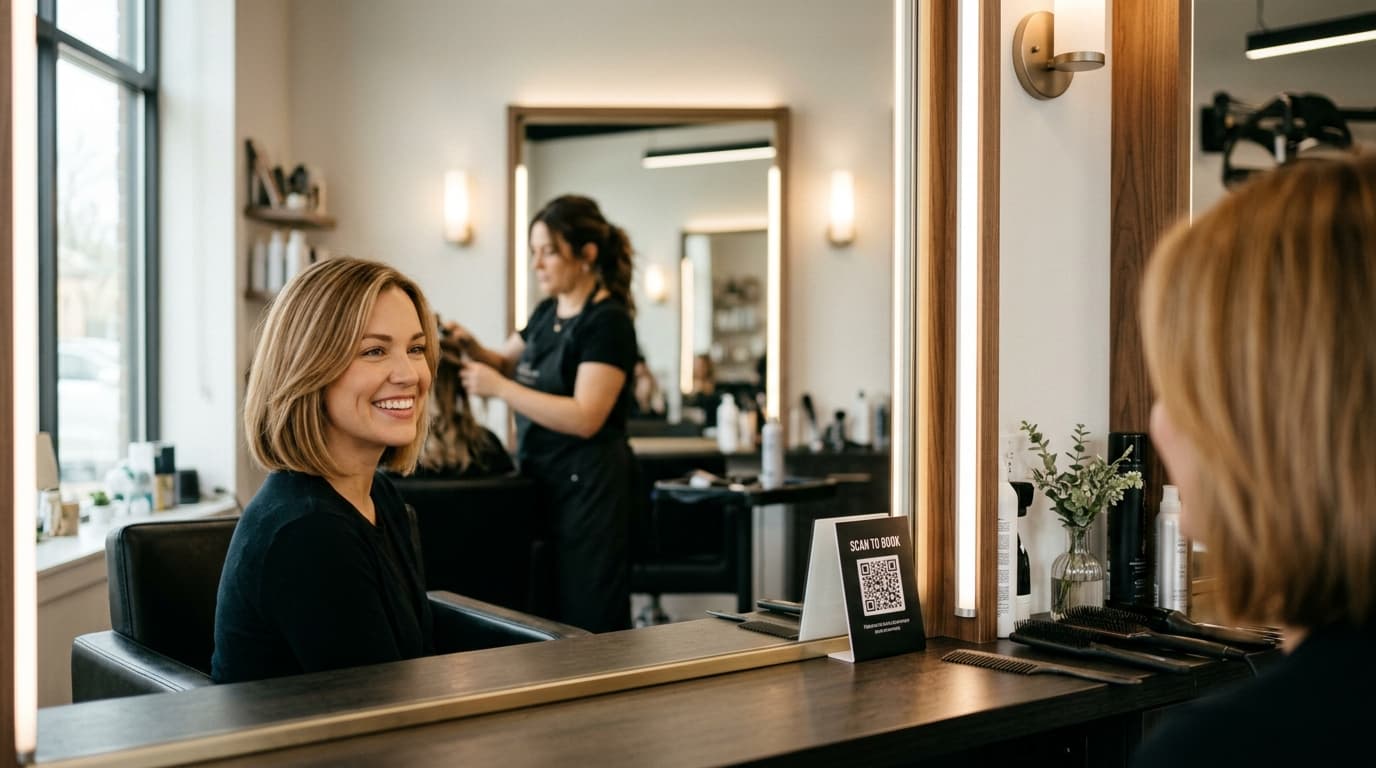
Your client just had her brows shaped, her skin treated, or her lashes applied. She's standing at your mirror, genuinely happy with what she sees. That moment — those 30 seconds before she reaches for her bag — is one of the most powerful windows for collecting a Google review that exists in any service business.
Most beauty institute owners know reviews matter. What they don't have is a system that captures that peak satisfaction moment before the client walks out the door and the feeling fades.
This guide covers exactly that: how to collect Google reviews consistently, how to remove friction with QR codes and gamification, and how to build a local reputation that makes your institute the obvious first choice.
Why Google Reviews Are Non-Negotiable for Beauty Businesses
When someone searches "esthetics salon near me" or "brow lamination [city]," the local pack — those top three results with star ratings and review counts — captures the vast majority of clicks. Appearing below that pack is effectively invisible for new client acquisition.
But Google reviews don't just help you rank. In an industry where trust is everything, they function as the primary filter a prospective client uses before booking a stranger to touch her skin. A profile with 60+ reviews averaging 4.7 stars reduces hesitation in a way that even a beautifully designed website can't replicate. Reviews from real people, describing real results, answer the question every first-time client silently asks: is this person actually good at what they do?
The competitive reality: In most markets, the top-ranked beauty institute in any neighborhood has three to five times more reviews than the second-place business. That gap rarely reflects a difference in treatment quality. It almost always reflects which business built a review collection system and which one relied on hoping clients would volunteer one.
The Structural Advantage Esthetics Businesses Have
Here's something most review guides won't tell you: beauty and esthetics businesses have a structural advantage in review collection that restaurants and retail stores simply don't have.
The emotional peak after a great treatment — the moment a client looks in the mirror and genuinely loves the result — is unusually intense, reliably timed, and happens in your space before the client leaves. A restaurant operator can't know whether a table had a great experience until the guests are already heading for the door. You can see the moment coming.
This means the ideal request window isn't "at the end of the appointment" in some abstract sense. It's the specific 30 seconds when your client is still in front of your mirror, before she's back in day-to-day mode. A QR code visible at that moment — on the mirror itself, on your checkout counter, or on a small card at your treatment table — lets her act on that impulse while it's still live.
The friction of navigating to Google manually, finding your listing, and writing something mostly kills review intent before it becomes action. Eliminating those steps changes everything.
Building a System That Doesn't Depend on Memory
The most common review collection failure in beauty businesses is inconsistency. Some staff members remember to ask; others don't. Busy days eat the habit entirely. Loyal clients get followed up on Instagram and never once asked for a Google review.
A system removes this variability:
One high-visibility QR code placement, used every time. The treatment room mirror, the checkout counter, or a small card in your aftercare bag are all viable. Don't try to cover every surface — one placement executed consistently every single day outperforms five placements used sporadically.
A brief, genuine verbal prompt from every team member. Something like: "If you enjoyed today's session, a quick Google review helps us a lot — you can scan this in two seconds." The ask works when it feels like a person speaking, not a script being delivered. Keep it short and mean it.
A weekly number to track. If you're serving 25 clients a week and collecting fewer than four reviews per week, something in the process is leaking. Either the ask isn't landing or the friction of leaving a review is too high. Both are fixable.
Why Gamification Converts at Twice the Rate
Most clients who leave a beauty treatment feeling good will happily leave a review if the action feels effortless and the request feels genuine. But there's a third factor that dramatically increases conversion: an immediate reward tied to the review.
This is where a gamified flow beats a plain QR code. Instead of linking directly to Google, a gamified approach adds one step: the client scans, spins a digital fortune wheel, wins a small reward — a discount on her next treatment, a complimentary product, or priority booking — and the Google review request is part of that same 60-second interaction.
The conversion difference is substantial. A standard "please review us" approach typically converts 5–10% of clients. A gamified flow with an immediate reward converts 25–40%. The mechanism is reciprocity: when someone has just received something tangible, the activation energy for a small return action drops sharply.
For esthetics businesses, the prize catalog reinforces business goals naturally. A discount on a next facial fills your booking calendar. A complimentary eyebrow touch-up brings clients back within weeks. A branded product sample introduces them to your retail line. The review drives new client acquisition; the reward drives repeat visits.
Responding to Reviews: The Step Most Salons Skip
Collecting reviews handles one side of the equation. How you respond to existing reviews — positive and negative — shapes how prospective clients read your entire profile.
Personalize every positive response. "Thank you, Amelia — so glad the lash lift turned out exactly the way you hoped!" lands differently than a generic "Thank you for your review!" It shows prospective clients that you know your clients as individuals, not as ticket numbers.
Mention service names in your responses. When a client praises your facial work, echo the specific treatment in your reply: "Really happy you loved the hydrafacial — can't wait to see you for your next session!" These service keywords appear in your Google Business Profile and help you rank for searches like "hydrafacial salon [city]" or "brow waxing near me."
Treat negative reviews as public demonstrations of professionalism. A calm, solution-focused response to a critical review frequently converts a hesitant reader into a booking faster than ten five-star reviews alone. It proves you handle problems — not just praise.
What Volume Should You Be Targeting?
For a beauty institute serving 20–50 clients per week, a realistic target is 8–15 new reviews per month. This pace keeps your profile fresh — Google's local ranking algorithm weights recent reviews heavily — gives you enough signal to catch service quality trends early, and compounds over time into a review count that newer competitors can't easily erase.
If you're currently collecting 1–3 reviews per month, a QR code with a gamified review flow can typically get you to 8–12 within the first four weeks of consistent use. The first 50 reviews tend to produce the most visible impact on local search ranking. After that, the benefit shifts toward ongoing freshness and deepening the social proof that converts profile visitors into bookings.
Making the Mirror Moment Work for You
Your treatment room mirror is your highest-conversion marketing real estate. Every client who stands in front of it after a successful treatment is in a state that no ad campaign can manufacture — genuinely happy, in your space, with her phone in her pocket.
A QR code at that moment, connected to a gamified review flow, closes the gap between "I should leave them a review" and "I just did." That gap is where 90% of review intentions die.
Ludofy is built specifically for physical businesses that serve clients in person. The platform places a branded digital fortune wheel behind your QR code: clients scan, spin, win a reward, and leave a Google review — all within the same 60-second interaction. For multi-service institutes, you can customize the reward wheel to promote specific treatments you want to fill. For solo practitioners, setup takes under 15 minutes with no technical knowledge required.
The beauty industry is intensely local and deeply trust-based. The businesses that dominate their local Google search results over the next five years are building their review systems today. Your next appointment is your next opportunity.