When a homeowner or office manager searches for a cleaning service on Google, they're not just looking for the cheapest option or the nearest provider. They're looking for evidence that you can be trusted with their private space — often when no one is home.
That evidence comes, overwhelmingly, from your Google reviews.
A cleaning business with 4.9 stars and 75 reviews will receive far more quote requests than an equally good competitor sitting at 4.3 stars with 11 reviews. Not because the higher-rated business does better work — often the quality is identical — but because trust is signaled through social proof before any other conversation takes place.
This guide covers why cleaning services depend on online reputation more than most industries, why review collection is harder in this sector, and how to build a system that generates reviews consistently without adding a single extra task for your team.
Why Google Reviews Matter More for Cleaning Services Than Most Businesses
Most service businesses benefit from strong Google reviews. Cleaning services depend on them in a way that's close to existential, for two reasons specific to the sector.
The trust barrier is higher than almost any other category. When a client hires a cleaning company, they're granting access to their home or workplace — frequently while they're absent. This is an act of significant trust. Before making that decision, prospective clients research with unusual care. They read multiple reviews, study how owners respond to feedback, and assess whether the business seems accountable and reliable. A thin or stale review profile is disqualifying before a word is spoken.
There's no physical storefront to substitute for credibility. A restaurant draws walk-in traffic from a busy street. A retail shop signals quality through its window display. A cleaning business has no equivalent passive visibility. Your Google Business Profile is your only public-facing identity for the majority of clients who find you online. If it's sparse, that's the impression you leave — no matter how good the actual work is.
The practical consequence: a cleaning company with a rich, regularly refreshed Google profile has a structural advantage in every local market. Not a marginal one — a decisive one that compounds month over month as competitors stay static.
The Invisible Service Problem: Why Satisfied Clients Don't Review
Cleaning services face a paradox almost unique to the sector. Client satisfaction rates tend to be high — professional cleaning companies generally do solid work. But review rates are among the lowest of any service category.
The reason is the invisible service effect: when cleaning is done well, it disappears. A client returns to a spotless home or office and has no active emotional reaction. There's no moment of delight, no experience to narrate, no product to photograph. The absence of mess isn't memorable — it's expected.
This doesn't mean clients aren't satisfied. It means that satisfaction doesn't automatically translate into the desire to document it publicly. Unlike a restaurant meal or a haircut, a clean space doesn't generate its own story.
In commercial cleaning, the B2B dynamic adds friction. Office managers and operations directors who are genuinely happy with your service simply don't have a consumer reflex for Google reviews. Even if they'd give you five stars, publishing the review isn't on their radar — unless something puts it there.
The solution is to design the ask so deliberately that it doesn't depend on spontaneous motivation.
When to Ask: Timing Windows That Convert
Timing your review request well can triple your conversion rate compared to an unfocused approach. These are the highest-leverage windows for cleaning services:
After a first successful appointment
The first clean is where the relationship is made. If the client signals satisfaction — a message, a call, a positive word to your team — act within two hours. A simple WhatsApp or short email: "We're glad you're happy with today's service. A Google review would genuinely help us reach more clients — here's the direct link." No preamble, no lengthy explanation.
After resolving a complaint
A client whose issue you handled quickly tends to become more loyal than one who never had a problem at all. After correcting a missed area or responding to a concern promptly, the psychological dynamic of reciprocity works in your favor. That's the moment to ask.
At contract renewal
In B2B cleaning, contract renewal is the clearest possible signal of satisfaction. It creates a natural, low-pressure moment to say: "We're really glad you're continuing with us — if you're happy with the service, a Google review would mean a lot and only takes two minutes."
Automated post-service follow-up
Build a review request into your operations workflow: 30-45 minutes after every appointment, an automated SMS or email goes out with your direct review link. This turns the volume of your service calendar into a consistent review pipeline without requiring anyone on your team to remember to ask.
QR Codes: Removing the Friction That Kills Review Intent
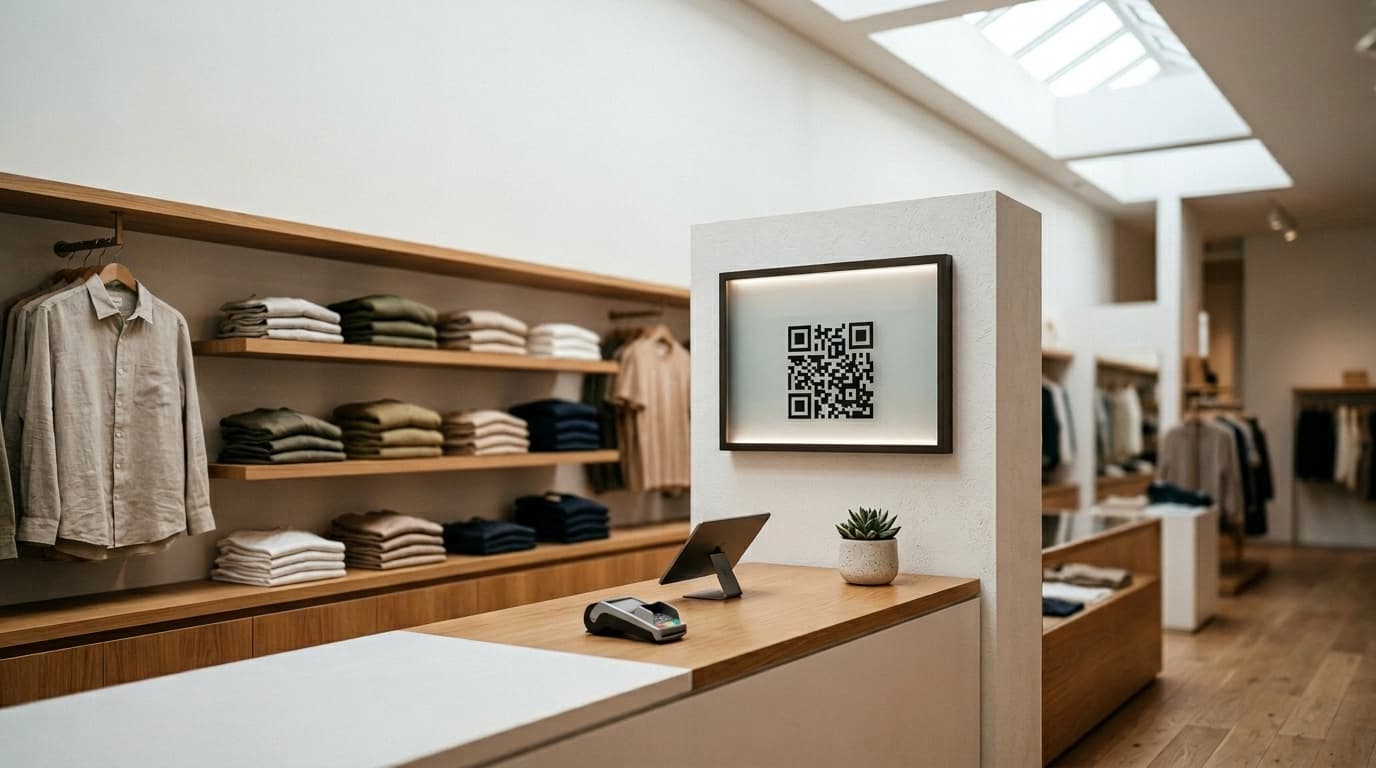
The gap between "I'll leave a review when I get a chance" and actually doing it is where most review intent dies. A QR code placed at exactly the right moment eliminates that gap.
For cleaning businesses, the highest-impact placements are:
On invoices and quotes. A small QR code beneath your signature transforms every billing interaction into a review opportunity. Caption it simply: "Happy with our service? Share your experience — it takes 30 seconds."
On your company vehicle. A sticker or decal on your van — visible when you're parked outside a client's home or building — is passive advertising to neighbors who are already pre-qualified prospects. Many cleaning companies report Google profile views directly traceable to vehicle sightings.
In your client welcome pack. A card included with your onboarding materials, handed over at the first appointment, establishes review culture from day one of the relationship.
On the end-of-service completion sheet. If your team leaves a signed completion form, a QR code on it captures review intent at the exact moment the client first sees the result of your work.
Context-appropriate QR codes consistently convert at 15-30%, compared to under 3% for a link sent cold via email two days after the appointment.
Gamification: Turning the Ask Into an Incentive
Many cleaning business owners avoid asking for reviews because it feels awkward — like asking clients for a favor. Gamification flips that dynamic entirely.
Instead of asking clients to do you a favor, you offer them something valuable in return for their review, and you make that offer genuinely enjoyable. A digital fortune wheel spun after leaving a Google review turns a transactional request into a moment of participation.
Prizes that work particularly well for cleaning services:
- One complimentary cleaning session
- A 15-20% discount on the next booking
- An eco-friendly cleaning product kit
- A gift voucher with a complementary local business partner
The result: clients leave a review because there's a tangible benefit for them. The reviews they write tend to be more detailed because the experience was memorable. And your collection rate climbs from the sector average of under 2% to 15-30%.
Responding to Reviews in a High-Trust Category
How you respond to reviews is, in a cleaning context, as important as the reviews themselves. A prospective client evaluating your profile treats your response patterns as a real-time audit of your accountability.
For positive reviews: go beyond a generic "thank you." Reference the context when possible — the type of service, the regularity of the appointment. "We're glad the weekly office clean continues to meet your standards" signals that you actually know your clients, not just your star count.
For negative reviews: respond within 24 hours, without defensiveness. "We take this seriously and will contact you directly to make it right" is more powerful to a reader than a detailed rebuttal. Demonstrated accountability is a stronger trust signal than a perfect score.
Building a Reputation That Works While Your Team Does
The cleaning businesses that dominate local search won't necessarily be the ones doing the best work. They'll be the ones that understood early that reputation is built systematically — through consistent review collection, well-timed asks, and a profile that looks alive week after week.
Ludofy gives cleaning services a turnkey system: custom QR codes, a gamified fortune wheel that makes review collection feel rewarding rather than transactional, and automated follow-up messages that go out after every appointment. Set it up once, and it runs in the background while your team focuses on the actual work.
In a market where clients search before they call, and decide before they speak with you, the business that compounds its reputation month by month has an advantage that no ad budget can easily replicate.