A customer walks into your store. She spends twenty minutes exploring, finds a piece she loves, brings it home, integrates it into her living room, posts a photo to Instagram, texts it to two friends who ask where she found it — and never once thinks to leave a Google review.
This is the standard lifecycle of a home decor purchase. Your best customers are enthusiastic ambassadors who share everywhere except the platform that actually drives new foot traffic.
Understanding this gap — and building a system to bridge it — is the difference between a shop that stays a neighborhood secret and one that becomes the destination everyone in the city knows about.
Why home decor customers are your best potential reviewers
The home decor customer is emotionally invested in a way that grocery or fast-food customers rarely are. She spent real time choosing. She came back twice. She debated between two options. When she finally finds the right piece, the satisfaction is genuine and meaningful — connected to her home, her identity, her sense of living well.
That emotional charge is exactly what makes for detailed, persuasive Google reviews. The problem isn't the customer's enthusiasm — it's her sharing instinct. Decor satisfaction naturally expresses itself through visual platforms: Instagram Stories, Pinterest boards, interior design Facebook groups. Google Maps isn't part of that mental workflow.
The good news: a small nudge at the right moment is all it takes to redirect that enthusiasm toward a review.
What people look for before visiting a decor store
The discovery journey for a home decor store increasingly starts on Google Maps. When someone moves to a new city, starts a renovation, or needs a meaningful gift, they search "home decor store near me" or "interior design shop [city]" before anything else.
What they evaluate: photos of the interior, total number of reviews, and overall star rating. A listing with beautiful shop photos and 150 reviews communicates one thing immediately — this place is worth the trip. A listing with 14 reviews at 4.9 stars raises a different question: why do so few people talk about it?
Volume signals safety. Customers making a discretionary trip to a shop they've never visited need social proof before committing to the visit. Your five-star average means less than it should if only a handful of people have contributed to it.
The checkout moment: highest leverage in a considered purchase
Unlike grocery or fast food, a decor purchase involves real deliberation. The customer has browsed, compared, possibly visited twice, and made a meaningful decision. By the time she reaches your register, she's already decided she loves your store.
This moment — the highest point of satisfaction and engagement in her entire interaction with you — is when you have the most leverage to ask for a review. And it's also the moment most decor store owners let pass without capturing it.
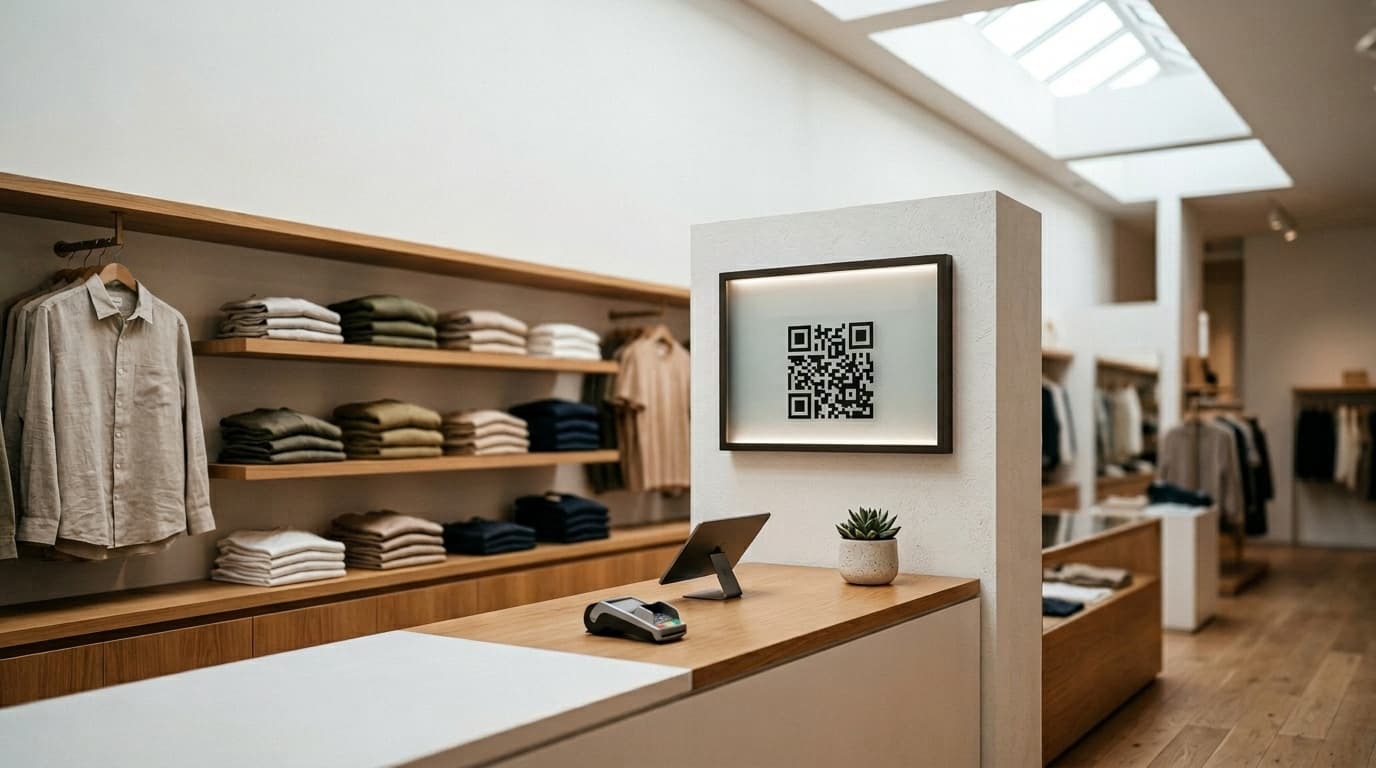
A QR code positioned at eye level during checkout, with a short, non-pushy message ("Loved something today? Leave us a review"), creates the bridge. The scan takes two seconds. The review, if she chooses to write one, takes thirty.
But a QR code alone converts modestly — typically 5 to 10% of customers who notice it. The obstacle isn't technical. It's motivational: writing a review takes a minute and benefits only the shop. To move past this, you need to change the nature of the exchange.
From QR code to fortune wheel: creating a reason to act
A fortune wheel turns "do me a favor" into "play to win." The customer isn't being asked for something — she's being invited into a game. The review becomes the entry ticket, not the obligation.
For a home decor store, the most effective prizes are ones that connect directly to your offer and create a reason to return:
- 10% off the next purchase — a concrete incentive that keeps customers coming back
- A free decorative accessory from your current collection — drives discovery of new products and doesn't cannibalize existing sales
- A £15 or €15 gift card valid on the next visit over a minimum spend — maintains basket value
- Free gift wrapping on the next purchase — high perceived value, low cost
- Invitation to a private or preview sale event — creates exclusivity and urgency
The key principle: prizes should be on-brand, specific, and desirable. "A mystery gift" creates less excitement than "one of our new winter candles." Specificity raises perceived value.
Photo reviews: your customers as curators
In home decor, a review with a photo is worth five times a text review. Google prominently features images in business listings, and a photo of a real living room styled with your pieces is far more persuasive than any professional product shot.
The ask is simple. Add a line to your QR code display: "Show us your space! Add a photo with your review." One photo review transforms a satisfied customer into an ongoing visual reference for your most aspirational shoppers.
Over time, your Google profile becomes a living gallery of real interiors styled with your products — authentic UGC (user-generated content) that shows future customers exactly what they're buying into. No marketing budget can buy what a hundred genuine before-and-after photos create.
The compounding effect: how 50 reviews becomes 200
The shops that reach 200+ Google reviews didn't get there through a one-time effort. They made the ask a standard part of every transaction. QR code always at the register, brief verbal mention from staff ("We have a fun little game on the counter if you'd like to try it"), occasional reminder on packaging or the receipt.
The result compounds automatically. More reviews improve your Google ranking, which generates more visibility, which brings in more new customers, which creates more reviews. The hardest step is starting the cycle — maintaining it is straightforward once the system is in place.
The competitor who relies on walk-in traffic and neighborhood word of mouth remains invisible to the growing number of customers who discover new shops through Google Maps rather than by chance.
Local SEO: the hidden advantage for independent decor stores
For an independent home decor store, local SEO is often the highest-leverage marketing channel available — and the most underutilized. Someone who just moved to your area, is renovating their home, or needs a housewarming gift will search Google before they ask a friend. That search result determines which shops they even consider.
Google ranks local businesses on three factors: relevance, distance, and prominence. Reviews contribute directly to prominence — both volume and recency. A well-reviewed shop in a secondary street can consistently outrank an under-reviewed competitor on the main high street.
This is still an open opportunity in most cities. Most independent decor stores haven't built the review infrastructure to compete on this dimension.
Common mistakes to avoid
Relying on Instagram shares. Your customers ARE sharing — just not to Google. The review system won't build itself; create the bridge actively.
Using vague prizes. "A surprise gift" is less compelling than "one of our new pieces from the January collection." Specific is better.
Not responding to existing reviews. Every response improves engagement signals and shows future customers you're attentive. Reply personally, within 24 hours, to both positive and critical reviews.
Collecting in bursts. A spike of reviews followed by silence looks suspicious to Google's algorithm and signals inconsistency to customers. Regular flow matters more than volume in short windows.
The store with the best online reputation wins the foot traffic
Home decor is a destination shopping experience. Customers travel to find the right shop. The store with 180 reviews at 4.8 on Google becomes the reference point for everyone moving into the neighborhood, renovating their space, or hunting for a unique gift — whether they heard about you before or not.
Ludofy gives home decor stores the infrastructure to build that reputation consistently. Configure a branded fortune wheel with your own prizes, generate a QR code for your checkout counter, and start tracking reviews from day one. Setup takes less than ten minutes; the reviews start coming in the same day.
The same care that goes into curating your collection should go into building your reputation. In 2026, the two are inseparable.