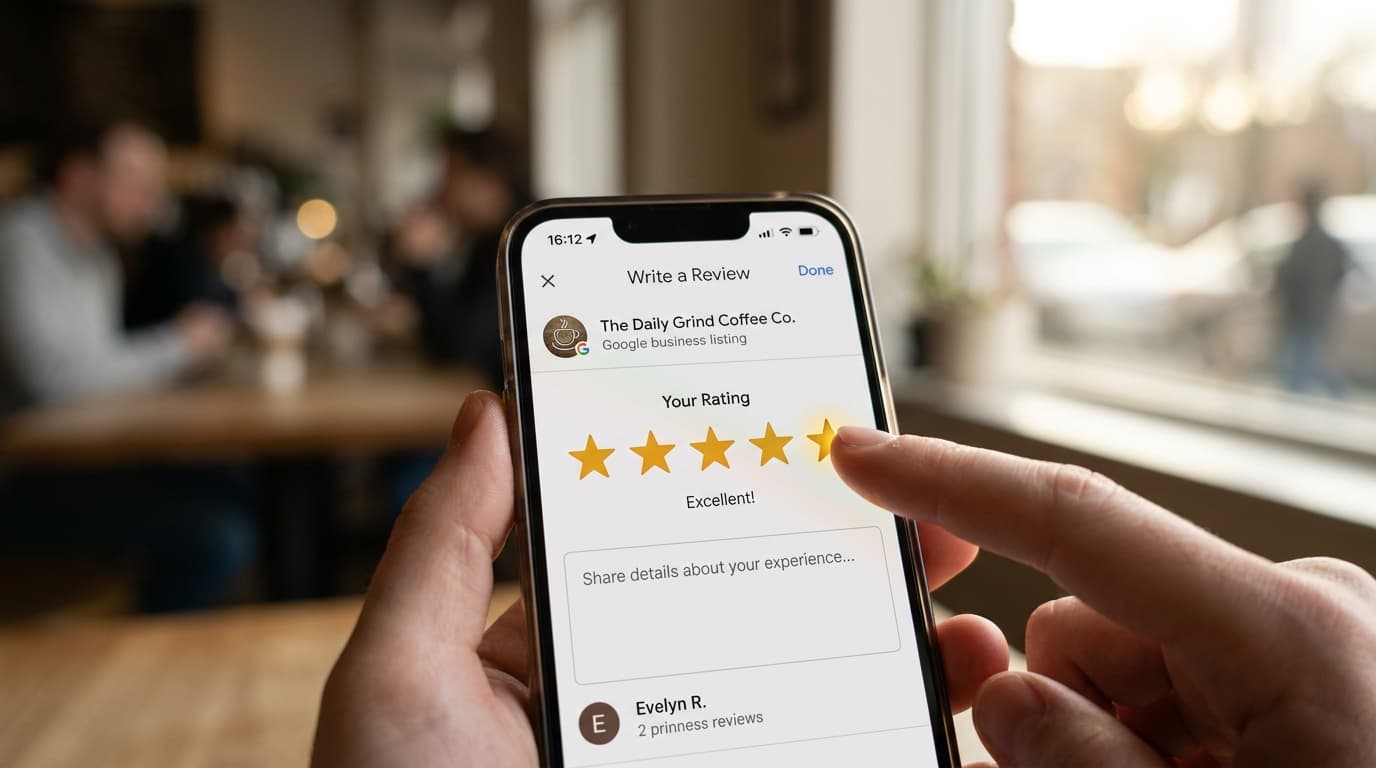
Ask a language school director what their biggest marketing challenge is and you'll hear some version of the same answer: "Word of mouth is great, but we can't control it." Google Reviews can change that. When a parent searches "English classes near me" or "best French school in [city]," the result that looks most authoritative wins the enrollment conversation before it even starts.
Yet most language schools treat review collection as an afterthought — a banner on the wall, a line in the welcome email, maybe an occasional reminder. That passive approach converts at perhaps 2–4% of satisfied students. Structured systems with a physical QR code and a digital incentive convert at 25–40%. The gap is enormous, and most schools are leaving it entirely untouched.
Why Google Reviews Are a Bigger Deal for Language Schools Than for Most Businesses
When someone picks a coffee shop based on Google ratings, the risk is low. But enrolling in a language school — particularly for parents choosing a program for their child — is a high-stakes decision involving months of fees, a long-term relationship, and the expectation of measurable progress.
In that context, reviews function as social proof of the school's entire pedagogical promise. A review that says "My daughter's English improved dramatically in three months, and the teachers were endlessly patient" is worth more to a prospective parent than any brochure or website copy you can write.
There is also a purely mechanical SEO effect. Google's local ranking algorithm weighs review quantity, recency, and rating when deciding which businesses show in the map pack. A school that generates 5–10 new reviews per month will consistently outrank a competitor with the same cumulative total but no new reviews in the past quarter. Freshness signals ongoing activity — and Google rewards it.
The Enrollment Decision: When Do Prospective Students Read Reviews?
The vast majority of prospective students or parents compare three to five language schools before making a decision. That comparison typically happens at three distinct moments:
At the initial research stage — Before even contacting a school. If your Google profile shows 18 reviews and a 4.1 rating, many prospects rule you out before picking up the phone.
After a trial class — The student or parent wants to validate their gut feeling against what others have said. Specific, detailed reviews carry more weight here than a high star count alone.
At price comparison time — When two schools are similarly priced, reviews are the tiebreaker. The school with more and better reviews wins even when its price is slightly higher.
Your review profile is an active participant in enrollment conversations you're not even in the room for.
Four Moments to Collect a Google Review at Your Language School
Language schools have an advantage most local businesses don't: ongoing relationships with students that multiply the chances of capturing honest feedback.
1. After the First Month
Students who complete their first month have cleared the initial commitment hurdle and are likely already forming a clear opinion. A brief WhatsApp message — "You've just completed your first month — we'd love your feedback!" — paired with a QR code on the classroom door at the end of class, catches them at a peak of early enthusiasm before routine sets in.
2. After Passing an Exam or Advancing a Level
Finishing a TOEIC session, earning a DELF certificate, or advancing from intermediate to upper-intermediate creates a genuine moment of pride and gratitude. Students are emotionally connected to the school's value right now. Acknowledge the achievement with a congratulatory message and embed a review request in the same breath.
3. At an End-of-Term Ceremony or Award Day
Schools that hold term-end events — even small, informal ones — gather students and families in a high-energy, positive state of mind. A QR code display near the exit, briefly mentioned by the director at the close of the event, generates reviews that wouldn't happen otherwise.
4. At Reception or Payment Checkout
Every time a student or parent visits the front desk to renew enrollment or pay tuition fees, that is a review opportunity. A small QR code stand with a simple "Enjoyed your experience? Share it on Google" prompt converts reliably. The phone is already out for payment, so scanning takes ten seconds.
Why a Fortune Wheel Changes the Conversion Rate
Getting someone to leave a Google review requires two things: motivation and immediate ease. A direct-link QR code solves ease. Motivation is where most schools fail.
A digital fortune wheel — where the student scans a QR code and spins to potentially win a small prize before or after leaving a review — transforms the exchange from a favor into a two-way interaction. The prizes don't need to be expensive: a discount on next term's study materials, a free conversation practice session, a small gift voucher. The psychological effect of spinning and winning is outsized relative to the reward's actual value.
The important compliance point: the reward must not be conditional on a specific star rating. Rewarding any honest review is permitted under Google's policies. Requiring a 5-star review in exchange for a prize is not, and can result in reviews being removed. A properly configured fortune wheel avoids this naturally by separating the spin from the rating choice.
Schools that implement this mechanic consistently report three to five times more reviews generated than those using a plain QR code alone.
Responding to Reviews: What Language School Directors Need to Know
Your response to reviews — positive and negative — is as visible to prospective students as the reviews themselves. A thoughtful response to a negative review can neutralize most of its damage. A generic non-response to a negative review suggests the school doesn't care about student experience.
For positive reviews, respond warmly and specifically. Mention the student's progress if it's referenced. Use their first name if included. A human, specific response signals an engaged institution: "Thanks so much, Maria — we're thrilled your IELTS result came in above your target. Best of luck with your application!" is worth far more than "Thanks for your review!"
For negative reviews, avoid defensiveness at all costs. Acknowledge the concern, apologize for the experience, and invite the reviewer to contact you directly to resolve it. Keep the response short. Prospective parents reading the exchange care about your tone, not the details of what happened.
What a 90-Day Review Campaign Looks Like in Practice
A structured 90-day push at a language school typically generates 30–80 new reviews — enough to move the needle on local rankings measurably. Here is a simple framework:
Month 1: Install the physical QR code at reception and all classroom exits. Brief front-desk staff on the checkout script. Set up the fortune wheel with two or three prize options. Ensure the QR code links directly to your Google Review page — not to your website, not to a form, directly to the review prompt. Every extra tap is a point where people give up.
Month 2: Add a review request to the end-of-first-month communication sequence. Monitor every new review and respond within 48 hours. Track which physical touchpoints generate the most scans.
Month 3: Identify students who recently passed an exam or completed a level. Reach out with a congratulatory message that includes the review request. Double down on whichever touchpoint converted best in Month 2.
After 90 days, maintain a monthly cadence. Even 8–10 new reviews per month compounds dramatically over a year. A school that goes from 20 reviews to 120 in twelve months doesn't just rank higher — it enters a different tier of perceived credibility entirely.
Ludofy: Built for Service Businesses With Ongoing Customer Relationships
Ludofy's QR code fortune wheel is designed for exactly this type of business: a service provider where the customer experience is rich and the relationship is long, but the moment of feedback capture is easy to miss. A student scans, spins the wheel, and leaves a Google review — the entire flow takes under two minutes with no app download, no account creation, no friction.
For language schools competing in dense urban markets — where the difference between a 4.3 and a 4.8 rating, or between 20 reviews and 120 reviews, can mean the difference between a full intake and empty seats — a systematic review collection strategy is the highest-ROI marketing change available. Start building it now, and by the next enrollment season, your Google profile will be doing the closing for you.