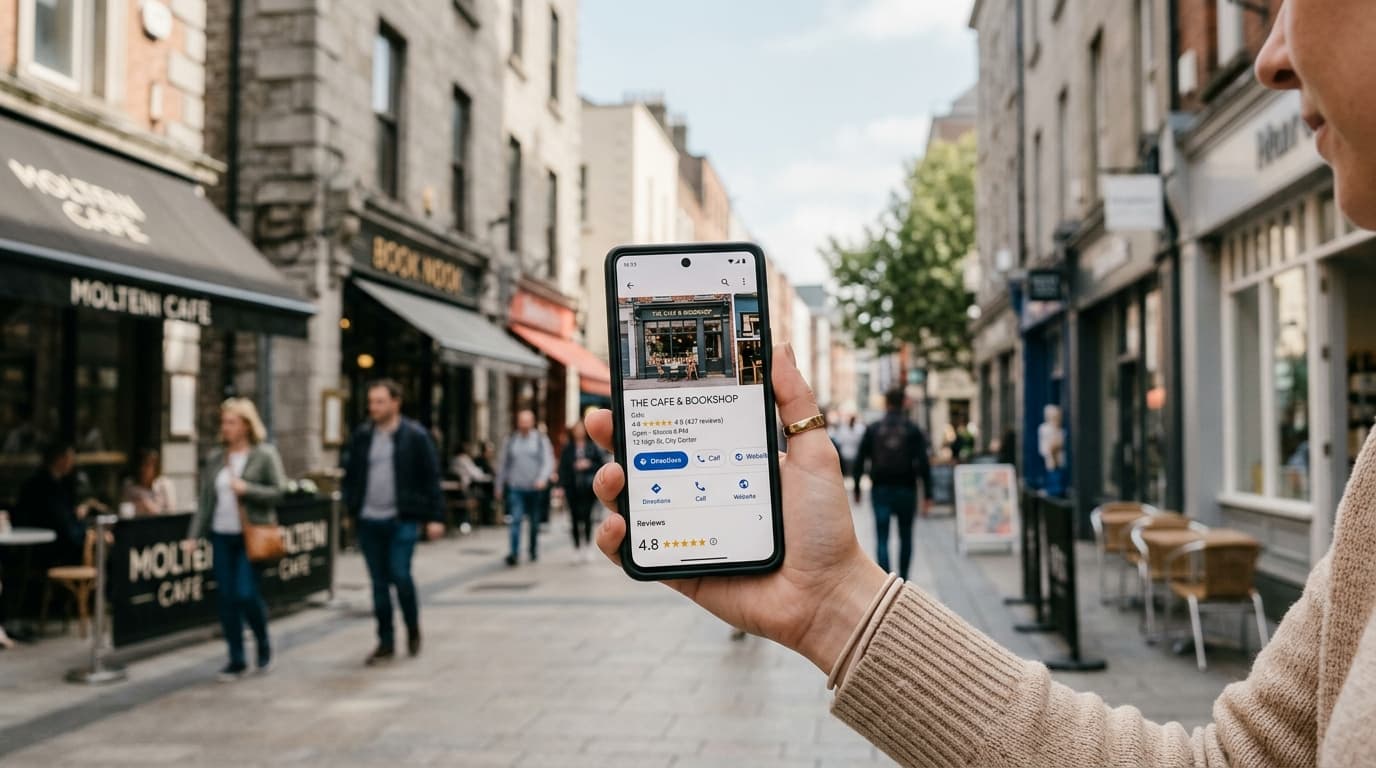
When someone searches "best sushi near me" or "hair salon open Sunday in Chicago," the results they see aren't random. Google runs a local ranking algorithm that weighs dozens of signals to determine which businesses appear in the Local Pack — that three-listing map block that shows up above organic results and captures the majority of clicks.
Google Reviews are among the strongest signals in that algorithm. Not in a fuzzy, feel-good way, but in a concrete, measurable way that shows up in your search position week after week. If you're not actively managing your review collection, you're almost certainly losing ground to competitors who are.
Why Google Weights Reviews So Heavily
Google's product depends on showing people useful results. If a user clicks through to a business that turns out to be poorly managed, disappointing, or closed — that's a failure in Google's core value proposition. Reviews solve a real problem for Google: they're aggregated human judgment at scale, collected without Google having to do anything.
When a business profile accumulates a steady stream of recent, positive, detailed reviews, Google reads that as a reliable signal of quality and relevance. It rewards that profile with better placement in local results. The relationship is documented and consistent across industries: businesses that invest in review collection move up; businesses that don't, stagnate.
The Four Review Factors That Drive Rankings
Not all reviews carry equal weight. Here are the four dimensions that matter most:
Total Review Count
Volume is a credibility signal. A restaurant with 400 reviews will reliably outrank a comparable competitor with 40 reviews, even at the same star rating. High review counts tell Google — and potential customers — that your business is active, frequented, and generating enough memorable experiences that people bother writing about them.
Recency
Google puts more weight on recent reviews than on older ones. A profile receiving new reviews regularly signals ongoing activity. A profile that hasn't received a new review in four or five months will typically drift down in rankings, even if it has a solid cumulative total. Consistency matters as much as count.
Average Star Rating
There's a real conversion cliff below 4.0 stars. Users filter, skip, and distrust sub-4-star listings at dramatically higher rates. Google accounts for this behavior. Keeping your rating at 4.5 or above has a compounding benefit: it improves your ranking position and increases the click-through rate once users see your listing — so the same ranking position produces more foot traffic.
Keywords in Review Text
When a customer writes "incredible wood-fired pizza" or "most attentive staff in the neighborhood," those phrases become indexable content. Google can match your listing to those specific searches. A profile full of detailed written reviews will rank for long-tail queries that a profile with only star ratings simply cannot. This is one of the least-appreciated dimensions of review SEO — and one of the easiest to influence.
The Compounding Advantage
There's a flywheel effect for businesses that figure this out. More reviews → better ranking → more profile views → more foot traffic → more opportunities to collect new reviews. Every review strengthens your position, and that position generates more exposure for the next one.
The inverse is equally true and more dangerous because it's invisible. Businesses without a review strategy plateau, then slowly slide as competitors push ahead. Getting outranked in local search is often a gradual process — you don't feel it until you're on page two and wondering where your traffic went.
Why Verbal Asks Don't Scale
Most restaurant and retail operators know they should be asking for reviews. Many do — a quick mention at checkout, a note on the receipt, a sign near the door. The conversion rate on those methods typically runs between 2% and 5%.
The problem isn't customer willingness. It's friction and timing.
Leaving a Google Review requires the customer to:
- Open a browser or the Google app
- Search for your business by name
- Navigate to the review section
- Write something
That's four steps from a standing start, at a moment when the customer has no particular urgency to complete them. Most satisfied customers don't get through all four — not because they didn't enjoy the experience, but because the moment passes and something else takes over.
Every hour that passes after a great meal or service reduces the probability that a review gets written. The ideal window is minutes, not hours.
Reducing Friction With a QR-Based Game Mechanic
The businesses that consistently collect reviews at high volume have figured out two things: get to the customer while satisfaction is still fresh, and make the next step obvious and worth taking.
A QR-based fortune wheel mechanic solves both. A QR code on the table, counter, or receipt opens a spin-to-win game. The customer spins to win a free dessert, a discount on their next visit, or another reward. The condition to play: a quick Google Review.
This works on a well-documented psychological principle: reciprocity. When someone receives something — even something small or probabilistic — they're naturally inclined to give something back. The game mechanic reduces the perceived cost of leaving a review to essentially nothing, while the potential reward provides a concrete reason to act right now rather than later.
The other operational advantage is independence from staff performance. Once the QR code is posted, the system runs on its own. It doesn't require a server to remember to ask, or a particularly persuasive employee to make it happen. Businesses that implement this approach report review collection rates several multiples higher than verbal-only methods — and more importantly, the collection is consistent across days and shifts.
What the Numbers Look Like Over a Six-Month Horizon
Consider two competing businesses starting at roughly the same rating and review count:
- Business A relies on occasional verbal asks: averages 3–5 new reviews per week.
- Business B uses a QR gamification system: averages 20–30 new reviews per week.
After six months, Business A has added around 100 reviews. Business B has added 500 or more. The gap in Google Maps ranking between them will be measurable and growing. Business B will also have a higher total that makes it harder for Business A to catch up even if they eventually put a system in place.
This isn't a marginal difference. It compounds into a durable competitive advantage that can take years to overcome from a standing start.
Building Infrastructure, Not Campaigns
The businesses that dominate their local market on Google Maps don't treat review collection as a campaign they run occasionally. They've built it into their operational infrastructure — it runs every shift, automatically, without depending on any individual team member's initiative.
That's the difference between hoping for reviews and systematically earning them.
Ludofy is built specifically for this. The platform provides a permanent QR code display for your location, a fortune wheel mechanic that engages customers and motivates action, and a direct routing to your Google Review page once they've played. Setup takes minutes, and from there the system works in the background — whether you're running a single coffee shop or coordinating review collection across multiple locations.
The businesses using it today are building a search position lead that will be very difficult for competitors to close in twelve months. The ones waiting for customers to review spontaneously are handing that lead away, one week at a time.