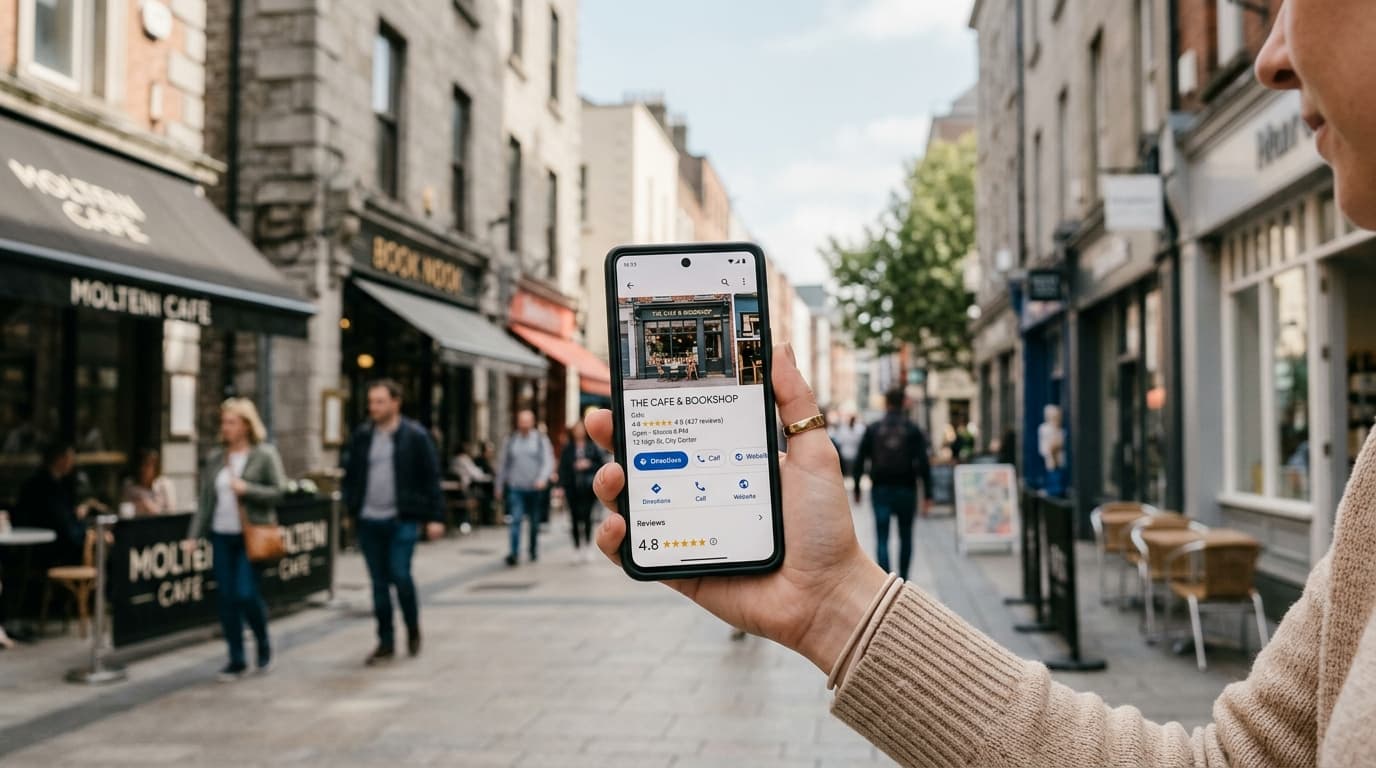
Your yoga or pilates studio delivers real transformation — calmer minds, stronger bodies, a community that keeps students coming back week after week. But when someone new to the neighborhood searches "yoga studio near me" on Google Maps, they're making a decision in seconds based almost entirely on what they see: star ratings, review counts, and the date of the most recent feedback.
The studio with 9 reviews from two years ago loses to the one with 90 recent ones, every time — regardless of the quality of teaching.
Why Google Reviews are the primary acquisition channel for yoga and pilates studios
Unlike restaurants or retail stores, yoga and pilates studios face a specific discovery challenge. Prospective clients aren't usually browsing spontaneously — they're triggered by a concrete need: chronic back pain, a doctor recommending low-impact exercise, post-injury recovery, a stress-reduction goal. When that trigger fires, the first thing they do is search Google Maps.
What they see on that results page determines which studios they even consider. Reviews are the single most visible trust signal at that moment. A studio with a high volume of positive, specific reviews — "reformer classes fixed my lower back in six weeks," "small group sizes feel like personal coaching" — converts that searcher into a trial booking. A sparse or dated profile pushes them toward a competitor.
Class-based businesses also face a subtler obstacle: the service is entirely experiential, and its value isn't obvious before you try it. A new client can't judge your teaching quality from a photo. Reviews give them the social proof they need to take the first step and book a class with someone they've never met.
The structural advantages your studio already has — but probably isn't using
Most businesses have to work hard to create review-collection moments. Yoga and pilates studios have them built in, recurring daily.
The post-class emotional state. The ten to fifteen minutes at the end of a class — savasana, the final stretch, the quiet restack of props — is a moment of genuine calm and well-being. Students feel physically and mentally better than when they arrived. That elevated emotional state is exactly the condition in which people are most naturally inclined to express gratitude and appreciation. The impulse to leave a positive review is strong; what's almost always missing is a system that directs that impulse before it fades on the drive home.
A loyal, recurring community. Unlike a restaurant where new clients represent the majority of review opportunities, yoga and pilates studios derive their core revenue from regulars — students who attend two, three, or four times per week. Every class is a fresh review-collection opportunity. A student who has practiced thirty sessions over the past year has probably never been asked for a review in any formal way. That's a substantial untapped resource.
An audience that values authenticity. Wellness clients respond well to approaches that feel genuine rather than transactional. A gamified review mechanic — scan to spin a digital wheel and win something — reads as a community perk from the studio, not a pushy favor request. When framed correctly, it fits naturally with a wellness brand's tone.
The mistakes costing you reviews every week
Verbal requests to the whole class at once
"Feel free to leave us a Google review!" addressed to fifteen students simultaneously is the most common approach and one of the least effective. Each person hears a message aimed at the room, not at them individually. Nobody pulls out their phone first, the post-class calm fills with conversation, and the impulse disappears. Real-world conversion rate: under 2%.
Treating social media engagement as a substitute for Google presence
A strong Instagram grid, an engaged Facebook community, and a healthy email list are valuable for retaining current students. They don't generate the Google presence that attracts new ones. Your Instagram followers already know you. The person searching "pilates studio near me" right now has never heard of your studio and is choosing from whatever the Maps listing shows them.
Waiting for satisfied students to post reviews spontaneously
Reviews that arrive without prompting are disproportionately from people who had a frustrating experience — a cancelled class, a booking problem, a studio that was too cold. The silent majority of happy students intends to write something positive and simply never finds the moment. Without a consistent prompt system, your average rating gradually skews negative relative to your actual quality — not because you're doing bad work, but because the incentive to act is asymmetric.
A practical review strategy for class-based studios
QR codes at the right pause points
The goal is to surface the review invitation at moments when students are stationary, phone-accessible, and emotionally warm — without interrupting the experience or requiring any verbal prompt.
The mat area at the end of class. A small tent card or A5 sign near the mat rack or prop storage sits in the natural line of sight during the post-class tidy-up. No cue from the instructor needed; the invitation is simply present at the right moment.
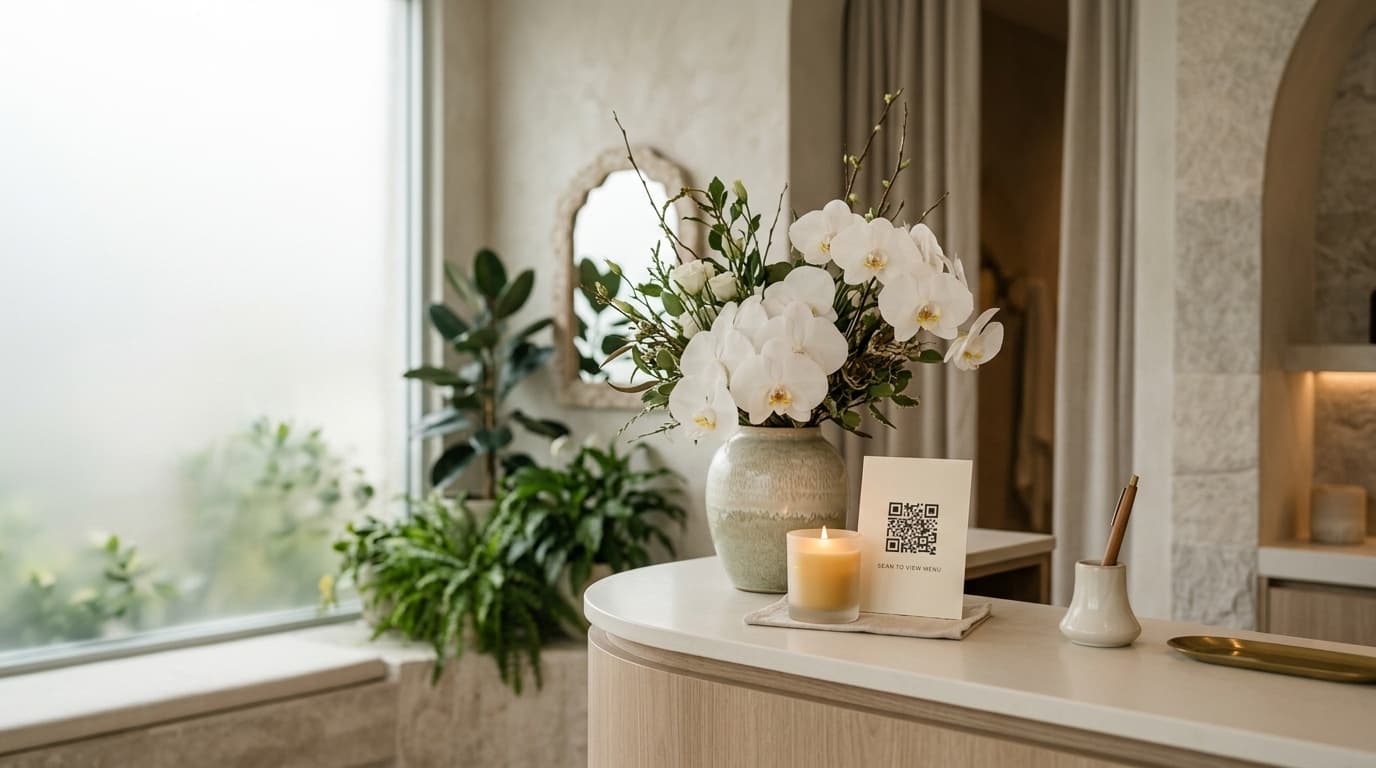
The reception desk or booking tablet. Students who stop by the front desk to book their next session or buy a product are already in "studio interaction" mode. A QR code at eye height on the counter turns a routine transaction into a review opportunity.
The changing room or common area. A sticker or card near the exit mirror catches students in the final moments before leaving — still in post-class mode, slightly more private than the studio floor, with a natural pause as they gather their things.
Gamification: turning a review request into a moment of play
A standard QR code links directly to your Google review page and asks for a favor. Gamified review collection inverts this: you offer something first, and the review becomes the entry step to something enjoyable.
The mechanic is simple: scan the QR code → write a Google review (freely, any star rating, no editorial direction) → spin the digital wheel to discover a reward. Prizes might include a free drop-in class, a discount on an upcoming workshop, priority booking for a premium time slot, or a branded product. The review is genuine and self-directed — students write what they actually think.
This reversal changes the psychology from "please do something for me" to "here's something for you." Studios using this approach consistently report participation rates of 25–35%, compared to under 5% for verbal requests or a plain QR code pointing straight to Google.
The rewards should feel appropriate for a wellness brand. Experiences and community perks outperform cash discounts for this audience. A free guest pass to bring a friend to class, for example, carries high perceived value while simultaneously driving referrals alongside reviews.
Prize design that resonates with your students
Think about what your specific community finds genuinely compelling:
- Free drop-in class — high perceived value, naturally introduces students to a time slot they might start attending regularly
- Priority access to workshops or specialty classes — ideal for dedicated students who value exclusivity over discounts
- Branded wellness product — a travel mat, massage ball, or essential oil roll-on — low cost, high brand affinity, something to take home and use
- Free month of membership (jackpot, rare odds) — the grand prize that makes the wheel genuinely exciting. A student who wins a free month will mention it to every friend who asks about their fitness routine
Variable reward probability is what makes the mechanic work. Even when most spins yield modest prizes, the possibility of the jackpot keeps engagement high and creates word-of-mouth around the game itself. That secondary effect — students telling friends "I won a free class at my yoga studio" — is acquisition momentum you can't buy.
The local SEO payoff over time
Google ranks local businesses on three main signals: relevance, proximity, and prominence. Review volume and recency are direct inputs to prominence. A studio collecting 8–12 new reviews per week consistently will outrank established competitors — even those with a longer history — in Google Maps within 60 to 90 days.
For yoga and pilates studios specifically, there's an additional SEO benefit: reviews often contain high-intent keywords organically. Students write things like "best yoga studio for beginners in [neighborhood]" or "pilates for lower back pain, small classes, really attentive instructor" — phrases that exactly match what prospective clients are searching. These organic keywords in review text strengthen your Maps profile in ways that no manual optimization can replicate.
The math is real. At 15 students per class across 6 weekly sessions, with a 25% participation rate, you add roughly 22 new reviews per week. Over 90 days: close to 300 fresh, keyword-rich reviews. That visibility gap becomes very difficult for competitors to close once you've opened it.
Ludofy is built for exactly this setup: a fully branded digital fortune wheel, triggered by QR code at the end of your class, with the Google review as the entry step before the spin. The dashboard tracks new review volume, participation rates, and prize redemptions by week — so you can see what's driving the highest conversion and adjust prizes accordingly. Setup takes under fifteen minutes, and most studios see their first new reviews arrive within hours of going live.
If your classes are full of loyal students who think the world of your teaching but your Google profile doesn't show any of it, the gap is mechanical — and it closes faster than you'd expect.