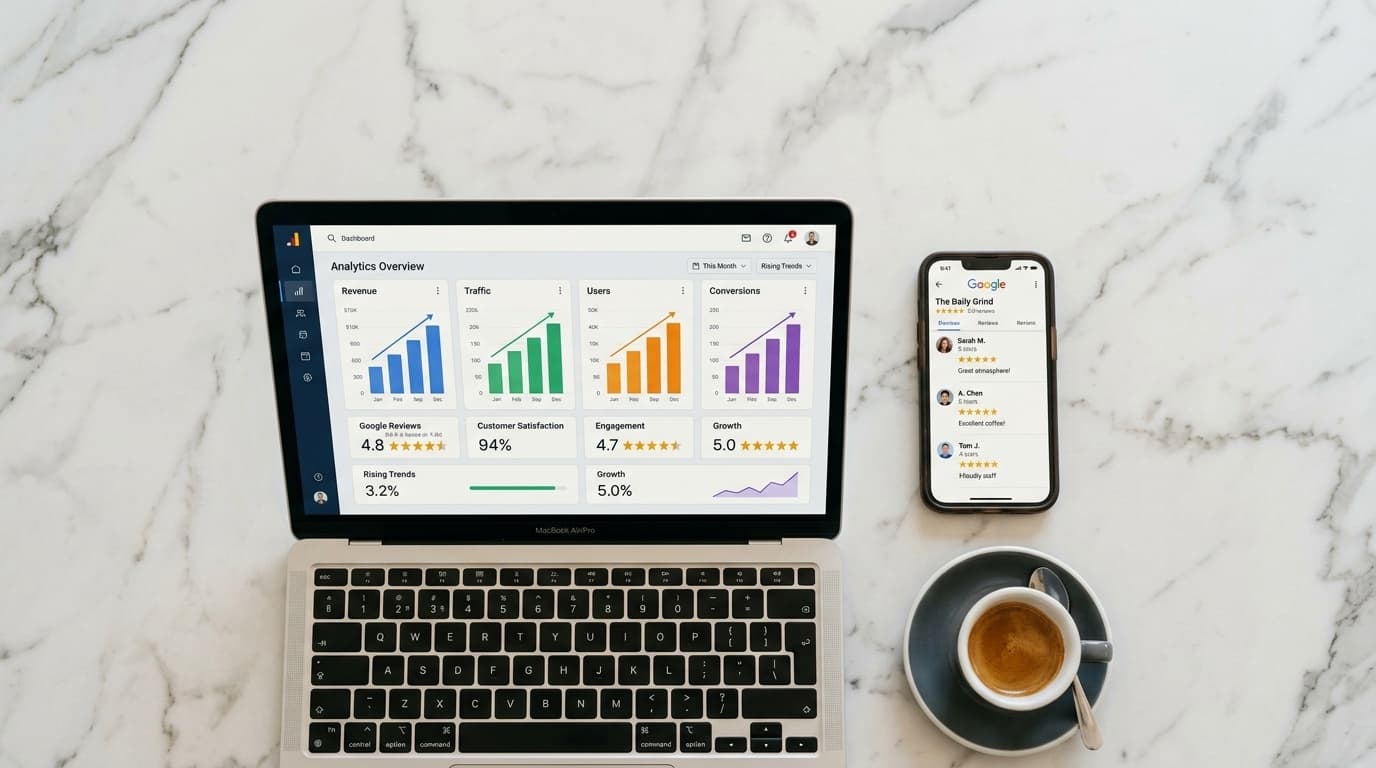
Most local business owners treat Google reviews as a vanity metric — something that looks good on the profile but doesn't really inform how they run the business. That framing misses a significant opportunity. Your reviews are a direct, unfiltered feed of customer opinion, organized by date, weighted by the effort customers put into writing them. Treated properly, they're one of the best operational data sources you have access to.
The challenge is that most operators don't have a system for actually reading and interpreting that data. They check the star rating occasionally, maybe respond to a few reviews, and move on. This article is about doing substantially more with what you're already collecting.
Volume and Velocity: Your Leading Indicator
Before diving into content, look at review velocity — how many new reviews you're getting per week, and whether that number is trending up, flat, or down. Velocity is a leading indicator of business health in a way the cumulative count isn't.
If your review count is growing steadily, customers are motivated enough by their experience to do something about it. If it's stalled, that's worth investigating. Sometimes it means the experience is good but not remarkable enough to prompt action. Sometimes it signals a real service decline that hasn't yet shown up in your star rating because the affected customers are simply leaving silently.
Tracking velocity over time also helps you measure the impact of operational changes. If you hired a new manager, updated your menu, or ran a promotion, the review velocity in the following weeks will tell you whether those changes translated into better customer experiences — or didn't.
Mining the Text for Actual Intelligence
Star ratings tell you very little on their own. The written text is where the intelligence lives. Most businesses with more than fifty reviews have enough material to identify clear patterns — things customers mention repeatedly across multiple reviews.
Start with your best reviews (4 and 5 stars). Read thirty of them back-to-back and look for recurring phrases. Is it the same server getting named? A particular dish? The speed of service? The atmosphere at a specific time of day? These recurring mentions are your actual differentiators — the reasons people chose you and will recommend you. They're worth knowing explicitly, not just intuiting.
Then do the same with your weakest reviews (1 and 2 stars). Look for the themes that recur. Slow service during peak hours? Inconsistency between visits? Parking? These recurring complaints are almost always fixable operational problems that most operators are vaguely aware of but haven't been forced to confront by hard evidence.
The middle reviews (3 stars) are often the most informative of all. These are customers who had an experience interesting enough to describe in detail, but not good or bad enough to feel strongly about. They often contain the most specific, actionable observations — the near-misses where a small change in execution would have produced a loyal customer instead of a one-time visitor.
Tracking Keyword Themes Over Time
Once you have a sense of what themes recur, start tracking whether they shift over time. If "slow service" appears in fifteen reviews from Q1 and only two from Q2, that's evidence your operational fix worked. If "parking" starts appearing more frequently in summer, that's a seasonal capacity issue worth planning around.
You don't need analytics software to do this. A simple spreadsheet where you tag each new review with one or two keyword categories — service speed, food quality, staff attitude, cleanliness, value, ambiance — and log the star rating gives you a time series you can actually work with. Ten minutes a week to maintain it will yield more insight than most operators get from much more expensive tools.
The Compounding SEO Benefit
There's a secondary advantage to tracking keyword themes: it helps you see which specific phrases customers use to describe your business. When review text includes phrases like "best outdoor terrace in the neighborhood" or "fastest lunch service downtown," those phrases become indexable content in Google's local algorithm. Your profile will rank for searches that match those exact terms.
Understanding which themes dominate your reviews lets you reinforce them — through the experience you deliver, the way you respond to reviews, and even the way you describe your business in your Google profile description.
Comparing Your Review Profile Against Competitors
Google Maps lets you browse competitor profiles as freely as your own. If you're losing customers to a specific competitor, spend thirty minutes reading their most recent fifty reviews. What do customers consistently praise? Are there things they're delivering that your business isn't? What complaints appear in their reviews that yours doesn't get?
This kind of competitive review analysis takes less than an hour and gives you a clear picture of where real differentiation is being felt at the customer level — not at the marketing level, where everyone says the same things. It's one of the fastest ways to find a genuine service angle you can actually execute on.
Using Response Patterns as a Trust Signal
How you respond to reviews — especially negative ones — is visible to every prospective customer who views your profile. But there's a less-appreciated angle here: the consistency of your responses is itself an indicator of how seriously you take customer feedback.
Businesses that respond consistently, even briefly, to reviews show prospective customers that someone is paying attention. For negative reviews specifically, a thoughtful response that acknowledges the problem and explains what changed will often convert a skeptical reader into a trial visit. A silence or defensive reply does the opposite.
Build a simple protocol: respond to all one and two-star reviews within 48 hours, and thank four and five-star reviewers in weekly batches. The content matters less than the consistency. A short, genuine response every time outperforms a lengthy response that appears occasionally.
Connecting Collection Frequency to Feedback Quality
One underappreciated benefit of collecting reviews at higher frequency is that you get faster operational feedback loops. If something goes wrong — a new supplier's product quality drops, a key employee leaves and consistency suffers — you want to know about it within weeks, not months. A business collecting thirty reviews per week will detect operational shifts in the feedback within two to three weeks. A business collecting two or three per week won't see the same signal clearly in the data for months.
This is the practical case for building a systematic review collection process rather than relying on spontaneous reviews. Ludofy's fortune wheel mechanic, delivered via a QR code at the point of service, produces a consistent weekly review volume that gives operators a real-time operational signal. Businesses using the platform typically collect enough weekly reviews to detect sentiment shifts in the same period they occur — meaning you can identify and fix problems before they compound into lasting reputational damage.
From Data to Decisions
The businesses that use their review data well have done something simple: they've made it someone's job to read reviews, extract themes, and bring findings into the weekly operations conversation. It doesn't require a data analyst or sophisticated software. It requires treating reviews as a first-party data asset — which, given how much information they contain, they are.
Start this week. Read your last thirty reviews end-to-end, identify the three most common themes in the positive ones and the two most common complaints, and bring those findings to your next team briefing. That fifteen-minute exercise will surface more actionable insight than most of the other intelligence-gathering your business does. The data is sitting in your Google profile right now. The only question is whether you're using it.