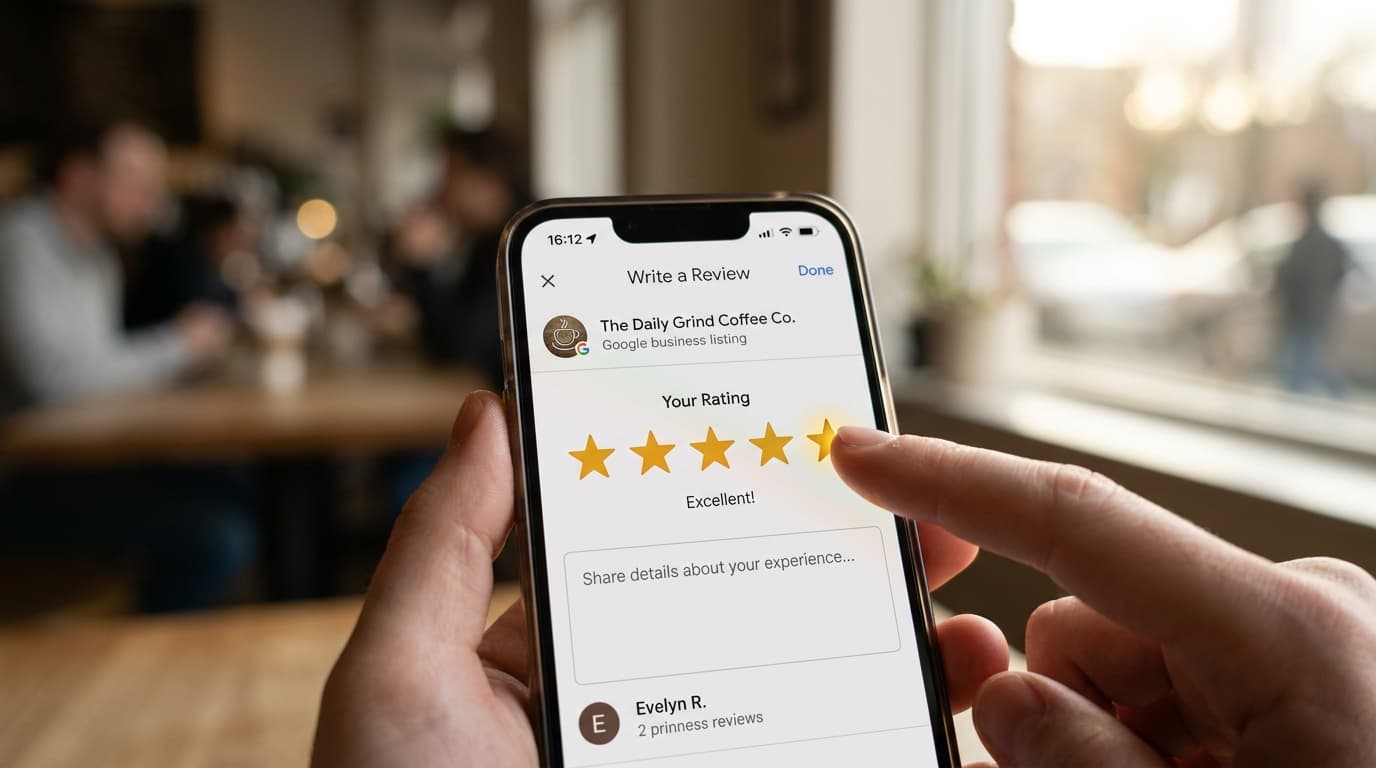
Your restaurant is busy every weekend. The food is excellent. Customers leave smiling. And yet your Google profile is stuck at 47 reviews — the same number it had six months ago — while a competitor two streets over keeps adding new ones every week.
This gap is almost never the result of a bad customer experience. It's the symptom of a broken collection mechanic. Google reviews don't arrive on their own: they come from a specific moment, a specific process, and the presence — or absence — of friction.
Here are the seven mistakes most local business owners make, and what to do instead.
Mistake 1: Asking at the wrong moment
When you ask for a review may be the single most important factor in your conversion rate — and it's the one most businesses get wrong.
Most requests happen at the point of payment. That's the worst possible timing. The customer is in "exit mode": calculating the tip, finding their card, mentally moving on to whatever comes next. Their attention is on the door, not on opening Google.
The ideal window sits just before that exit moment — while satisfaction is still at its peak but the customer hasn't yet started winding down. In a restaurant, that's typically the 5–10 minutes before they ask for the bill. In a salon, it's when the client is looking in the mirror at the finished result. In a retail shop, it's during wrapping or bagging.
Fix it: Identify the "peak satisfaction moment" in your customer journey. That's where your review invitation belongs — not at the register.
Mistake 2: Making the process too complicated
"Could you leave us a Google review? Just search for our name..." Anyone who has guided a customer through that process knows how it ends: a polite nod, a vague "sure, of course," and no review the next day.
The research on behavioural drop-off is unambiguous: every additional step in a process roughly halves completion rates. Searching for your business on Google, finding the right listing, navigating to the review section, choosing a star rating, writing a comment — that's five to six actions for someone who just finished a meal and has no particular motivation to complete an administrative task.
Fix it: Reduce the number of steps to one: scan a QR code that opens directly to your Google review page. Friction drops by 80%, and conversion rates follow.
Mistake 3: Only training one or two people
In most businesses, review requests depend on the initiative of a single person — often the owner or one particularly motivated member of staff. On the days that person is off, no one asks. The result is an erratic collection pattern: a good week here, weeks of silence there.
Data from review collection platforms consistently shows that consistency is a stronger driver than effort spikes. A business that generates five reviews every week for 12 months structurally outperforms a competitor who collects 50 in one burst and then nothing for five months — both in terms of Google's local ranking algorithm and consumer trust signals.
Fix it: Make review requests a team-wide service standard, not an individual initiative. It should be as routine as thanking guests on the way out. Train everyone — including seasonal staff — and build it into onboarding.
Mistake 4: Not giving customers a reason to act right now
A satisfied customer genuinely intends to leave you a review. That intention has a half-life of roughly 5–15 minutes after they walk out the door. Once they're outside — checking their phone, getting in the car, catching up with whoever they're with — the impulse is gone. The probability that they'll return to Google later that evening on their own initiative is close to zero.
This isn't a loyalty issue. It's basic behavioural psychology: intentions without an immediate trigger don't convert. What the customer needs is a reason to act now, while they're still in front of you.
Fix it: Build an immediate trigger into the moment. Gamification is the most effective tool here: invite the customer to leave a review, then spin a digital fortune wheel for a chance to win something (a free drink, a discount on their next visit, a dessert). The anticipation of the reward holds their attention long enough for the review to be submitted — and transforms a favour into something genuinely fun.
Mistake 5: Having an incomplete Google Business Profile
Few operators connect the state of their Google Business Profile to their review collection rate — but the link is real. A listing with no recent photos, an outdated description, approximate opening hours, or the wrong business category signals neglect. A customer who's on the fence about leaving a review is more likely to abandon the idea if the profile itself looks like an afterthought.
The reverse is also true: a well-maintained listing — quality photos, an accurate description, responses to existing reviews — signals that the business takes its online presence seriously. That signal actively encourages new contributors.
Fix it: Set aside two hours to audit and complete your Google Business Profile. Upload at least ten recent, high-quality photos. Fill in every field. Make sure your hours are current, including public holidays. This is a one-time task that improves the effectiveness of everything you do to collect reviews afterward.
Mistake 6: Not responding to existing reviews
Imagine leaving a comment on a friend's post and getting no reply — ever — even though other people comment all the time. You'd be less likely to comment again. The same dynamic applies to Google reviews.
Businesses that respond consistently to their reviews — positive and negative — send a clear signal: feedback is read, acknowledged, and valued. That signal encourages new customers to contribute. Conversely, a listing with 200 reviews and zero responses communicates that nobody in the building cares what customers write.
Google's local ranking algorithm also considers listing activity. Operators who respond regularly tend to see better positions in Maps results over time.
Fix it: Block 15 minutes each week to respond to all new reviews. For positive ones, a short, personalised reply is enough. For negative ones, a calm, factual response that offers a resolution is far more effective than silence — or a defensive reply that escalates the situation.
Mistake 7: Relying on chance instead of a system
The biggest mistake isn't a badly timed request or a confusing process — it's having no system at all. Asking for reviews "when you remember," "when the evening goes well," or "when a customer seems particularly happy" produces random results at best, and nothing most of the time.
The businesses that accumulate hundreds of reviews quickly don't necessarily have better products than you. They have the same customers you do. What they have that you don't is a repeatable, consistent process.
An effective review collection system has four components: a clear trigger (when to ask), a physical touchpoint (QR code, table display), an incentive (gamification, prize draw), and a feedback loop (a weekly check of new review volume and average rating). Remove any one of those components and the others lose most of their power.
Fix it: Formalise your process once. Define the moment, the tool, the incentive, and the person responsible for weekly tracking. A simple system applied consistently will always outperform a brilliant idea executed sporadically.
All seven of these mistakes are fixable — often within a week, without significant investment. None of them require changing your product, hiring extra staff, or overhauling your communication strategy. They require a system.
Ludofy is built to eliminate six of these seven mistakes in one move: a digital fortune wheel activated by QR code at the right point in the customer journey, combining an immediate trigger, near-zero friction, and a built-in incentive in a single mechanic. Setup takes under thirty minutes, and the first new reviews typically arrive the same day.
If your Google profile doesn't reflect the quality of what you actually deliver, you now know why — and you know how to close that gap this week.