December is the busiest month of the year for most customer-facing businesses — and paradoxically one of the most neglected when it comes to Google Review collection. Restaurants are fully booked, retail stores see double or triple their usual foot traffic, hotels fill with families and corporate parties. Yet the typical local business ends December with roughly the same number of reviews it had in November.
That is a costly missed opportunity. The holiday season creates a perfect storm of conditions that make customers more likely than usual to leave a review: elevated emotions, first-time visits from friends and family of regulars, the natural human desire to celebrate and share. What is usually missing is the right prompt at the right moment.
Why the Holiday Season Is Your Highest-Leverage Review Window
The math is straightforward. If your business serves 300 customers in a typical November week and 500 in a December week, every percentage point of review conversion rate represents more in December than it does the rest of the year. Even a modest lift in your collection system yields a disproportionate return during this period.
But the real leverage is algorithmic. Google's local ranking system weights recent reviews more heavily than older ones. A business that collects 30 genuine reviews in December enters January with a freshness advantage over competitors who coasted through the holidays. Those reviews are still recent when potential customers search for a Valentine's Day dinner, a birthday brunch, or a retail gift in February.
There is also an audience quality argument. December visitors are often first-timers — the friend of a loyal regular who comes for a holiday dinner, the tourist spending a long weekend, the colleague who discovers your café during a team outing. First-time visitors who have a great experience are ideal review writers: they have something genuinely new to say, and their review carries credibility precisely because they have no prior relationship with your business.
The Specific Challenges of December Review Collection
None of this happens automatically. December introduces three frictions that do not exist the rest of the year.
Team overload. Your front-of-house staff is managing higher volumes, more complex reservations, and emotionally charged situations. Asking them to verbally request a review from every customer is unrealistic. They will not do it consistently, and when they try, it often comes across as rushed or mechanical.
The post-dinner dispersal problem. Holiday meals typically end in a collective euphoria. Groups gather their coats, say their goodbyes, and are out the door in minutes. The window between "bill paid" and "left the building" is shorter than on a quiet Tuesday, and opening Google Maps is not on anyone's mind.
Review fatigue from other channels. November and December are peak periods for email marketing, loyalty program communications, and social media campaigns. Customers are receiving more digital requests than usual. A fifth "please review us" email gets ignored.
The solution to all three is the same: a passive, in-person collection system that your team does not need to operate and your customers do not need to feel solicited by.
Building Your Holiday Review System Before December 1st
If you deploy nothing new before December, you will collect the same number of reviews as always. The preparation window is now — in the final days of November.
Update your Google Business Profile with holiday hours. This is not glamorous, but it is urgent. Incorrect hours during the holidays generate one-star reviews from customers who showed up when you were closed. Update your hours for every exception: Christmas Eve, Christmas Day, New Year's Eve, New Year's Day, and any other closure or reduced-hours day. Add a holiday photo to signal that the profile is current.
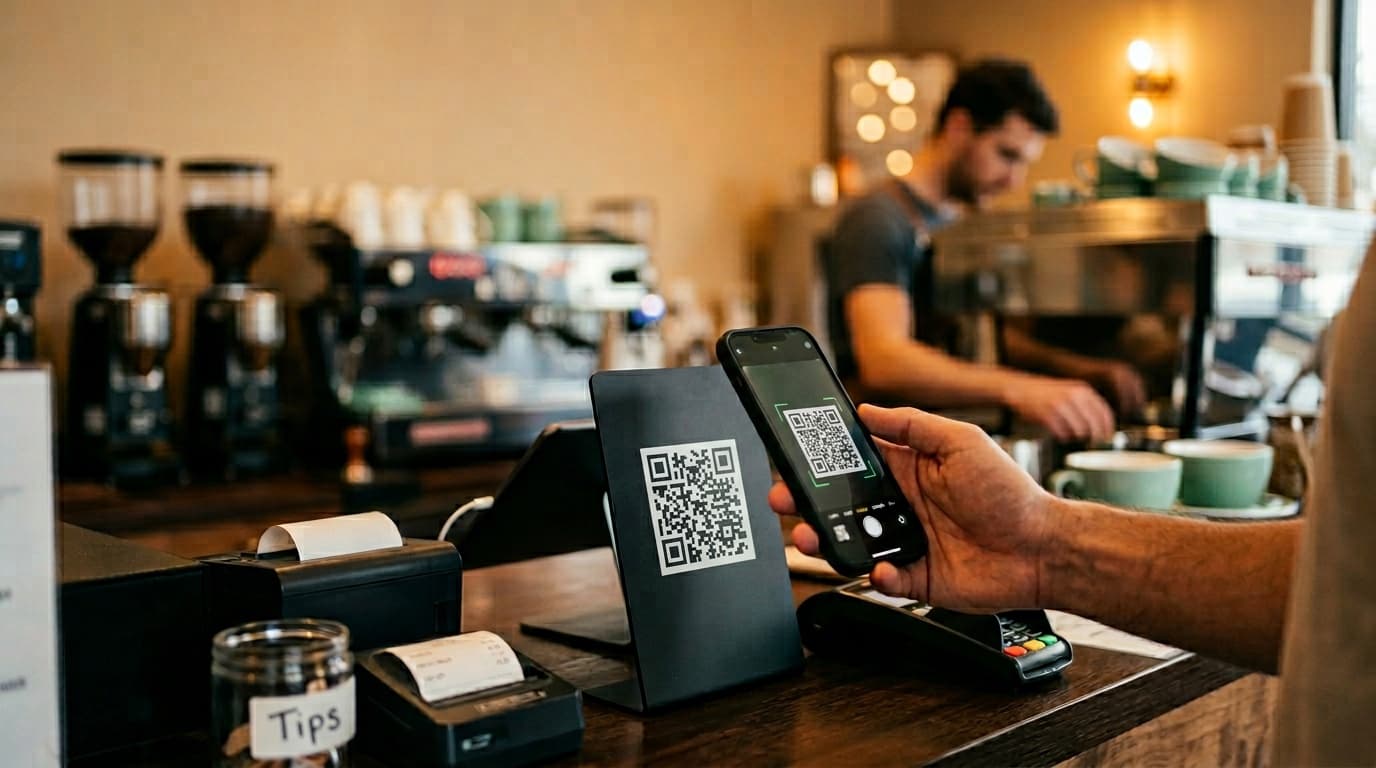
Audit your QR code touchpoints. Count every table, counter, checkout station, and waiting area where a QR code could sit. Each is a silent sales rep. Consider replacing generic QR code cards with seasonal versions — a small card printed on kraft paper with a star motif that says "Enjoyed your evening? Tell us about it." blends into the holiday atmosphere instead of looking like a corporate ask.
Brief your team in two minutes. You do not need a training session. You need one sentence: "If a customer mentions they loved it, point to the QR code and say it helps us a lot." That is the entire ask. Your staff does not need to actively push; they just need to remove the friction when the moment arises naturally.
Design a holiday-specific incentive. The festive period is the ideal time to attach a small reward to the review-collection flow. A holiday-themed prize wheel — spin to win a complimentary dessert, a mulled wine, a 10% discount on their next January visit — matches the spirit of the season far better than a generic discount offer. Customers in December are already in a giving and receiving mindset. A playful, low-stakes gamification mechanic converts at dramatically higher rates than a plain "please review us" prompt.
Holiday-Specific Collection Tactics That Work
The festive fortune wheel. A QR code that leads to a branded spin-the-wheel experience, with holiday-themed prizes and a review as the entry condition, is the single highest-converting tactic for this period. Platforms like Ludofy allow you to customise the wheel's visual theme, prizes, and the redirect to your Google review page. Businesses deploying this mechanic in December consistently report that 20–30% of customers who scan the code complete a review — compared to under 5% for a verbal request alone.
Table cards with seasonal framing. A card that reads "Before you go — a moment of your time means the world to us this holiday season" positions the review request as a human act of reciprocity rather than a business transaction. The phrasing matters. "Help us spread the word" outperforms "Please leave us a review" because it frames the customer as a generous contributor rather than a surveyed subject.
The take-away reminder. For retail and hospitality businesses where customers leave with a bag or a printed receipt, a small insert card — roughly the size of a business card, printed in festive colors, with a QR code and a warm thank-you message — travels home with the customer and captures late-evening reviews from people who wanted to but forgot before leaving.
Staff recognition as a secondary driver. Some businesses motivate team members by displaying a live count of reviews collected this month in a staff area. When service teams see that Tuesday's shift brought in four reviews and Friday's brought in one, they naturally calibrate their engagement. This is a soft driver, not a commission scheme, but it works because it makes the abstract tangible.
Responding to Holiday Reviews: The Opportunity Most Businesses Miss
Every review you receive in December is a public conversation happening in front of potential customers planning their own holiday outings. How you respond to those reviews signals whether your business is worth visiting.
A review that says "had the most magical Christmas dinner here — the staff made us feel so welcome" deserves a response that is warm, specific, and human. Acknowledge the occasion. Thank them for celebrating with you. Mention that you hope to see them again. This takes 45 seconds and makes an enormous impression on the dozen or so people who read it before making their reservation decision.
Avoid templated responses during this period above all. A copy-pasted "Thank you for your feedback, we hope to see you again" under a glowing Christmas review reads as tone-deaf. It signals that no one is actually reading the reviews — which undermines the credibility of the reviews themselves.
If you manage multiple locations, assign a holiday-review-response shift to one team member per location, running Monday to Friday throughout December. Even a 15-minute daily review of incoming feedback and a few personalised responses is enough to maintain a human presence.
Turning December's Momentum Into January and Q1 Growth
The return on a December review push does not plateau on January 1st. It compounds.
Google's freshness weighting means your December reviews are still young — and therefore more influential — in January, February, and March. A competitor who ignored the holiday season now has to catch up. You enter the new year with a lead.
The reviews themselves become content. A five-star note describing your restaurant as "the best New Year's Eve we've had in years" is a powerful social proof asset for Valentine's Day promotions. Pull your best December reviews and feature them in your January email newsletters, your Instagram stories, and your Google Business Profile posts.
Finally, consider a brief follow-up outreach in mid-January to customers who visited in December but did not leave a review. A warm, personal message — "We hope the holidays treated you well — if you enjoyed your visit with us in December, your review helps more people discover us in the new year" — converts surprisingly well because it carries a genuine personal quality that generic review requests lack.
Ludofy was built for exactly this kind of seasonal leverage: a gamified review collection system you can deploy in hours, customise to your holiday branding, and activate across every touchpoint where customers interact with your business. If December is coming, the time to set it up is today.