A busy fast-food location serves between 300 and 900 customers on a typical weekday. That's more foot traffic than most sit-down restaurants see in a week. And yet the average QSR Google listing sits at 4.1 stars with around 80 reviews — while the bistro two blocks away, serving a fraction of the covers, often has twice the review count.
The gap isn't caused by dissatisfied customers. It's caused by a structural mismatch between the rhythm of quick service and the systems most operators use to collect reviews. Fix the structure, and the volume advantage that defines fast food becomes a review engine that's almost impossible for competitors to replicate.
Why QSRs Have a Review Collection Problem
The answer isn't apathy — it's timing and friction.
In a full-service restaurant, there's a natural window at the end of the meal. The bill arrives, conversation winds down, customers linger. That's the moment a review request lands most naturally. In a QSR, the experience moves from order to eat to leave in under eight minutes. There is no natural pause. The meal ends when the customer stands up, throws out their wrapper, and walks out — a transition that doesn't invite reflection.
Three compounding factors make this worse for QSRs specifically:
No dedicated relationship layer. Servers in traditional restaurants build micro-relationships during service that can make a review request feel personal. In fast food, the interaction is transactional by design. There's no "Hailey, the server who remembered my order" to inspire a five-star moment — the experience is the food and the atmosphere, nothing more.
Staff are operationally maxed out. A QSR team at lunch rush is managing queues, orders, and throughput simultaneously. Asking them to verbally prompt every customer for a Google review adds a step they physically cannot execute consistently, especially during peak hours.
Loyalty is often brand-level, not location-level. A customer who loves your brand may rotate between three different locations in a month. Their loyalty doesn't translate naturally into a review for your specific address.
The result: solid satisfaction numbers, and a Google listing that doesn't reflect them.
The Two Windows That Actually Work
Rather than retrofitting the verbal review request that works in sit-down restaurants, QSRs need touchpoints that do the work passively — intercepting the customer where they already are.
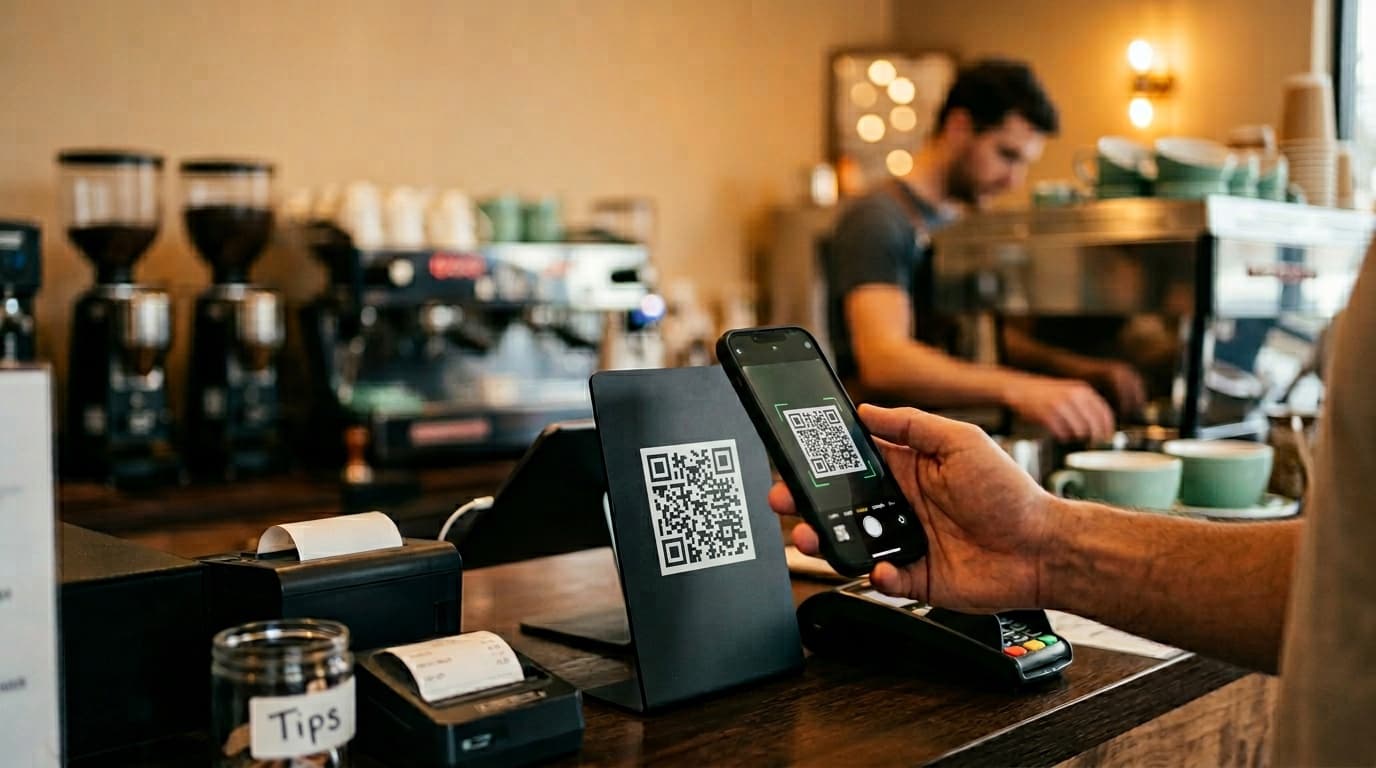
At the payment counter. This is the highest-intent moment in any QSR visit. The customer has their phone out (to tap, scan, or check their app), the transaction is completing, and attention is briefly available. A QR code on the counter display, the receipt, or the POS card reader with a short visual — "Scan to win — takes 30 seconds" — captures that window precisely.
On the tray, bag, or packaging. In eat-in visits, the customer sits with their tray in view for three to five minutes. That's a longer window than the checkout moment, and one of the few genuine pauses in the QSR experience. A tray insert, a card tucked into a takeout bag, or a sticker on the packaging intercepts a moment of calm that's otherwise wasted. For takeout and delivery orders, that card reaches the customer at home — when they're unwrapping and genuinely relaxed.
Neither touchpoint requires staff to say anything. The physical materials do the work.
Why Standard QR Codes Underperform — and Gamification Changes Everything
A QR code pointing to a plain review request page converts at roughly 2–4% in a QSR context. The emotional connection isn't strong enough to justify the effort of opening a form and writing something. Most people scan, read "Leave us a Google review," and put their phone away.
A gamified experience changes that dynamic fundamentally. Instead of asking customers to do something for your benefit, it gives them a personal reason to act.
The mechanic:
- Customer scans the QR code (on tray, counter, or bag)
- They leave a Google review
- They return to the page and spin a digital prize wheel
- They instantly win a reward — free fries on their next visit, a free drink, a discount, or another offer aligned with your margins
This reframes the entire transaction. The customer isn't leaving a review out of goodwill — they're playing a game with a personal upside. In a QSR context where the emotional bond to a specific location is weaker than in a neighbourhood restaurant, this change in framing matters enormously.
The results are clear. Fast-casual concepts running gamified review flows consistently outperform standard request systems by a factor of three to five times in monthly review volume. One well-known European fast-food chain generated 3,000 Google reviews in 20 days after deploying a wheel mechanic across their locations — a number that would take years to reach with passive collection.
Building a Prize Structure That Works for QSR Economics
Fast-food margins are tighter than full-service restaurants, which means prize selection requires precision. The goal is high perceived value for the customer at low actual cost to you.
High-performing QSR prizes:
- Free fries or side with next order (low cost, high perceived value, drives return visit)
- Free drink with next visit (clear CTA, easy to condition on minimum spend)
- 15% off next order (condition on minimum purchase amount to protect margins)
- Free dessert or snack item (impulse-value item, minimal margin impact)
- Free size upgrade (costs almost nothing, feels generous)
Prizes to avoid:
- Free full meals (high cost, easy to abuse without a robust verification system)
- Cash-equivalent discounts with no minimum spend condition
- Any prize requiring manual staff verification at the counter during service
Target a cost per review of €0.50 to €1.50 in real prize value distributed. With research consistently showing that one additional Google star correlates with a 5–9% revenue increase, the return on that investment is clear from the first month.
Integrating Review Collection Without Adding Operational Burden
The critical constraint in QSR is that any system requiring consistent staff execution will fail during peak periods — and peak periods are when you're serving the most people. The system needs to run without them.
Deploy permanent physical touchpoints. Tray liners, receipt messaging, bag stickers, counter standees, small table cards in eat-in areas. Print them once, install them, and they work continuously with no ongoing staff involvement.
Don't overlook takeout and delivery. A printed card in every bag reaches customers in a completely different context — at home or in their car, with full attention rather than standing at a busy counter. This is a separate review wave that many QSRs leave entirely untapped.
One line, not a script. If your team culture supports it, a single informal mention at handoff boosts results measurably: "There's a game on your receipt — you might win something." That's it. No pressure, no memorization, and it adds 15–20% to conversion without feeling rehearsed.
Track weekly, not monthly. In QSR, you think in daily and weekly numbers. Apply the same cadence to your review metrics:
| Metric | Target |
|---|---|
| New reviews per month | 50+ minimum |
| Average rating | Maintain ≥ 4.3 stars |
| Response rate | 100% within 48 hours |
| Reviews with written content | > 50% |
Reviews containing text carry more weight in Google's ranking algorithm than star-only ratings, and they convert prospective customers far more effectively. If you're seeing mostly star-only reviews, add a nudge to your QR code prompt: "Tell us what you ordered — it helps others find us."
The Compounding Effect of High-Volume Review Collection
A QSR with 400 covers per day and a gamified review system capturing just 3% of customers generates roughly 360 new reviews per month. After six months: 2,000+ reviews. At that volume, you appear in local map results where competitors with 100 reviews simply don't rank.
Customers searching "fast food near me" or "burger [neighbourhood]" on Google Maps click the listing with the most reviews and the highest recent activity. At 2,000 reviews you stop being an option and become the obvious first choice. That compounding is the real prize — not any individual review.
The challenge is that this flywheel only starts if you start. Competitors who activate a review system in month one will have a six-month head start that's difficult to close through volume alone.
Ludofy was built to activate exactly this flywheel for QSR operators. The gamified fortune wheel connects to your QR code, runs automatically across every touchpoint you set up, and generates reviews daily without requiring ongoing management. Setup takes under 15 minutes, and the first reviews typically arrive within 48 hours of going live.
Your customer throughput is already the asset. You just need the system to convert it.