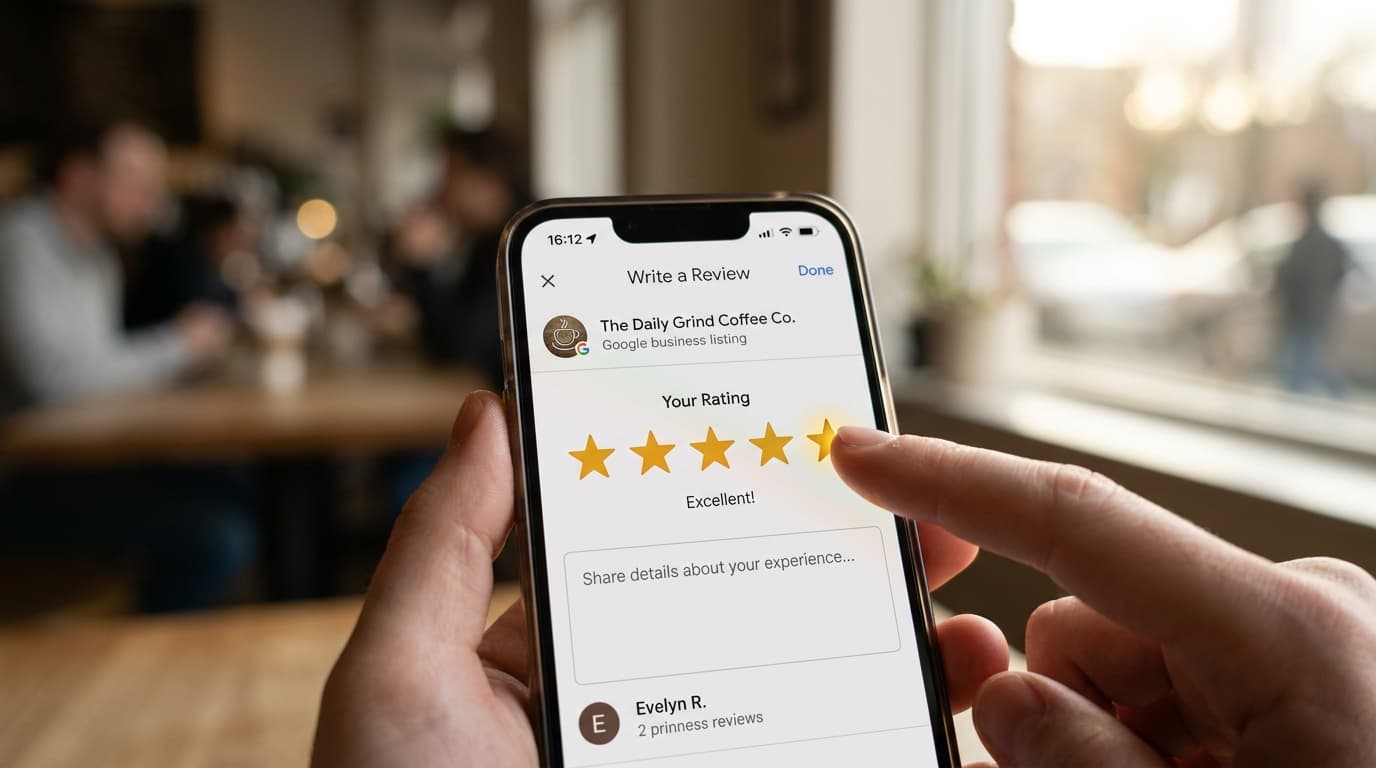
Why Google Reviews matter more for law firms than you think
When someone urgently needs a lawyer — after a car accident, a business dispute, or a family separation — they don't ask friends first. They open Google Maps and search "lawyer near me." In that moment, your star rating and review count can make or break whether they call you or your competitor across town.
A 2025 survey found that 87% of people look at online reviews before contacting a professional service provider. For lawyers, where trust is the entire product, this number is even higher. A firm with 4.8 stars and 45 reviews will consistently outperform a firm with better lawyers but a near-empty or mixed review profile — simply because most prospective clients never look past the first three results in Google Maps.
Beyond individual client decisions, Google Reviews directly influence your Local Pack ranking — those three businesses that appear in the Google Maps box above regular search results. Practices with more frequent, higher-quality reviews appear higher in those results. In competitive urban markets, a 0.3-star difference can mean the difference between visible and invisible.
The unique challenge: professional conduct rules
Lawyers face a constraint other local businesses don't: professional conduct rules set by bar associations and law societies. These rules vary by country and jurisdiction, but they generally prohibit:
- Paying or offering any form of incentive in exchange for reviews
- Making misleading claims about your practice in how you solicit reviews
- Contacting former clients in ways that could be seen as harassment or undue influence
This doesn't mean you can't ask for reviews — it means you need to ask cleanly. A simple, sincere request at the conclusion of a matter, with no pressure and no promise of reward, is acceptable in virtually every jurisdiction.
Before launching any review collection campaign, verify the specific rules of your bar association or law society. When in doubt, consult your professional indemnity insurer or a colleague specialising in professional conduct.
When is the right time to ask a client for a review?
Timing is everything in legal practice review collection. Unlike a restaurant where the meal just ended, a legal matter can span months — and the emotional context of the client varies wildly depending on where they are in the process.
The best moments to ask:
- At case closure, when you confirm a successful outcome to the client (settlement reached, will signed, contract completed)
- At the final invoice conversation, when the engagement is clearly concluded and the client is satisfied
- During a follow-up call a few weeks after closure, when the client has had time to reflect on the whole experience
Moments to avoid:
- During active litigation or contentious proceedings
- Immediately after delivering bad news (an unfavourable verdict, a failed negotiation)
- When the client is visibly distressed or emotionally raw
Family law, criminal defence, and immigration cases require particular sensitivity. In these areas, wait until the matter is fully resolved and the client has had time to re-stabilise before any review request. If in doubt, skip the request — a missed opportunity is better than an uncomfortable interaction that damages the relationship.
How to ask without it feeling transactional
The way you frame a review request dramatically affects whether you get a response — and what kind. Avoid scripted or impersonal requests; they read as corporate and usually get ignored.
By phone: "I'm really glad we got that result for you. A lot of people find us through Google, and if you're happy with the work we did together, a review there would genuinely help others in a similar situation find us. I'll send you a direct link to make it easy."
By email: Keep it brief. One or two sentences explaining that reviews help new clients find the firm, followed by a direct link to your Google review page. No long preamble, no checkbox list — just a clean, personal note that takes thirty seconds to read.
In person at the office: Place a small QR code card on your desk or at reception. "We have a QR code here that takes you straight to our Google page if you'd like to share your experience." It's a softer ask and many clients find the spontaneity natural — they scan it while waiting for the lift.
Using QR codes in your law firm
QR codes solve the biggest friction point in review collection: getting the client to navigate to your Google profile without getting lost along the way. A QR code placed on the right surface takes a client straight to your review page in one tap.
Good placements in a law office context:
- On a small card included with closing documents or the final invoice
- At the reception desk, where clients wait before and after appointments
- On the firm's email signature (as a clickable link for desktop users)
- On the cover sheet of the closing letter, above your signature
Avoid cluttering every surface. One well-placed, well-timed ask is more effective than four mediocre ones spread across the office.
Tools like Ludofy let you generate branded QR codes linked directly to your Google review page. Setup takes under an hour, and the code can be printed on any surface — business cards, folders, thank-you notes. For firms that want to understand which placement drives the most scans, Ludofy's dashboard tracks engagement by QR source, so you know whether reception cards outperform closing-letter cards.
How to respond to Google Reviews as a law firm
Responding to reviews is as important as collecting them. Google surfaces your responses publicly, and potential clients read them carefully — especially responses to negative reviews. How you handle criticism in public says more about your firm than the criticism itself.
Responding to positive reviews: Thank the reviewer briefly and personally, without using their name or any case-identifying information. A response like "Thank you — it was a privilege to assist you through that process. Wishing you all the best." is appropriate and signals attentiveness without breaching confidentiality.
Never confirm or deny the reviewer is a client. Even in a positive review response, confirming that someone engaged your services can, depending on jurisdiction, constitute a disclosure of confidential information. Keep responses warm but deliberately neutral about the specifics of the engagement.
Responding to negative reviews: Stay composed and professional. Acknowledge that the experience fell short of your standards without defending the outcome, arguing about facts, or asking questions about the matter in a public reply. Invite the reviewer to contact you directly to resolve their concerns.
A template that works across most situations: "We take client feedback seriously and I'm sorry this wasn't the experience you expected. Please contact me directly at [email] and I'll personally look into this."
Never respond in a way that reveals case details, even to correct a factual error — you'd be disclosing confidential information to prove a point in a public forum, which creates a far larger problem than the original review.
Building a sustainable review strategy
Sporadic bursts of review collection followed by long silences hurt more than they help. Google's algorithm places significant weight on review freshness. A firm that collects 20 reviews in January and nothing for eight months will rank below a competitor who consistently gets two or three reviews per month.
The most sustainable model doesn't rely on individuals remembering to ask — it relies on a system:
-
Systemise the ask — build a standard review request step into your file closure process. Whoever sends the closing letter or makes the final call has a checklist item: send the review link.
-
Track by fee earner — in larger firms, different partners and solicitors have different client relationships. Track which matters close without a review request and address gaps with individual fee earners in supervision meetings.
-
Respond within 48 hours — make review monitoring part of a weekly admin routine. Unanswered reviews signal to Google and to prospective clients that your firm is passive about client relationships.
-
Set a realistic target — two new reviews per month is a defensible and sustainable target for a small to mid-sized practice. It keeps your profile fresh without creating compliance risk through overly aggressive solicitation.
The competitive edge your firm is missing
Most law firms in your market are not actively collecting Google Reviews. This isn't because they don't value their reputation — it's because they haven't built a simple system for asking. That gap is your opportunity.
A consistent, ethical approach to Google Reviews — timely asks, clean links, professional responses — will compound over time into a meaningful competitive advantage. Ludofy helps law firms and professional service businesses build exactly that system: a branded QR code, a streamlined review landing page, and a dashboard to track results across locations or practice areas.
The firms with the strongest online reputations in your local market didn't get there by accident. They built a process, they trained their staff, and they kept it running. Now is the best time to start doing the same.