Why your Google rating needs to be ready before the busy season
Most local business owners think about Google reviews reactively — they notice the problem when a competitor outranks them right before Christmas, Valentine's Day, or the summer rush. By then, it's too late.
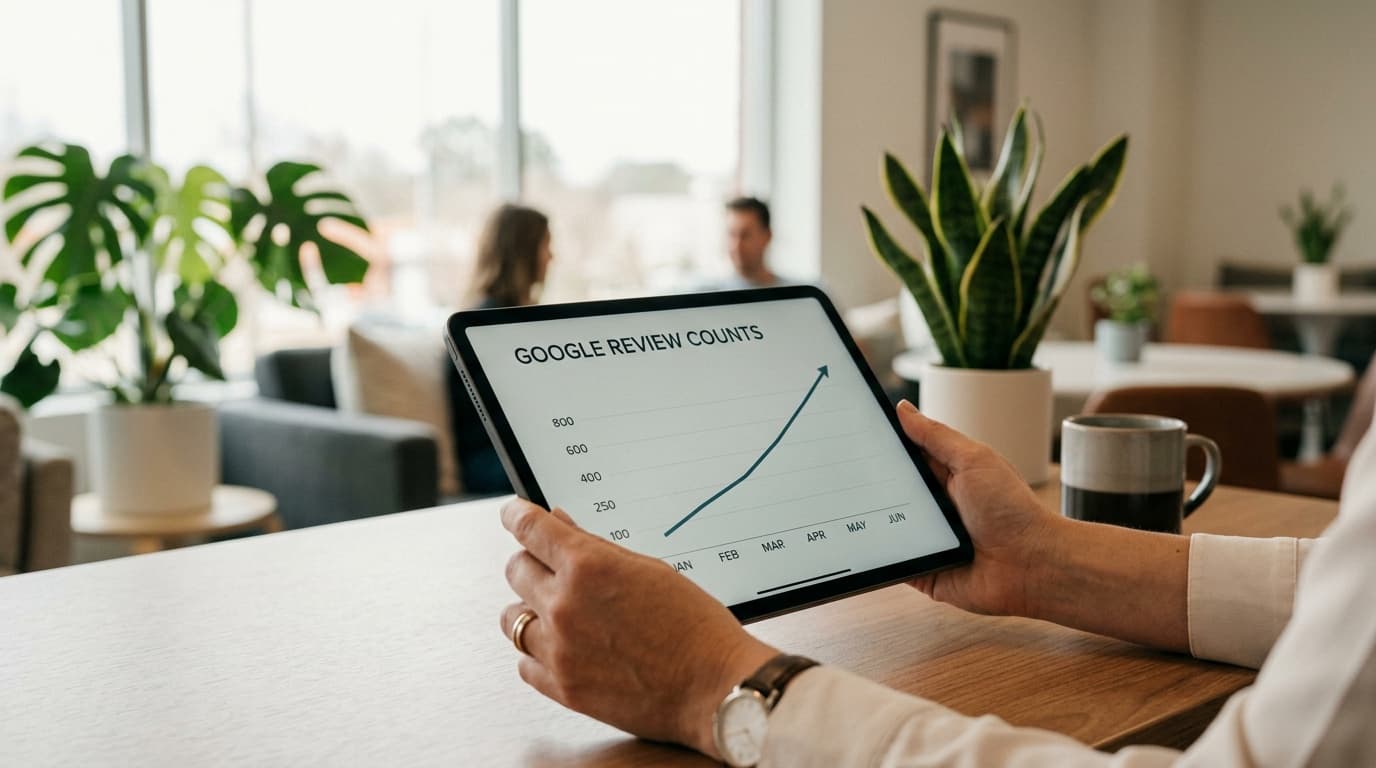
Building a strong review count isn't a weekend project. It takes consistent effort over six to eight weeks. And during peak season, when a tourist is choosing between two restaurants on Google Maps or a local is picking a florist for a wedding, your star rating is often the deciding factor in under ten seconds.
Treating your online reputation as a seasonal asset — something you actively prepare, like staffing or inventory — changes everything.
The four peak periods worth preparing for
Every business has its own rhythm, but some periods are almost universally high-stakes.
Christmas and year-end holidays (November–December)
For restaurants, hotels, gift shops, florists, and chocolatiers, this is the busiest stretch of the year. Google searches for "restaurant Christmas dinner," "hotel New Year's Eve," or "gift shop near me" start climbing in early November. If you haven't built your review count by late October, you're already behind.
Target: At least 40–60 fresh reviews (posted within the last 90 days) before December 1st.
Valentine's Day (January–February)
The most booked dining night of the year. Florists, beauty salons, hotels, and intimate restaurants all see a significant spike. Searches begin in mid-January. Reviews that specifically mention ambiance, service quality, and the romantic experience give you a natural edge in search results.
Target: Reviews containing experiential keywords — "romantic," "perfect for couples," "exceptional service" — which signal relevance to Valentine's-specific searches.
Summer season (May–June)
For coastal restaurants, hotels, ice cream shops, food trucks, and activity centers, summer can represent 60–70% of annual revenue. Tourists who don't know you rely almost entirely on Google Maps to decide where to go. A rating above 4.5 with 100+ reviews is the threshold that triggers trust from first-time visitors with no local knowledge.
Target: Pass the 100-review mark and reach 4.5+ stars before June 1st.
Back-to-school (August–September)
Often underestimated, this period drives strong demand for hair salons, beauty institutes, tutoring centers, pharmacies, and children's activity centers. Families returning from vacation reassess their regular providers — and often try new ones for the first time. Being visible with a strong rating during this transition can win long-term loyal customers.
Your 8-week action plan before peak season
Weeks 1–2: Audit your current standing
Before you can improve, you need to know where you are. How many total Google reviews do you have? What's your current average rating? How many reviews per week are you receiving on average? Where does your nearest competitor stand?
Set a specific, measurable goal: "I want to go from 72 reviews and 4.2 stars to 120 reviews and 4.6 stars before November 15th." A vague intention stays a vague intention.
Weeks 3–4: Activate passive collection channels
Make it easy for satisfied customers to leave a review without being directly asked:
- QR code at checkout or on the receipt — the moment of payment is often peak satisfaction
- QR code on tables or in hotel rooms — available while customers are still on-site
- Link to your Google listing in your email footer and social media profiles
- Instagram story inviting followers to share their experience
These passive channels won't explode your numbers overnight, but they create the consistent drip of reviews that Google's algorithm rewards.
Weeks 5–6: Add gamification
This is where results accelerate dramatically. Instead of asking politely for a review — which everyone does and almost no one converts — give customers a reason to engage that's genuinely fun.
A fortune wheel tied to a QR code is the most effective tool for this. The customer scans, spins the wheel for a chance to win something (free coffee, a discount, a surprise gift), and lands naturally on Google to leave their review. Conversion rates jump from the industry average of 2–5% to 20–30%, simply because the process becomes interactive rather than transactional.
Real example: A bistro in Bordeaux added a fortune wheel to their checkout process six weeks before Christmas. They collected 58 new reviews in 40 days, jumped from 4.1 to 4.7 stars, and ranked number one on Google Maps for "restaurant Bordeaux Christmas dinner."
Weeks 7–8: Train and mobilize your team
Reviews don't collect themselves — and your staff is your biggest lever. They need to understand why reviews matter and how to naturally invite customers to leave one.
Train them on two things:
- The right moment — when a customer spontaneously expresses satisfaction: "Amazing meal," "We'll definitely be back," "Best service I've had"
- The right phrase — something natural, not scripted: "If you enjoyed your visit, a quick Google review really helps us. We even have a wheel you can spin at the counter!"
Track weekly progress as a team. Who contributed the most this week? Celebrate the wins out loud — it reinforces the behavior.
Common mistakes to avoid
Starting too late. Google's algorithm values consistency. A sudden spike of 30 reviews in 48 hours may be filtered as suspicious. Spread your effort over six to eight weeks.
Chasing only 5-star reviews. A mix of 4- and 5-star reviews reads as more authentic than a parade of perfect scores. Don't discourage honest feedback — it makes your profile look real.
Ignoring your existing reviews. Responding to every review (positive and negative) signals to Google that you're an active, engaged business. Do this before peak season. Unanswered reviews, especially negative ones, read as neglect.
Offering rewards for positive reviews. Google's policy explicitly prohibits exchanging incentives for review content. The right approach: offer a reward for the act of participating (spinning the wheel), not for what the customer writes. That distinction matters legally and practically.
Tracking your progress
Monitor weekly:
- Total review count
- Average star rating
- Number of reviews posted in the last 90 days (freshness matters as much as volume)
- Your Google Maps position for key search terms
If you're off track at the halfway point, intensify team reminders and test a new channel — email, WhatsApp, or a table tent card with a QR code.
How Ludofy helps you prepare for peak season
Ludofy was built for exactly this kind of preparation. By combining a customizable fortune wheel, a dedicated QR code for your business, and a real-time review tracking dashboard, it gives restaurants, hotels, shops, and salons a structured way to collect three to five times more reviews than manual outreach — without adding work to your team's plate.
The businesses that dominate Google Maps during peak season aren't the ones that started asking for reviews last week. They're the ones that started building their reputation eight weeks ago. The question isn't whether you should prepare — it's whether you can afford not to.