A hotel with 4.7 stars and 280 recent Google reviews will fill its rooms faster than a property with a technically superior product and 35 reviews that haven't been updated since 2023. That's not marketing theory — it's how travelers actually behave when they open Google Maps or type "hotel near [city center]" into a search bar.
The frustrating reality for most independent hotel operators is this: your guests are satisfied. Your service is good. Your rooms are clean. And your Google review count is stuck in the double digits while the chain hotel down the street — with impersonal service and mediocre breakfasts — has accumulated hundreds of reviews through sheer volume and a systematic process you don't yet have.
This guide is about building that process. Specifically, it's about turning the check-out moment — which most hotels waste — into your most effective review-collection touchpoint.
Why Google Reviews Matter More Than You Think for Independent Hotels
Hotel distribution has always been dominated by intermediaries. OTAs like Booking.com and Expedia take 15 to 20% commissions while presenting guests with options ranked by their own algorithms, not by your quality. Your Google presence, by contrast, is something you can actually influence — and it feeds directly into how travelers discover and evaluate you before they ever visit a booking platform.
When someone searches "boutique hotel in [your city]" on Google Maps, the results that appear in the top three positions share a common profile: high review counts, strong average ratings, and — critically — recent reviews. Google's local ranking algorithm treats review freshness as a signal of business activity. A property that collects 20 reviews this month looks more relevant than one that collected 20 reviews last year.
This matters for two reasons. First, it affects your organic visibility — whether you appear at all in competitive local searches. Second, it affects your conversion rate once you appear. Research consistently shows that travelers need to see at least 10 to 20 reviews before they feel confident enough to book a property they've never visited, and that conversion drops significantly when the most recent review is more than 90 days old.
Put plainly: you need a steady flow of reviews, not a one-time burst. And that requires a system built into your daily operations.
The Check-Out Moment Is Where the Review Gets Lost
Most hotels either don't ask for reviews at all, or they ask at the wrong time. A "Please review us!" email sent 48 hours after check-out might seem logical, but by then the guest has moved on. The emotional peak of a positive stay fades quickly once the suitcase is unpacked and the inbox refills.
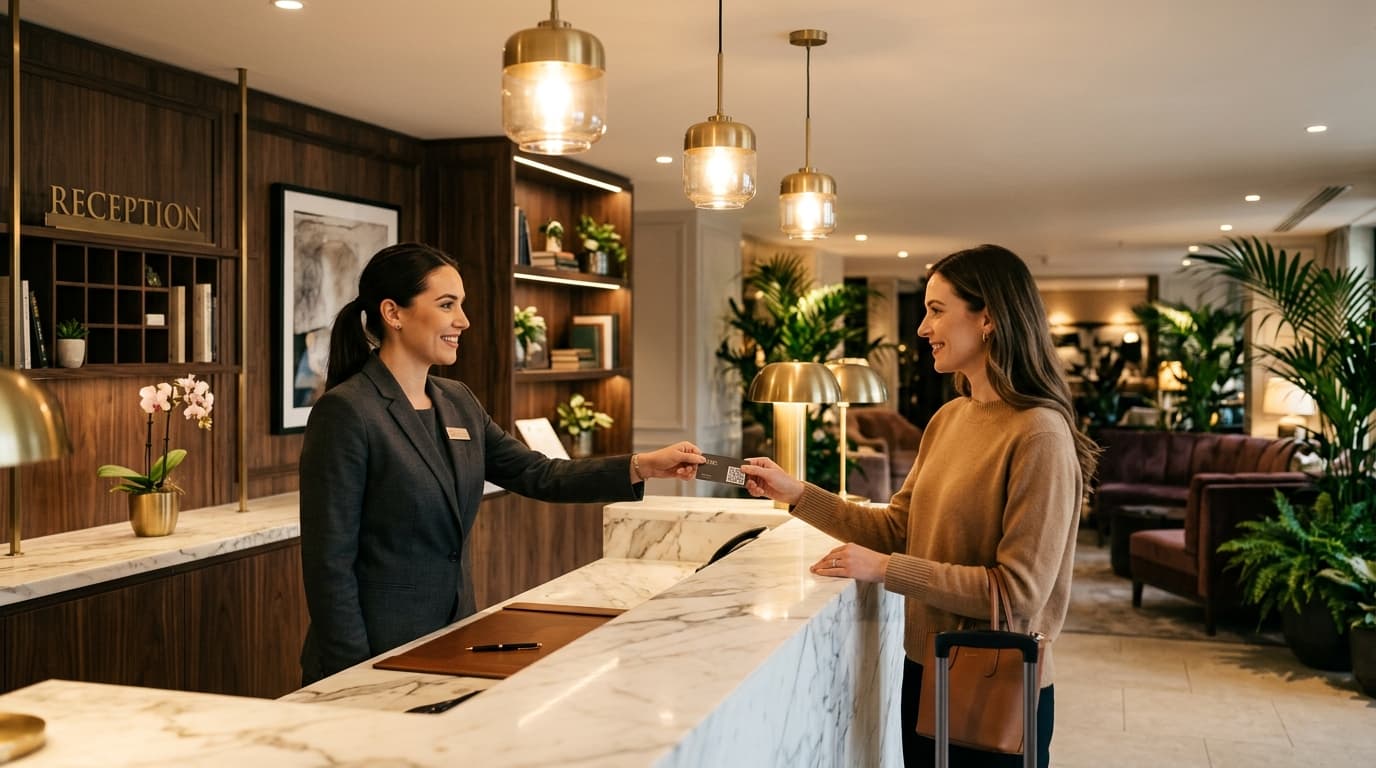
The check-out moment is different. The guest has just experienced the entirety of your product. Their satisfaction — or dissatisfaction — is at its freshest and most complete. And there's almost always a natural pause in the interaction: processing payment, reviewing the bill, waiting for a receipt. That 30-to-60 second window is the moment when a well-placed prompt can convert an intention into an action.
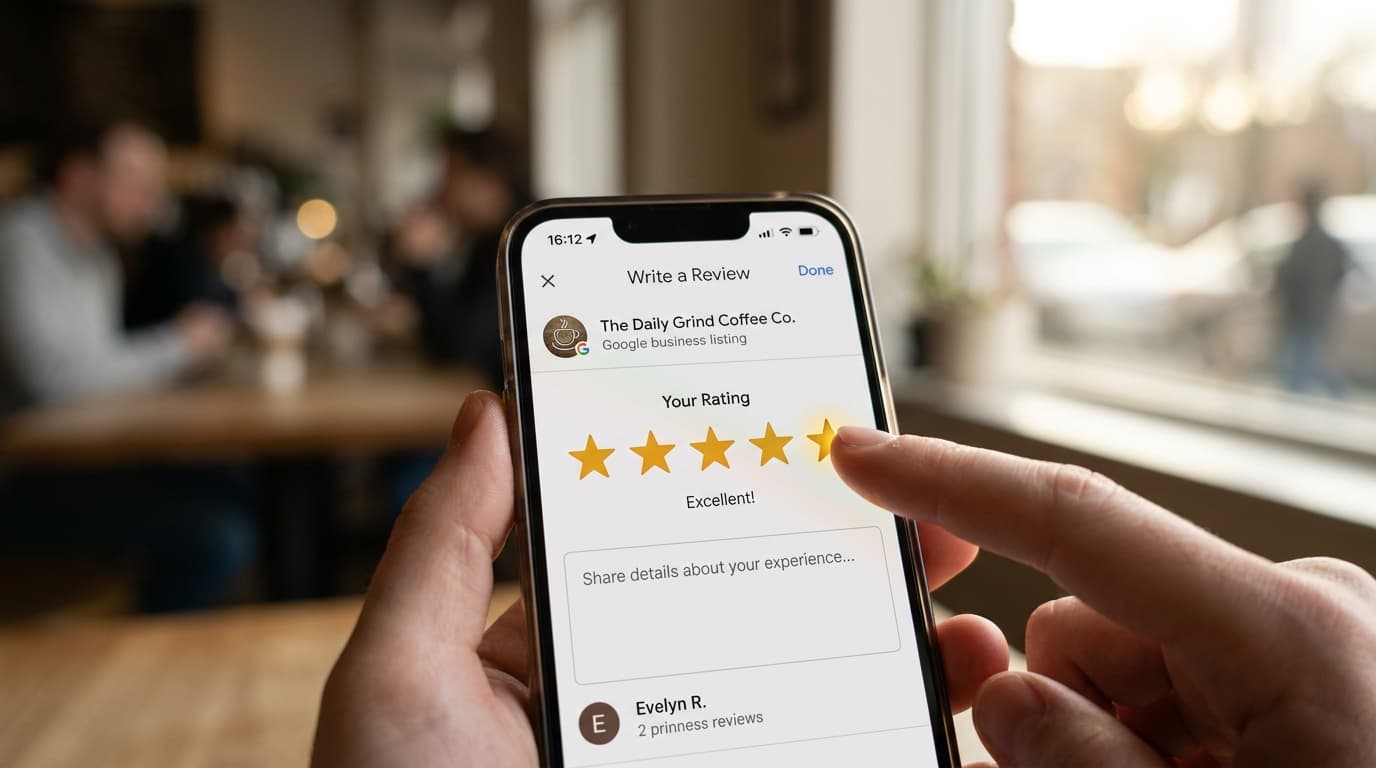
The problem with verbal requests — "We'd really appreciate it if you left us a Google review" — is that they depend on the guest to initiate four separate steps on their own: finding your listing on Google, navigating to the review section, recalling what to write, and completing the form. Even genuinely motivated guests abandon that process. Studies on digital behavior show that review intent drops by more than 60% within two hours of leaving a business if no immediate action is taken.
The goal isn't to make better verbal requests. It's to remove all four of those steps at the exact moment when the guest is most likely to act.
Why a Spin-to-Win Approach Outperforms a Direct Ask
A plain QR code linking to your Google review page will generate some results — typically 5 to 10% of guests who scan it will complete a review. Add a gamified incentive, and that conversion rate typically reaches 25 to 40%.
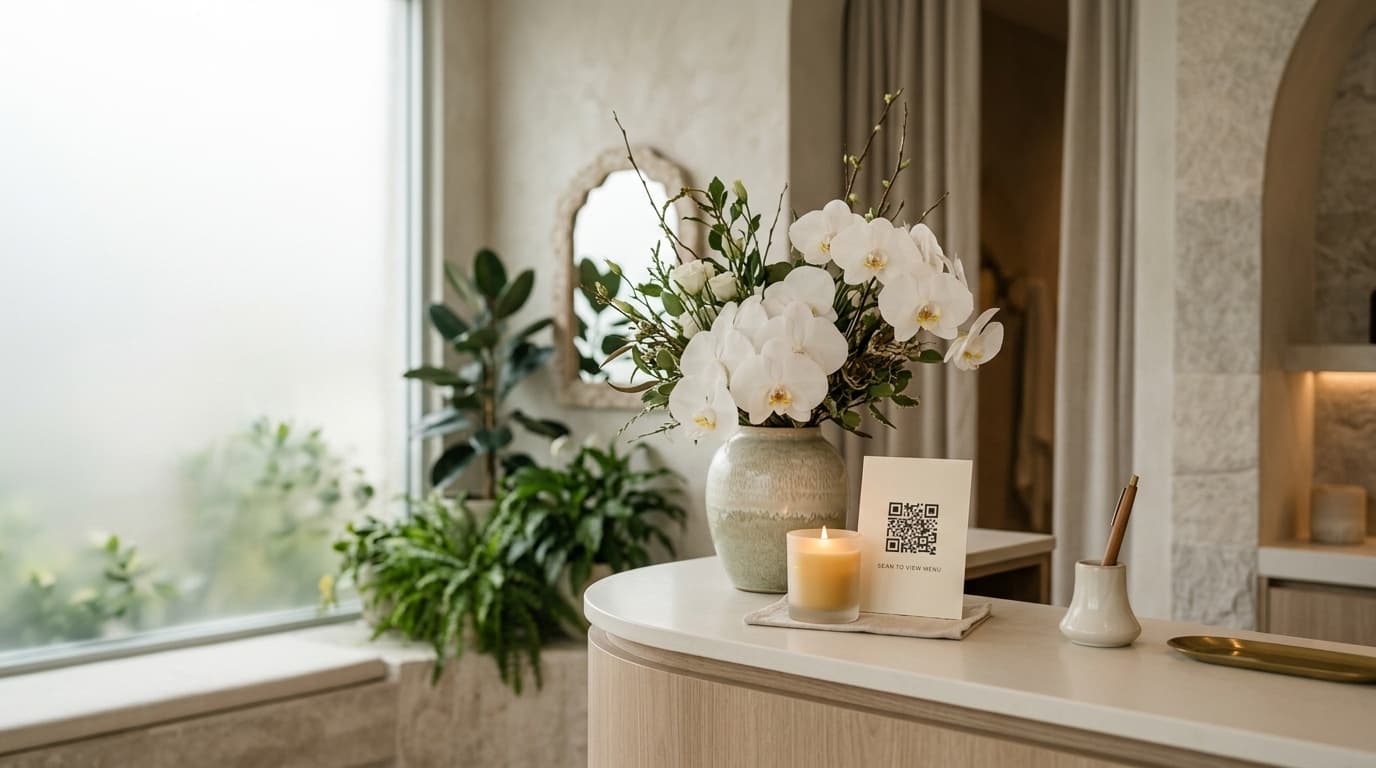
The mechanic works like this: a small card or stand at the front desk features a QR code with a prompt along the lines of "Spin to win a treat for your next stay." The guest scans the code, lands on a page with a digital fortune wheel, and is invited to leave a Google review before spinning. Once the review is submitted, the wheel activates and reveals a reward.
Two well-established psychological principles explain why this approach works so consistently.
Reciprocity. When you offer something of value — even a chance at something — people feel a natural inclination to give something back. A Google review costs the guest nothing but a few minutes. The perceived exchange feels fair, even generous on your part.
Variable reward. Unlike a flat incentive ("leave a review, get 10% off"), a spinning wheel introduces uncertainty. The guest doesn't know whether they'll win a free breakfast, a room upgrade priority, or a small discount. Research on reward systems shows that unpredictable rewards generate significantly stronger engagement than predictable ones. The game element makes the act of reviewing feel like participation rather than obligation.
The result is that guests who might have scrolled past your post-stay email now actively want to interact.
Setting Up Your Hotel's Review System
Pick rewards that encourage return visits
The most effective rewards for hotels serve a dual purpose: they thank the guest for the review and create a reason to come back. Good options include:
- A percentage discount on a next direct booking (15 to 20%) — you avoid the OTA commission, so even a 20% discount can be margin-neutral
- Late check-out on a return visit (subject to availability) — high perceived value, near-zero operational cost
- A welcome drink at the bar on the next stay
- Priority breakfast table reservation (if you have a busy breakfast service)
- An in-room amenity — a bottle of local wine, a welcome basket — for their next booking
Avoid rewards that feel generic or require redemption outside your property. The best rewards loop the guest back through your front door.
Choose your placement carefully
The reception desk is the obvious primary location, but consider layering your touchpoints:
- Key card sleeve: Include a QR code and a teaser ("Scan on departure to spin for a reward") when you hand over the room key at check-in. This plants the idea early.
- In-room card: A small card on the desk or bedside table can prompt guests to think about leaving a review before they even reach checkout.
- Breakfast table tent card: A quieter moment than checkout, but useful for guests who linger over coffee.
- Post-stay email: Include the same gamified link in your thank-you email as a second chance — some guests will act then if they missed the desk opportunity.
Brief your front desk staff in under five minutes
Your team doesn't need a long script. One line is enough at checkout: "Before you go, scan this code — you can win something for your next stay." Keep it light and casual. The more naturally it's offered, the better the uptake. If a guest declines, move on immediately — no pressure, no repetition.
Track your results and adjust
A proper gamification platform gives you data: how many QR codes were scanned, how many reviews were generated, which rewards are most popular. Use this to iterate. If one reward consistently outperforms others, weight the wheel toward it. If scan rates are low, experiment with placement or the desk card's copy.
What Hotels Are Actually Seeing
Independent hotels that implement a systematic gamification approach at check-out typically report:
- 8 to 12 times more monthly reviews within the first 60 days
- Stable or slightly improved overall rating — guests who engage with a game prompt are almost always satisfied guests
- Measurable improvement in Google Maps ranking for local search terms within 90 days
- Small but real uptick in direct bookings from the return-visit incentives
A 30-room independent hotel that was collecting 4 to 6 reviews per month can realistically reach 40 to 70 monthly reviews with a consistent process. That volume is the threshold at which Google's algorithm begins treating a property as a dominant local player — and the difference between appearing in the top three results or not appearing at all.
The Review Gap Between You and Chain Hotels Is Closeable
Chain hotels have advantages that independent operators can't easily replicate: brand recognition, loyalty programs, massive marketing budgets. But they also have one persistent weakness — impersonal, high-turnover operations that don't naturally inspire guests to write about their experience.
Independent hotels can win on warmth, character, and relationships. What they often lack is the system to translate those guest experiences into public, searchable testimonials. That's exactly what a structured check-out review process provides.
The hotels that close the review gap with chain competitors over the next two years won't do it by accident. They'll do it by treating check-out as a strategic moment — not just an administrative one.
Ludofy gives independent hotels a complete system: a branded digital fortune wheel, QR code generation, and direct integration with Google Reviews, ready to deploy in under an hour with no technical expertise required. Every satisfied guest who walks through your lobby is a potential five-star review. The question is whether you have the system in place to capture it.