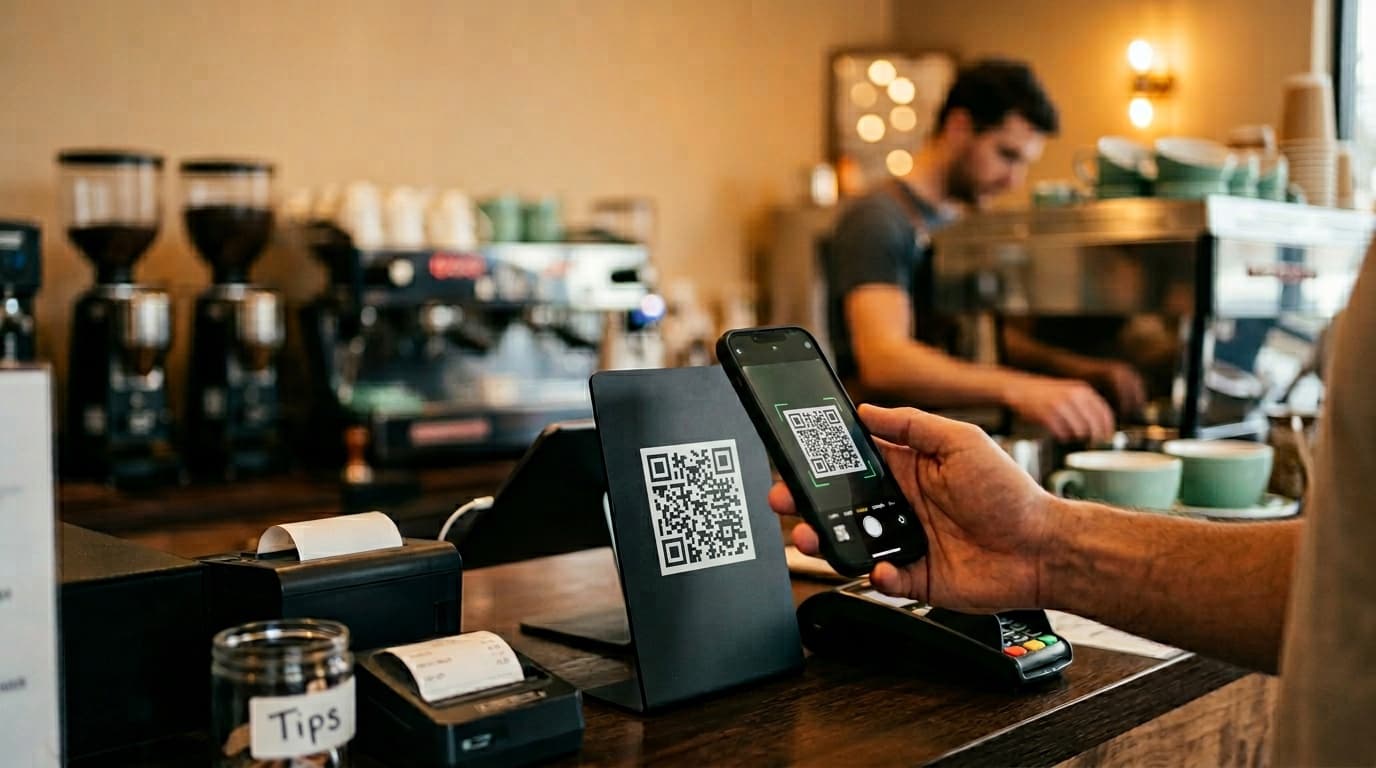
Every business owner collecting Google Reviews eventually faces the same question: should you invest in sleek NFC tap cards, or stick with printed QR codes? Both technologies get a customer's phone pointed at your review link — but they behave very differently in a busy restaurant, a retail shop, or a hotel front desk.
This guide gives you an honest, side-by-side comparison so you can make the right choice for your operation, your budget, and your review goals.
What Is a QR Code and How Does It Work for Reviews?
A QR code is a two-dimensional barcode that a smartphone camera can read instantly. When a customer points their camera at your Google Reviews QR code, they land directly on your Google Business Profile review form — no app download, no typing.
For review collection, QR codes are typically printed on:
- Table tent cards
- Paper receipts
- Window stickers
- Counter displays
- Loyalty cards
- Packaging inserts
Setup cost: A QR code is free to generate. Printing on quality card stock typically costs $0.05–0.20 per unit at scale. A set of 10 table cards might cost $5–15 total.
Scan rate: QR code visibility drives action. A well-placed QR code with a strong call to action ("Spin the wheel – win a prize!") can achieve 8–15% conversion on foot traffic in hospitality settings.
What Is an NFC Tag and How Does It Work for Reviews?
NFC (Near Field Communication) is a short-range wireless technology built into virtually every smartphone sold since 2015. An NFC tag is a small chip — often embedded in a card, sticker, or tabletop stand — that transmits a URL when tapped by a compatible device.
Your customer holds their phone close to the NFC tag, a notification appears, they tap "Open," and they land on your Google review page. No camera needed.
Setup cost: Programmable NFC tags range from $0.50–3.00 each. Custom-branded NFC cards (the kind you'd display on a restaurant table) run $3–10 per unit. A set of 10 premium NFC cards can cost $50–100.
Compatibility: NFC works on all modern iPhones (XS and later, with iOS 14+) and virtually all Android devices. Older iPhones and some budget Android models may not support NFC scanning without a dedicated app.
Head-to-Head Comparison
| Factor | QR Code | NFC Tag |
|---|---|---|
| Setup cost (10 units) | $5–15 | $50–100 |
| Scan ease | Camera app (built-in) | Tap gesture + notification |
| Visual impact | Moderate (printed square) | High (clean, invisible chip) |
| Durability | Low (paper tears, fades) | High (chip survives water, wear) |
| Reprogrammable | No (print new) | Yes (change destination URL) |
| Customizable design | Fully (any shape/color) | Mostly (chip dictates size) |
| Gamification-ready | Excellent | Limited |
Where QR Codes Win
Lower barrier to scan
A QR code can be scanned by any smartphone camera — no special settings, no app, no tap gesture. The customer sees a square with a prompt ("Scan me to win a prize"), points their camera at it, and they're done. This friction-free path matters enormously in environments where customers are in a hurry: fast-casual restaurants, retail checkouts, and coffee shops.
Even older customers who are less tech-savvy are now comfortable with QR code scanning. The pandemic normalization of QR menus means that pointing a phone camera at a square is as natural as tapping a card on a payment terminal for most customers.
Works seamlessly with gamification mechanics
This is the biggest differentiator. QR codes can link to dynamic landing pages that change the customer experience — a digital fortune wheel, a discount reveal, or a prize draw. When a customer scans a QR code and sees a spinning wheel before the Google review prompt, conversion rates jump dramatically.
Research on gamified review flows consistently shows 3–5× higher completion rates versus a direct review link. The visual theater of the scan — looking at a screen, seeing animation, feeling the anticipation of a potential reward — primes the customer emotionally for the review request that follows.
NFC tags send customers directly to a static URL. You could theoretically point an NFC tag at a gamified landing page, but the tap interaction is invisible. There's no accompanying visual, no call to action text, no image of a spinning wheel to set expectations. The psychological runway that drives gamification's effectiveness simply isn't there.
Replaceable without hardware cost
If you update your branding, change your review link, or want a seasonal design for Valentine's Day or the summer rush, you print new cards. A set of 50 updated QR cards costs a few dollars at most, compared to reprogramming or replacing NFC hardware. For businesses that want to run short-term campaigns, this flexibility alone justifies the format.
Where NFC Tags Win
Premium customer experience
In a fine-dining restaurant, a minimalist hotel suite, or a luxury spa, a card with a barely visible tap point looks significantly more refined than a black-and-white QR code square. NFC cards signal that the business cares about aesthetics all the way down to the table details. For establishments where the average check is high and every touchpoint communicates brand, that impression matters.
Long-term durability
NFC chips embedded in acrylic or metal holders don't fade, tear, or become unscannable in direct sunlight. For businesses where table materials receive heavy daily use — beach bars, outdoor terraces, popular bistros — NFC hardware outlasts printed cards by years. The higher upfront cost amortizes over time when you're not reprinting every few months.
Re-programmable destination
If your Google Business Profile URL changes (rare, but it happens), or you want to rotate between review platforms — Google one month, TripAdvisor the next — a single app on your phone updates every NFC tag instantly. No reprinting, no repricing, no swapping physical materials at every table.
Real-World Scenarios: Which Should You Choose?
High-volume casual restaurant, café, or brasserie: QR code. Speed of scanning, low replacement cost, and gamification compatibility make it the obvious choice. A rotating "spin to win" prompt near the counter or at the table drives significant review volume without requiring any extra staff effort.
Fine dining or boutique hotel: NFC. The aesthetic investment makes sense when average spend per customer is high and brand presentation is everything. Pair it with a personal verbal ask from your service team for the best results — technology alone won't close the gap.
Retail store or pop-up shop: QR code on a prominent display or printed on shopping bags. The visual footprint of a QR code at a counter is far easier to merchandise than an NFC tap point that customers may not notice at all.
Food truck at a market or festival: QR code, printed large and laminated. NFC infrastructure adds cost without benefit in a mobile context. A weather-resistant laminated QR code survives the season and can be swapped seasonally.
Nail salon or beauty studio: Both work well depending on positioning. A QR code on a small card near the payment terminal is inexpensive and effective. If the studio has a premium brand identity, a matching NFC stand at the reception desk adds polish without disrupting the service.
The Gamification Multiplier: Why QR Codes Still Lead
The honest reason that serious review collection strategies still center on QR codes is not the cost — it is the gamification opportunity.
When a customer scans a QR code and lands on an interactive experience (a spinning fortune wheel, a prize reveal, a countdown to a reward), they're no longer simply being asked to do you a favor. They're participating in something fun. That emotional shift is the difference between a 3% review rate and a 15% review rate on the same foot traffic.
The math is straightforward: if 100 customers visit your business on a given day and your QR code converts at 12% thanks to a gamified flow, that's 12 new reviews. The same 100 customers, direct NFC tap to review form, might convert at 3–4% — generating 3–4 reviews. Across a month, across a year, that compounding difference is what separates a business with 80 reviews from one with 400.
Tools like Ludofy are built specifically for this mechanic. A customer scans your branded QR code, spins a digital wheel to potentially win a discount or free item, and the review prompt appears as a natural step in that journey — not as a cold ask at checkout. The result is a review flow that customers actually enjoy completing, with conversion rates that manual asking or NFC taps cannot match.
Final Verdict
NFC cards have genuine advantages in durability and premium aesthetics, and they're a smart choice for high-end establishments willing to invest in the hardware and comfortable with a lower but consistent review rate.
But for the vast majority of local businesses — restaurants, cafés, retail shops, beauty studios, food trucks — QR codes remain the superior technology for Google review collection. They're cheaper to deploy, easier to gamify, and remove every barrier between a satisfied customer and a published five-star review.
If you're serious about growing your Google rating consistently, the question is not just QR or NFC — it's what happens after the scan. A branded experience that rewards customers for their time, rather than simply asking for a review, is what separates businesses with 50 reviews from those with 500.
Ludofy makes that gamified QR review flow simple to set up in minutes — no technical knowledge required, no hardware to order, and your first campaign can be live before the end of service tonight.