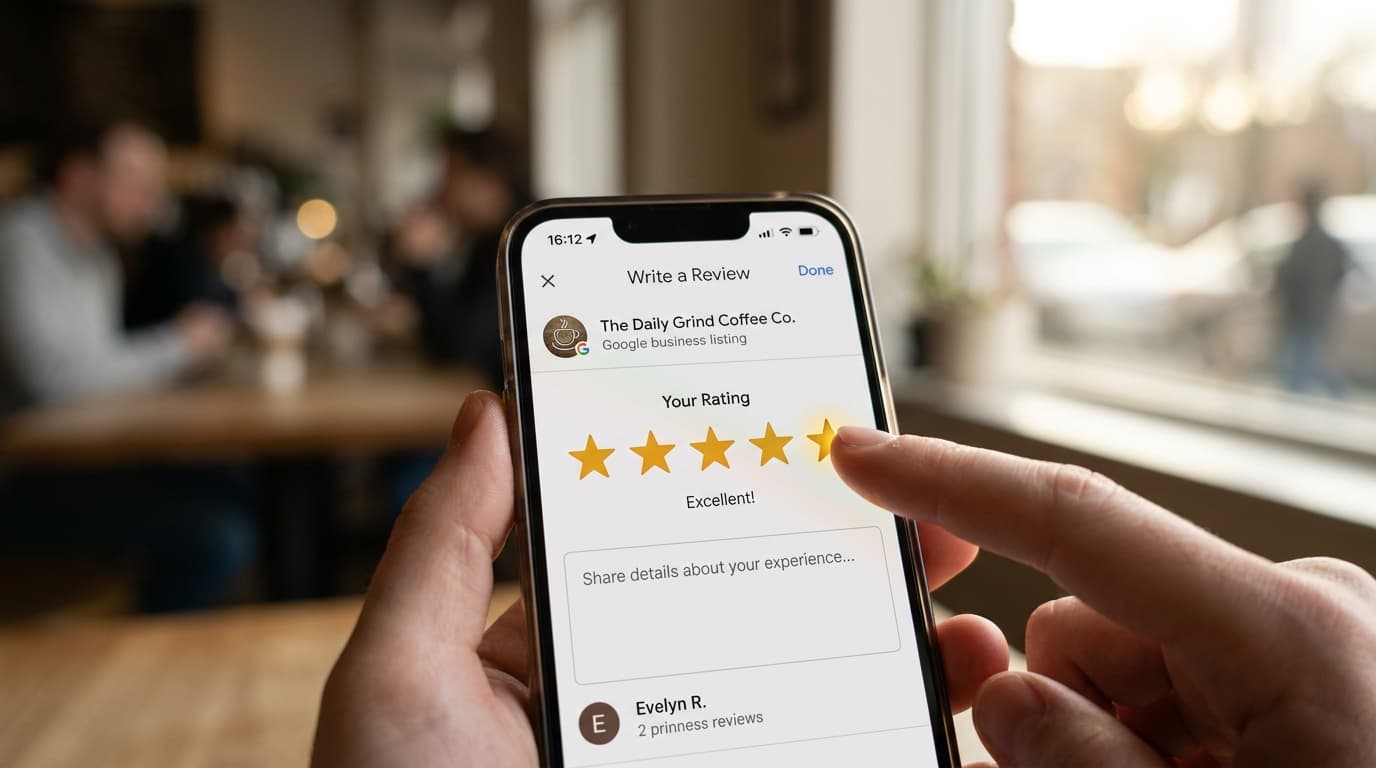
When a potential customer searches for your business on Google, they don't stop at the star rating. They read, scan, compare — and within a few minutes they've made a decision that either sends them through your door or into the arms of a competitor. Most operators focus all their energy on collecting more reviews. But to genuinely move the needle on your online reputation, you first need to understand how customers actually read those reviews — and what they're looking for when they do.
Star ratings as a threshold, not a destination
The overall star rating is the first filter — and it's nearly automatic. Most consumers eliminate businesses below 4 stars without conscious deliberation. But above that threshold, the precise rating matters far less than operators assume. The psychological gap between 4.3 and 4.7 stars bears no relationship to the actual difference in scores.
What matters after the threshold is the coherence of the overall profile. This has a direct implication for where to invest your energy: pushing your rating from 4.5 to 4.9 delivers far less return than improving the regularity of your reviews, the richness of their content, and the quality of your responses. That's where decisions are actually made.
Recency: the strongest trust signal
A potential customer landing on your Google profile in 2026 and seeing that your most recent review is from 2023 will feel instinctive doubt. Is the business still open? Has the quality shifted? Is the team still the same? The absence of recent reviews triggers questions you can't answer — and uncertainty consistently benefits your competitor.
Recent reviews signal that your business is active and that customers are still choosing you today, not years ago. Google also factors recency into its local ranking algorithm, which compounds the benefit. A business collecting five reviews per week consistently will almost always outperform — in both visibility and conversion — a business that collects fifty reviews in a single month and then goes quiet for six months.
What they actually read
Customers don't read all your reviews — they read three to six, mostly the most recent. And they're not looking for confirmation of an impression they've already formed. They're searching for specific details that help them project themselves into the experience.
A generic five-star review that says "great place, highly recommend" carries almost no persuasive weight. A detailed account — "the lamb shoulder was perfectly braised, and the server noticed we were celebrating and brought a complimentary dessert" — is dramatically more powerful. It enables the reader to picture themselves in the scene. The more sensory and specific the review, the more it activates the mental simulation that drives a booking decision.
This is why review collection systems that encourage detailed write-ups — rather than a quick star tap — have an outsized impact on conversion. Gamification, by creating an engaging moment around the review process, naturally produces richer content because the customer is actively participating rather than rushing through an obligation.
The negative review paradox
Here's something counterintuitive: your potential customers actively seek out your worst reviews. Not to condemn you, but to calibrate their risk assessment.
A profile with zero negative reviews raises suspicion. Consumers understand intuitively that no business pleases everyone, and a perfect 5.0 rating across dozens of reviews often triggers skepticism about authenticity. A handful of honest 3- or 4-star reviews, handled well, actually strengthens the credibility of the positive ones — it signals that the glowing reviews haven't been engineered.
What weighs heavily in the decision is how you respond to critical reviews. Research consistently shows that 89% of consumers read business responses to negative reviews before making a decision. Your response is read by hundreds of future customers — it's a public sales argument, not a private service recovery exercise. A response that acknowledges the issue, explains what has changed, and thanks the reviewer sincerely can turn an apparent liability into a demonstration of professional maturity.
Review photos: an underestimated trust accelerator
Google lets customers attach photos to their reviews, and these images receive heightened attention from readers. A photo of a well-presented dish, a welcoming dining room, or a clean and attractive storefront is worth more than any textual description — it makes the promise tangible rather than abstract.
Google profiles with recent customer-generated photos (not just owner-uploaded images) see significantly higher engagement. Reviews accompanied by photos also collect more upvotes from other users, pushing them higher in the display order and extending their influence over future decisions.
Creating genuinely photogenic moments in your venue — careful food presentation, an attractive display, distinctive décor details — naturally encourages customers to photograph and share their experience. This spontaneous content amplifies the perceived authenticity of your profile in ways that no amount of owner-uploaded photography can replicate.
The diversity credibility effect
One factor that sophisticated review readers pick up on quickly: the diversity of reviewer profiles. When every review appears to come from the same type of account — no profile photo, generic names, users who have never reviewed any other business — perceptive readers suspect orchestration.
A varied review pool — regular neighborhood customers, one-time visitors, tourists, families, professionals — creates powerful implied authenticity. This diversity is only achievable if your collection system reaches all your satisfied customers, not just the most enthusiastic ones or those you specifically ask. Systematic collection tools, like QR-code-activated review flows at point of sale, naturally capture this breadth because they're available to every customer who chooses to engage.
How reviews influence what customers are willing to pay
Behavioral economics research has found that a business rated 4.5 stars can command prices 15 to 20 percent higher than an otherwise identical competitor rated 3.5 stars, without losing demand. Google reviews aren't just a customer acquisition tool — they directly influence perceived value, and therefore your ability to protect your margins.
This changes the ROI framework for reputation investment. Building your Google profile isn't optional marketing spend: it's an economic decision whose returns show up in both volume and margin per customer. A strong reputation doesn't just fill more seats — it fills them at better prices with customers who are less price-sensitive because they've already decided you're worth it.
Translating this into a concrete operating strategy
Understanding how customers read reviews changes how you should build your reputation profile:
Prioritize consistency over spikes. A handful of reviews every week beats a hundred in a single month followed by silence. Consistent activity signals ongoing operations and feeds the Google Maps algorithm in a way that irregular bursts cannot.
Respond to every review, quickly. Each response is read by dozens of future customers. Treat every response as a public message to your next wave of clients — because that's precisely what it is.
Make detailed reviews easy to write. By creating an engaging moment around the review ask — a gamified spin at the point of departure, for example — you naturally encourage more thoughtful responses, because the customer is already invested in the interaction.
Embrace imperfection deliberately. A 4.5-star profile with a few well-handled criticisms often outconverts a 5.0 profile that reads as too polished. Credibility is worth more than apparent perfection.
Understanding how your future customers read your reviews means understanding their decision process from the inside. That process rarely takes more than ten minutes — but it determines whether your business stays on their list or gets filtered out entirely.
Ludofy helps local businesses build this reputation profile systematically: a consistent stream of authentic, detailed reviews collected at exactly the right moment through gamification, compounding week after week into a Google presence that actively works to bring in the next customer — long before they ever walk through your door.